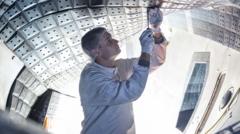
The 'dumb machine' promising a clean energy breakthrough
The 'dumb machine' promising a clean energy breakthroughJust nowShareSaveAdd as preferred on GoogleBen MorrisTechnology of Business EditorProxima FusionA stellarator has twists and curves to help contain burning plasma"I remember a few people said that the place where Proxima is today was impossible," says Francesco Sciortino, the co-founder and CEO of Proxima Fusion.Being accused of attempting the impossible is not unusual for the scientists and engineers working on nuclear fusion projects around the world. After all, they are attempting to capture, on earth, the reaction that powers the Sun.Success could mean abundant, cheap and emission-free electricity. But the challenges are daunting and a working power stations remains a long way off. Fusion is the process of fusing hydrogen nuclei together, which releases immense amounts of energy. On the Sun huge gravitational forces help keep the reaction going. To maintain fusion here on earth, extremely high temperatures - many times those found on the Sun - are needed.So, a fuel (usually a combination of the hydrogen isotopes tritium and deuterium) is heated until it becomes a burning hot plasma, which then has to be controlled and manipulated to spark fusion.What is nuclear fusion?There are a number of ways to do this, and Germany's Proxima Fusion is attempting one that is considered difficult, even by the extreme standards of the fusion industry.A common approach to fusion is to build a tokamak. It's a doughnut-shaped device, which uses powerful magnets to contain the plasma.But Munich-based Proxima is working on a stellarator. It also uses magnets to manipulate the plasma but the reaction container has a more complicated shape, with twists and turn, making it much more difficult and expensive to build.Proxima FusionA fusion reactor should be a "dumb machine" says Francesco SciortinoSo why go down this torturous path?Well, if the design works, the twists and turns of a stellarato...المصدر: BBC Technology | Source: BBC Technology
ملاحظة تحريرية | Editorial Note: نُشر هذا المقال في الأصل بواسطة BBC Technology. خبر (Khabr) هي منصة إعلامية أردنية مرخّصة تعمل بالذكاء الاصطناعي. نضيف قيمة تحريرية من خلال: تحليل ذكي للأخبار، ملخصات تلقائية، رواية صوتية بالذكاء الاصطناعي، ترجمة متعددة اللغات، وتدقيق الحقائق. هدفنا جعل الأخبار أكثر وضوحاً وسهولةً للقارئ العربي.
This article was originally published by BBC Technology. Khabr is a licensed Jordanian AI-powered news platform (Registration #82086). We add editorial value through: AI-powered news analysis, automated summaries, AI audio narration, multi-language translation (Arabic, English, French, Turkish), and AI fact-checking. Our mission is to make news more accessible and understandable for Arabic-speaking audiences worldwide.