⚡ عاجل: كريستيانو رونالدو يُتوّج كأفضل لاعب كرة قدم في العالم●⚡ أخبار عاجلة تتابعونها لحظة بلحظة على خبر●⚡ تابعوا آخر المستجدات والأحداث من حول العالم●
AI اقتراحات ذكية
AI مباشر|--مشاهد مباشر
889,697مقال401مصدر نشط228قناة مباشرة4,412خبر اليوم
As NASA’s record-breaking Artemis mission bolsters the US path back to the moon, China’s bid to land astronauts there by 2030 is taking on greater geopolitical significance and putting pressure on Beijing to meet or beat its timetable.
Four US astronauts on the Artemis II mission this week flew past the moon’s shadowed far side, travelling deeper into space than any humans before them and setting the stage for Artemis IV to land on the moon in 2028.
The planned US return after more than half a century is being closely watched in China, which is developing the full architecture for its first crewed landing on the moon, from the Long March-10 rocket to the Mengzhou spacecraft and Lanyue lunar lander.
Beijing has made significant advances in recent years by becoming the first country to return robot-taken samples from both the near and far sides of the moon, and its crewed spaceflight programme has become proficient in operating space stations and handling emergencies in orbit.
“There is no bigger prize for China on the table today than landing people on the moon, this is the essential next step for China on the road to preeminence in space,” said Clayton Swope, deputy director of the Aerospace Security Project at the US-based Center for Strategic and International Studies (CSIS).
Washington and Beijing are also competing in institution-building efforts in preparation for a future when humans have a permanent presence on the moon, with the US-led Artemis Accords on lunar exploration matched up against the Chinese and Russian-led International Lunar Research Station (ILRS).
“The question now is no longer simply who gets there first, but who can stay longer and do more,” Kang Guohua, an aerospace professor at the military-linked Nanjing University of Aeronautics and Astronautics, told China’s state-backed Global Times last week.
Entirely new hardware
A major hurdle for Beijing will be proving an entirely new lunar mission architecture within the next four years, demonstrating all of the hardware being developed for the 2030 mission, from heavy-lift rockets to spacesuits, can work reliably on first use.
China’s manned space agency said in 2023 that the mission would rely on two Long March-10 rockets, one launching a crewed spacecraft and the other a lunar lander. The two vehicles would rendezvous and dock in lunar orbit. Two astronauts would descend to the surface on the lander, collect samples, then return to lunar orbit, redock with the spacecraft and head back to Earth.
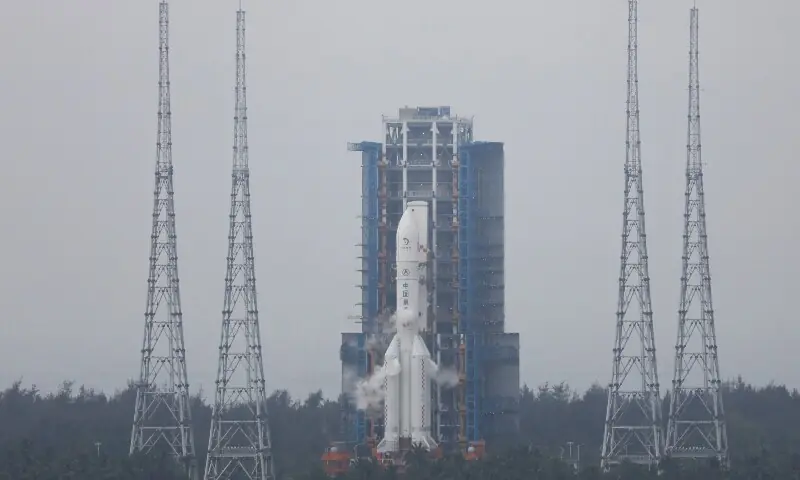
The Chang’e 6 lunar probe and the Long March-5 Y8 carrier rocket combination sit atop the launch pad at the Wenchang Space Launch Site in Hainan province, China May 3, 2024. —Reuters/File
The Mengzhou spacecraft can carry up to seven astronauts, according to China’s manned space agency, which has not yet announced the size and members of the 2030 mission team.
China’s recent robotic lunar missions have given it valuable experience in communications, rendezvous, and docking operations around the moon. But crewed missions impose far stricter safety requirements and critical parts of the mission chain are still being tested, including the rocket and spacecraft.
In February, China carried out the first low-altitude escape test for the Long March-10 with a Mengzhou spacecraft aboard it at a launch site on Hainan Island. The vessel’s return capsule successfully separated after an abort command and splashed down safely at sea.
Last year, the Lanyue lunar lander’s ascent and descent capabilities were also tested in Hebei province. While these were important milestones, the pace of testing will need to accelerate if China is to certify the system for a crewed landing by 2030.
Still, CSIS’ Swope said China appeared to be making steady progress and it seemed “very plausible” it would meet its deadline.
“China has a history of setting deadlines for space activities and closely meeting those deadlines, there are no public signs of any missteps or setbacks to Beijing’s crewed lunar landing plans,” he said.
Geopolitical stakes
The stakes are not only technical but geopolitical. As the US-China rivalry deepens across trade, technology and military power, lunar exploration has become another arena of competition.
US analysts point to China’s rising defence spending, use of space diplomacy to increase its influence overseas, growing private launch sector and successful robotic lunar missions as evidence that Beijing is highly motivated to reach the moon quickly, even if it avoids race rhetoric in public.
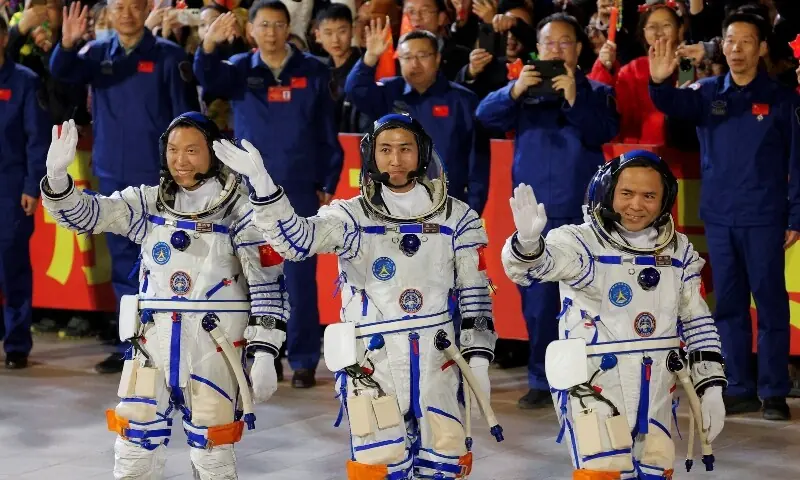
Astronauts Zhang Hongzhang, Wu Fei, and Zhang Lu wave during a see-off ceremony before taking part in the Shenzhou-21 spaceflight mission to China’s Tiangong space station, at Jiuquan Satellite Launch Center, near Jiuquan, Gansu province, China October 31, 2025. —Reuters/File
“China might avoid directly using language that suggests there is a lunar or space race, but their overall strategic goal is to be the hegemon in space,” said Kathleen Curlee, a research analyst at Georgetown University’s Center for Security and Emerging Technology.
At the same time, China may be moving faster than it admits. Wu Weiren, chief designer of China’s lunar exploration program, told Reuters last year that the 2030 goal was intentionally conservative.
“Eastern peoples always leave a little room when they speak,” he said. “If I can do a 10, I tend to say eight or nine.”
ملاحظة تحريرية | Editorial Note:
نُشر هذا المقال في الأصل بواسطة Dawn.
خبر (Khabr) هي منصة إعلامية أردنية مرخّصة تعمل بالذكاء الاصطناعي.
نضيف قيمة تحريرية من خلال: تحليل ذكي للأخبار، ملخصات تلقائية، رواية صوتية بالذكاء الاصطناعي، ترجمة متعددة اللغات، وتدقيق الحقائق.
هدفنا جعل الأخبار أكثر وضوحاً وسهولةً للقارئ العربي.
This article was originally published by Dawn.
Khabr is a licensed Jordanian AI-powered news platform (Registration #82086).
We add editorial value through: AI-powered news analysis, automated summaries, AI audio narration, multi-language translation (Arabic, English, French, Turkish), and AI fact-checking.
Our mission is to make news more accessible and understandable for Arabic-speaking audiences worldwide.
هذا الخبر ضمن تغطية خبر لقسم علوم.
نقدّم لك تحليلات ذكية وملخصات يومية لأهم الأخبار من مصادر موثوقة متعددة.
المصدر: Dawn.
يوجد 6 مقالات مرتبطة بهذا الموضوع.
This article is part of Khabr's coverage of Science.
We provide AI-powered analysis, summaries, and multi-source aggregation to keep you informed.
Source: Dawn.
Tags: NASA, lunar, China.
🍪 نستخدم ملفات تعريف الارتباط لتحسين تجربتك وعرض الإعلانات المخصصة. باستخدامك للموقع، فإنك توافق على سياسة ملفات تعريف الارتباط وسياسة الخصوصية.
We use cookies to enhance your experience and show personalized ads. By using this site, you agree to our Cookie Policy and Privacy Policy.
🔍
FREEFree 1GB Internet + Free International Calls
$1 trial — eSIM in 190+ countries — No roaming charges