NASA Unveils ‘Roman’ Telescope to Map the Universe
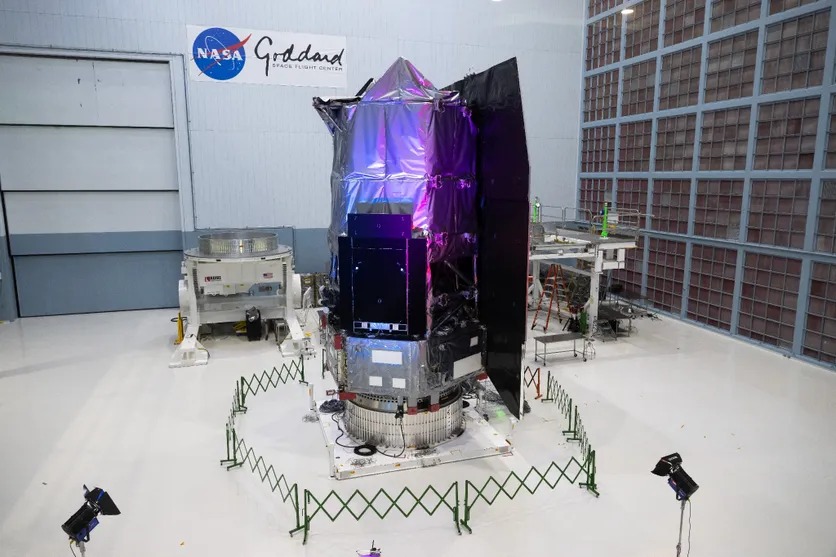
المصدر: Morocco World News | Source: Morocco World NewsTetouan – NASA has introduced its latest space observatory, the Nancy Grace Roman Space Telescope, a major scientific project designed to expand our understanding of the universe.
The telescope will focus on detecting distant planets beyond our solar system and investigating two of the most complex questions in modern physics: dark matter and dark energy.
Speaking from the Goddard Space Flight Center, NASA Director Jared Isaacman said the telescope will offer what he described as “a new atlas of the universe,” highlighting its role in reshaping how space is mapped and studied.
The Roman telescope, measuring more than 12 meters in length and equipped with large solar panels, will soon be transported to Florida in preparation for launch.
The mission is scheduled for early September and will rely on a rocket developed by SpaceX, reflecting the growing role of private companies in space exploration.
Named after Nancy Grace Roman, a pioneering figure in astrophysics often referred to as the “mother” of the Hubble Space Telescope, the project represents an investment of more than $4 billion.
The naming also underlines the telescope’s scientific ambition, as it builds on the legacy of previous missions while introducing new capabilities.
From its observation point about 1.5 million kilometers away from Earth, Roman will scan wide areas of the sky with a field of view more than 100 times larger than that of Hubble.
This wide-angle capability is expected to significantly accelerate the pace of discovery, allowing scientists to conduct large surveys rather than focusing only on narrow sections of space.
One of the most notable aspects of the mission is the volume of data it will generate.
According to mission systems engineer Mark Clampin, the telescope will send around 11 terabytes of data to Earth every day.
Over the course of its first year, this could exceed the total amount of data collected by Hubble over its 35 years in operation.
This data will support a wide range of scientific goals. NASA’s science chief Nicky Fox said Roman is expected to identify tens of thousands of new exoplanets.
These discoveries could improve understanding of how planetary systems form and how common Earth-like planets may be across the galaxy.
The telescope will also detect thousands of supernovae, offering further insight into the life cycles of stars and the expansion of the universe.
Beyond visible discoveries, the mission will focus on what cannot be directly seen.
Scientists estimate that dark matter and dark energy make up about 95 percent of the universe, yet their nature remains largely unknown.
By using infrared technology, Roman will be able to observe light emitted billions of years ago, effectively looking back in time.
This will help researchers study how galaxies formed and evolved, and how the universe has expanded over time.
The telescope’s ability to combine wide-field imaging with deep sensitivity is expected to open new paths in astrophysics.
It will allow scientists not only to observe more objects, but also to place them within a broader cosmic context.
With its advanced design, large-scale data collection, and ambitious scientific goals, the Roman telescope is set to become one of the most important tools in space research.
Its findings are expected to shape scientific understanding for years to come, offering a clearer picture of a universe that remains, in many ways, still largely unknown.
The post NASA Unveils ‘Roman’ Telescope to Map the Universe appeared first on Morocco World News.
ملاحظة تحريرية | Editorial Note: نُشر هذا المقال في الأصل بواسطة Morocco World News. خبر (Khabr) هي منصة إعلامية أردنية مرخّصة تعمل بالذكاء الاصطناعي. نضيف قيمة تحريرية من خلال: تحليل ذكي للأخبار، ملخصات تلقائية، رواية صوتية بالذكاء الاصطناعي، ترجمة متعددة اللغات، وتدقيق الحقائق. هدفنا جعل الأخبار أكثر وضوحاً وسهولةً للقارئ العربي.
This article was originally published by Morocco World News. Khabr is a licensed Jordanian AI-powered news platform (Registration #82086). We add editorial value through: AI-powered news analysis, automated summaries, AI audio narration, multi-language translation (Arabic, English, French, Turkish), and AI fact-checking. Our mission is to make news more accessible and understandable for Arabic-speaking audiences worldwide.