World powers urge US, Iran to uphold truce, return to talks
المصدر: Dawn | Source: Dawn• Dar says imperative truce remains in place for durable peace in ‘region and beyond’
• EU insists diplomacy essential to resolve conflict, to contribute to peace efforts
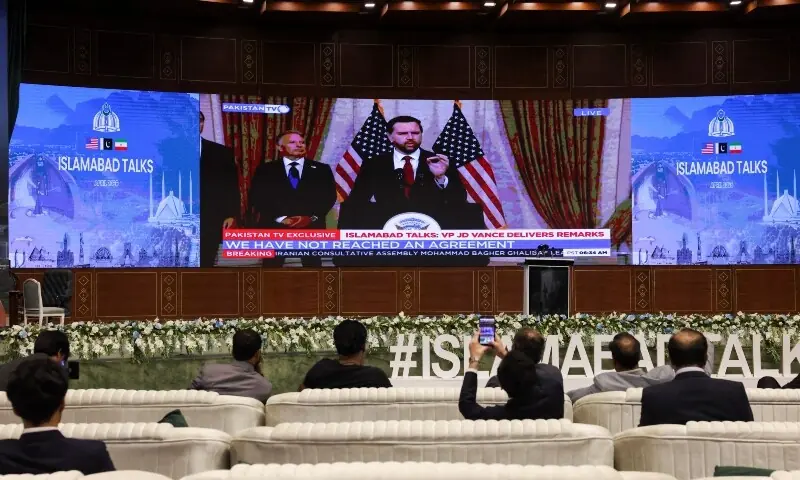
• Oman, Australia ministers urge both sides to extend ceasefire, return to negotiationsISLAMABAD: As talks failed to break the deadlock, Pakistan on Sunday requested the US and Iran to uphold the ceasefire amid calls from the international community to extend the truce and to use diplomacy to resolve the war in the Middle East, which flared after the US and Israel struck Iran on Feb 28.
After weeks of fighting, both sides signed a temporary ceasefire for two weeks and also arrived in Islamabad for high-level talks, which could not lead to a breakthrough, prompting fears of a new phase of hostilities.
In a media talk on Sunday, Foreign Minister Ishaq Dar said it was imperative that the “parties continue to uphold their commitment to ceasefire”.
“Pakistan has been and will continue to play its role to facilitate engagement and dialogue between the Islamic Republic of Iran and the United States of America in the days to come,” Mr Dar affirmed, concluding his media statement. He said the US and Iran delegations participated in the ‘Islamabad Talks’ and the “intense and constructive negotiations between the two sides that continued over the last 24 hours and ended this morning”.
The foreign minister said, “We hope that the two sides continue with the positive spirit to achieve durable peace and prosperity in the entire region and beyond.”
Australian Foreign Minister Penny Wong also urged a continuation of the Middle East ceasefire after US-Iran talks ended with no deal. “The priority now must be to continue the ceasefire and return to negotiations,” Ms Wong said in a statement, adding it was “disappointing that the Islamabad talks between the United States and Iran have ended without agreement”.
Mr Dar also emphasised this in his separate calls with the Saudi and Egyptian foreign ministers on Sunday.
EU ready to contribute
A similar appeal was made by the European Union. According to AFP, its spokesperson said diplomacy was “essential” to resolve the war. Noting the US-Iranian talks hosted by Pakistan, EU foreign affairs spokesman Anouar El Anouni said, “We salute Pakistan for its mediation efforts” and added Brussels would contribute to further efforts to reach a settlement in coordination with its partners.
Oman’s appeal
Oman’s Foreign Minister Badr Albusaidi also urged both sides to continue talking and extend the ceasefire. “When I met Vice President Vance just hours before the war began, I formed an impression that both he and the President had a genuine and strong preference to avoid the entanglements of war. So I urge that the ceasefire be extended and talks continue,” he said. “Success may require everyone to make painful concessions, but this is nothing as compared to the pain of failure and war,” he said in a tweet. It may be noted that the talks between the US and Iran were held in Oman shortly before Tehran was attacked by the US and Israel.
Australia, UK disappointed
UK government minister Wes Streeting also expressed dismay at the stalemate, saying it was “disappointing” that negotiations between the United States and Iran in Islamabad had stalled. “It’s obviously disappointing that we haven’t yet seen a breakthrough in negotiations and an end to this war in Iran that is a sustainable one,” Mr Streeting told Sky News.
“As ever in diplomacy, you’re failing, until you succeed. So while these talks may not have ended in success, [it] doesn’t mean there isn’t merit in continuing to try,” the minister added.
Meanwhile, Iranian state media said that the country was in “no hurry” to plan another round of negotiations with the US. The State-affiliated Fars news agency, citing a source close to the negotiating team, said that the Strait of Hormuz would remain closed until the US agreed to a reasonable deal, CNN reported, citing the Iranian agency.
Published in Dawn, April 13th, 2026
ملاحظة تحريرية | Editorial Note: نُشر هذا المقال في الأصل بواسطة Dawn. خبر (Khabr) هي منصة إعلامية أردنية مرخّصة تعمل بالذكاء الاصطناعي. نضيف قيمة تحريرية من خلال: تحليل ذكي للأخبار، ملخصات تلقائية، رواية صوتية بالذكاء الاصطناعي، ترجمة متعددة اللغات، وتدقيق الحقائق. هدفنا جعل الأخبار أكثر وضوحاً وسهولةً للقارئ العربي.
This article was originally published by Dawn. Khabr is a licensed Jordanian AI-powered news platform (Registration #82086). We add editorial value through: AI-powered news analysis, automated summaries, AI audio narration, multi-language translation (Arabic, English, French, Turkish), and AI fact-checking. Our mission is to make news more accessible and understandable for Arabic-speaking audiences worldwide.