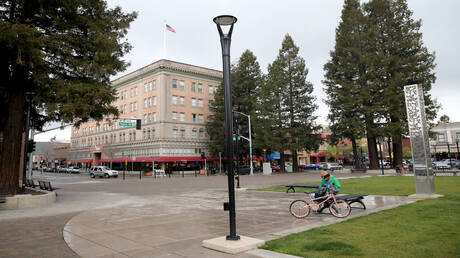
By CANDACE SUTTON, SENIOR NEWS REPORTER, AUSTRALIA Published: 01:16, 16 August 2026 | Updated: 01:16, 16 August 2026 A country town's furious debate over a statue of a 'little black boy' that has been on its main street for 150 years is set to explode as accusations emerge about its true origins. A row has been festering for weeks in Maitland, in the NSW Hunter Valley, between Puerto Rican-born artist Osvaldo Budet and some locals over an 84cm-tall cast iron depiction of an African-American boy, which has sat on High Street since the 1870s. Mr Budet this week gave evidence to the Daily Mail that he said indicates the statue's history is, in fact, racist - flying in the face of romantic notions that it was based upon a statue of a hero slave boy honoured by the first US President George Washington. Mr Budet obtained American iron foundry catalogues from the 1870s that show an identical, mass-produced statue of a young black boy, with a similar stirrup in hand, was sold under the racist slurs of 'Darkey' and 'Sambo'. Maitland's statue, known locally as Jocko, was originally placed outside a High Street tobacco store around 1870, after which it became a town fixture, repainted and restored, and eventually a popular prop for selfies. Mr Budet is not calling for the town to get rid of the statue, but says that locals should admit that Jocko has racist origins. 'The object is loved, I get it, I'm not even arguing about removing it from the street,' Mr Budet said. 'I just want it acknowledged that the complexity is there, an object that can be loved by people, can hurt people.' Puerto Rican-born artist Osvaldo Budet - who lived in Maitland for five years - sparked furious debate in the country town in the NSW Hunter Region with an exhibition about the iconic statue Debate has raged for weeks over the 'little black boy' statue some call Jocko, which has set on Maitland's High Street for 150 years Mr Budet argues the statue was acquired from 1870s catalogues where the African-American boy was referred to under the racist slurs of 'Darkey' and 'Sambo' Mr Burdet first sparked debate over the statue on July 11, when Maitland Regional Art Gallery opened up a four-month exhibition where he sought to explain the 'racist history of the hitching post statue'. It featured town souvenirs including tea towels, spoons and pictures of Maitland that featured images of the African-American statue, in order, he said, to explain its 'racist history'. Budet said his display was informed by his 'experience growing up in Borikén (the Indigenous word for Puerto Rico) fighting colonialism, racism, patriarchy and imperialism through my art'. Budet said the council should address the statue to 'at least place a plaque on it to explain the racism, the hurt ... to people of colour'. His exhibition sparked both strong debate and outrage on social media - with some comments saying, 'Keep your hands off our boy' and 'We love him', while one local councillor suggested the statue should be thrown in the local river. The council put up a sign next to the exhibition stating that Mr Budet's display may 'cause offence' but that it 'respects freedom of expression and the artist's right to present this exhibition on this occasion.' It also took the future of the statue to a vote, with nine councillors voting to keep it, and four against. In the weeks since, Budet and Maitland Mayor Philip Penfold have shaped up on opposite sides of the stoush. Marketed in a 19th century catalogue by New York foundry JL Mott Iron Works' Illustrated Catalogue of Statuary, 'Hitching Post Sambo' was for sale among classic statues of Greek and Roman gods, statues of animals, and an Indian chief Osvaldo Budet said he knows some locals love the statue, but that its origins are undeniably racist Maitland Council placed a sign next to Budet's art exhibition , saying that it could cause offence to community members, but that the council recognised freedom of speech In a statement, Mr Penfold declared: 'The "Little Black Boy" has been part of our city’s story ... during Queen Victoria's reign, before Federation, through both World Wars and throughout the terms of every one of Australia’s 31 Prime Ministers. 'He has appeared on badges, teaspoons, postcards, phone books and Maitland Mutual money boxes, with a replica still proudly displayed at their Maitland branch today. 'For generations, he has been embraced by children, dressed in sporting colours, photographed by families, as a beloved part of Maitland’s identity.' However, Mr Budet told the Daily Mail that the council was in a 'municipal panic' over the issue and that locals - black and white - supported him in his quest to have 'the object' declared abjectly racist. He said the 'Sambo' and 'Darkey' statues marketed by the New York iron foundries 'were intended from the beginning to make fun of black people or humiliate black people'. Budet also complained that the council had temporarily removed a report it had issued itself into the statue. The report said if the statue remained on Maitland's High Street, it would be accompanied by a 'reinterpretation' plaque. The plaque would describe its contested history, including information about First Nations history and cultural heritage, with public consultation. Maitland Mayor Philip Penfold has staunchly defended the statue which has been in the town's main street for 150 years 'Given the sensitivity of the hitching post, it may be considered for removal from the public domain,' the report says. Budet said his exhibition brings together six years of research and 20 artworks looking at the Maitland Black Boy Hitching Post. Mayor Penfold has previously said: ''I did not start this debate. I have only responded as I believe it is important to make clear that the exhibition in our ratepayer-funded gallery does not reflect the strong community sentiment in support of Jocko. 'To be clear, I did not seek to remove the exhibition, seek to censor it, seek to remove any element of it, nor silence artistic expression. 'I simply made it clear that the views expressed in the exhibition are not the views of council nor our community.'
المصدر: Daily Mail
| Source: Daily Mail
ملاحظة تحريرية | Editorial Note:
نُشر هذا المقال في الأصل بواسطة Daily Mail.
خبر (Khabr) هي منصة إعلامية أردنية مرخّصة تعمل بالذكاء الاصطناعي.
نضيف قيمة تحريرية من خلال: تحليل ذكي للأخبار، ملخصات تلقائية، رواية صوتية بالذكاء الاصطناعي، ترجمة متعددة اللغات، وتدقيق الحقائق.
هدفنا جعل الأخبار أكثر وضوحاً وسهولةً للقارئ العربي.
This article was originally published by Daily Mail.
Khabr is a licensed Jordanian AI-powered news platform (Registration #82086).
We add editorial value through: AI-powered news analysis, automated summaries, AI audio narration, multi-language translation (Arabic, English, French, Turkish), and AI fact-checking.
Our mission is to make news more accessible and understandable for Arabic-speaking audiences worldwide.