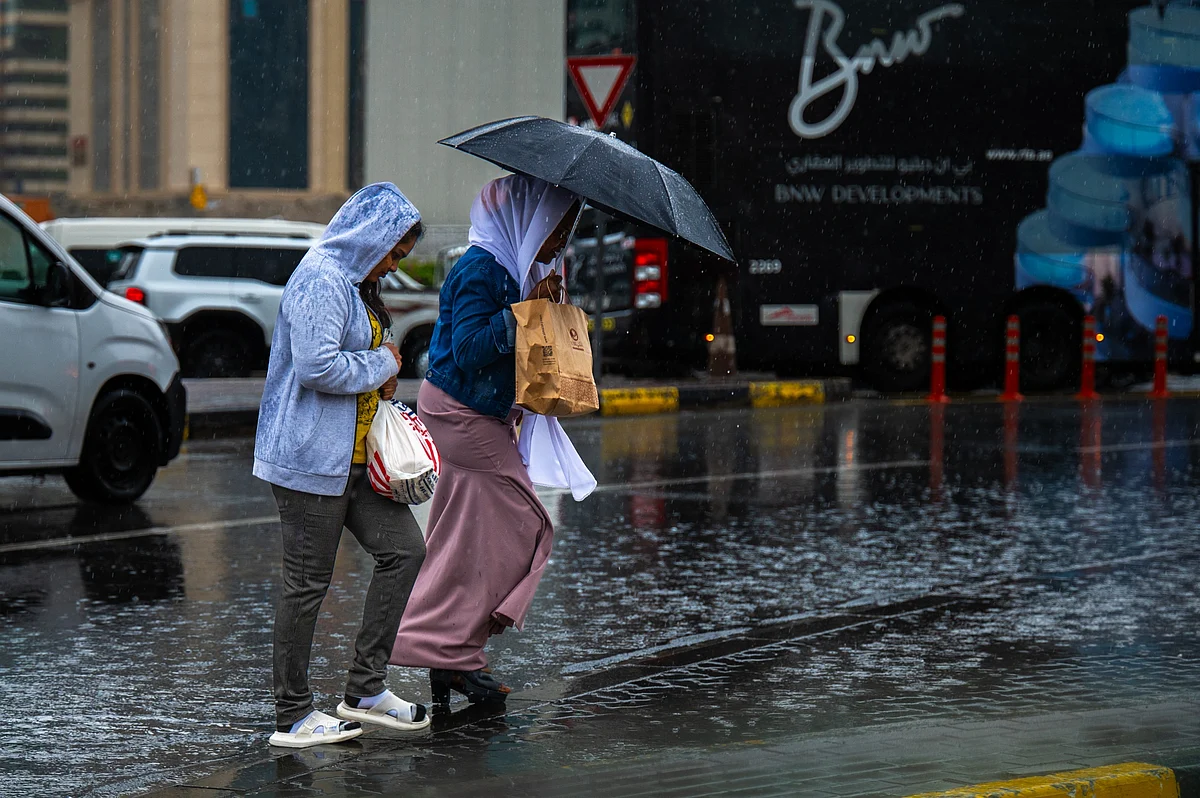
After weeks of heavy downpours, earlier in the UAE, residents can expect more showers in the coming days — this time arriving in intermittent spells across different parts of the country at varying times.
The National Centre of Meteorology (NCM) has forecast rainfall starting Thursday, with conditions expected to remain unstable through to Monday. The forecast comes after late March saw what many described as “unprecedented” rainfall, causing flooding in low-lying areas and disrupting daily life across few emirates.
Clouds are set to move in from the west at intervals, bringing light to moderate rain across scattered areas, with occasional heavy bursts in some regions.
Low-pressure systems driving rain
Explaining the shift in weather, Dr Ahmed Habib, a veteran meteorologist at the NCM, told Khaleej Times on Tuesday that multiple weather systems at different atmospheric levels are currently influencing the country.
He noted that the UAE is expected to see rainfall from “Thursday through to Monday as conditions turn increasingly unstable. A low-pressure system extending from the Arabian Sea into the lower atmosphere, combined with another in the upper layers moving in from the Middle East, will increase humidity and cloud formation.”
He added that clouds are likely to develop over Saudi Arabia before gradually moving towards the UAE, resulting in rainfall across the country.
Where rain will be heaviest
While most areas will see light to moderate showers, some regions could experience more intense rainfall.
Dr Habib explained that rainfall will vary in intensity — light to moderate in general, “with heavy spells at times, particularly over Al Dhafra and Al Ain. These heavier bursts will be driven by convective cloud activity, while northern and mountainous areas could also see periods of heavier rain due to dense cloud cover.”
“Overall, cities including Abu Dhabi, Dubai, Sharjah and Ras Al Khaimah are likely to receive rainfall, with occasional downpours expected across the country.”
Regional transition period
Currently, the low-pressure system affecting parts of the Middle East is going to influence weather conditions in the days ahead, before gradually moving eastward towards the Mediterranean.
Habib added, “This is expected to bring cloud cover to parts of the region, including northern Saudi Arabia, Jordan and Lebanon. However, in the UAE, the primary influence is the low-pressure system extending from the Arabian Sea.”
“Different regions — including Oman, Yemen and Qatar — are being affected by varying weather systems, while in the northern Middle East like, Jordan, Lebanon, Iraq, northern Saudi Arabia, weather systems are typically influenced by the Mediterranean or the Red Sea.”
Increased cloud cover is likely to bring a noticeable drop in temperatures, with conditions shifting rapidly between stable and unstable phases.
“As this is a transitional period (across much of the Middle East), temperatures are also expected to fluctuate quickly depending on air mass movement and wind direction,” added Habib.