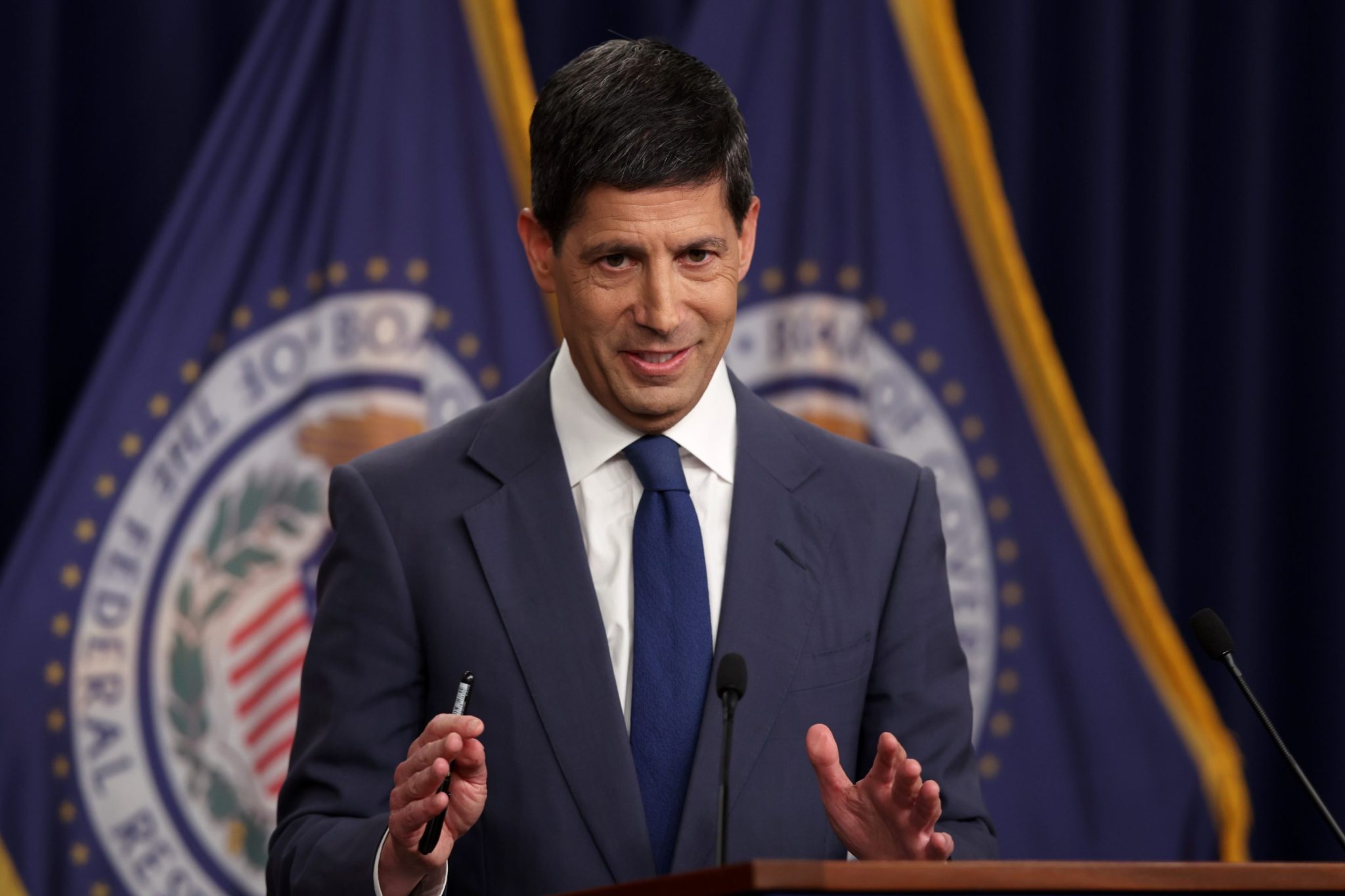
The debate over artificial intelligence and monetary policy is already well under way. Federal Reserve Chair Kevin Warsh and others have rightly emphasized that AI could raise productivity and productive capacity even as the investment boom puts pressure on resources before those benefits arrive. That timing problem is real. But it risks obscuring a more immediate challenge: AI is also creating a large and rapidly evolving financing ecosystem whose leverage, exposures and vulnerabilities are much less well understood.
Morgan Stanley projects nearly $3 trillion of global AI-related infrastructure investment through 2028, with an estimated $1.5 trillion external financing gap. This investment is already absorbing construction, semiconductors, electricity and skilled labor. In the near term that can raise resource utilization and prices. Over time, automation, organizational change and new capital should raise potential output and reduce unit costs.
The mistake would be to treat every sign of pressure from this buildout as an inflation problem requiring higher interest rates. Monetary policy does not merely restrain demand; it can also affect the investment and innovation that determine future supply. Patrick Moran and Albert Queralto showed in a 2018 Journal of Monetary Economics paper that when innovation and technology adoption are endogenous, monetary policy changes firms’ incentives to develop and implement new technologies and can therefore affect future productivity.
The 1990s provide the more compelling historical counterfactual. By the mid-1990s unemployment had fallen below what policymakers then regarded as its natural rate, and pressure was building inside the Fed to tighten. Chairman Alan Greenspan instead entertained the possibility that the models were wrong—that faster productivity growth had raised the economy’s speed limit—and largely resisted further rate increases. Unemployment continued to fall while inflation remained subdued.
The question worth asking today is: How much of the 1990s productivity boom would America have missed if the Fed had continued tightening until the economy conformed to its models? We can never know. That is precisely the problem. Inflation caused by excessive accommodation eventually appears in the data. Productivity lost because investment and innovation never occurred does not. With AI, moreover, the damage could be permanent. Data centers, power capacity, human capital, financing expertise and the businesses that form around them create cumulative advantages. If that investment occurs elsewhere, lowering U.S. rates several years later does not necessarily bring it back. Missing a significant part of the AI investment cycle could leave lasting scars on American productivity and competitiveness.
Focusing on inflation also misses the other half of the AI boom: its rapidly changing financial architecture. Traditional monetary-policy models give financial variables remarkably little independent weight. Standard frameworks focus on inflation and employment or the output gap, with financial conditions mattering largely insofar as they forecast those variables. In recent work with Sergey Sarkisyan, we show that credit spreads contain policy-relevant information about financing distortions and firms’ cost of capital that inflation and the output gap miss.
This reflects a peculiar drift in the Fed’s mandate. The Federal Reserve was created to protect financial stability after recurrent banking panics. Yet its original purpose has become secondary as inflation and employment have come to dominate its models and policy debate. Financial stability belongs alongside price stability and employment at the heart of the Fed’s mandate—and at times should take precedence over both. Leverage, funding fragility and severe distortions in capital allocation can do far more lasting economic damage than modest deviations of inflation or employment from target.
AI makes this particularly consequential. The Fed needs a much better understanding of how the investment is being financed: the growing role of private markets, increasingly complex links among borrowers and intermediaries, and where leverage, maturity risk and ultimate exposures actually reside. It needs better data and better models of how losses could propagate if expected revenues disappoint or today’s expensive computing capital becomes obsolete faster than anticipated.
That calls for a different allocation of intellectual resources. Since 2008, the Fed has invested heavily in understanding banks, housing and mortgages. That expertise remains valuable. But the next financial vulnerability is unlikely to resemble the last one. Private markets and new funding structures deserve comparable analytical depth. A central bank exceptionally well equipped to understand the last crisis is not necessarily well equipped to anticipate the next one.
That is the lesson from 2008. The central failure was not simply an incorrectly set federal-funds rate. Policymakers failed to appreciate the leverage, complexity and interconnectedness of a rapidly changing mortgage-finance system until the consequences became systemic. AI is not subprime mortgages, and predicting another financial crisis would be unwarranted. But the institutional lesson is clear: when financial innovation is moving faster than our models, understanding where risk is accumulating must be a central concern of the Fed. Higher interest rates are no substitute for understanding the problem.
Indeed, reflexive tightening could produce the worst of both worlds. If the emerging vulnerability is financial rather than inflationary, higher rates could expose leverage we do not fully understand while simultaneously raising the cost of the productive investment necessary for AI to generate its expected gains. The result could be a financial vulnerability the Fed failed to understand combined with something much harder to repair: a lasting loss of U.S. technological leadership as investment, expertise and complementary infrastructure develop elsewhere.
None of this is an argument for easy money. Persistent inflation will certainly require a monetary-policy response, and central bankers have no business choosing which AI projects deserve funding. The task is to match instruments to problems and restore financial stability to its proper place in the Fed’s framework, without unnecessarily impairing the capital formation on which America’s long-run competitiveness may depend.
The Fed spent the past few years relearning the dangers of underestimating inflation. The challenge now is not to allow complexity and financial innovation to leave policymakers blindsided. Inflation eventually announces itself. Financial vulnerabilities can remain hidden until they become crises. Missing productivity is harder still to detect—and potentially permanent.
The risk we should not underestimate is eroding America’s AI advantage before its full productivity gains arrive.
The opinions expressed in Fortune.com commentary pieces are solely the views of their authors and do not necessarily reflect the opinions and beliefs of Fortune.
This story was originally featured on Fortune.com