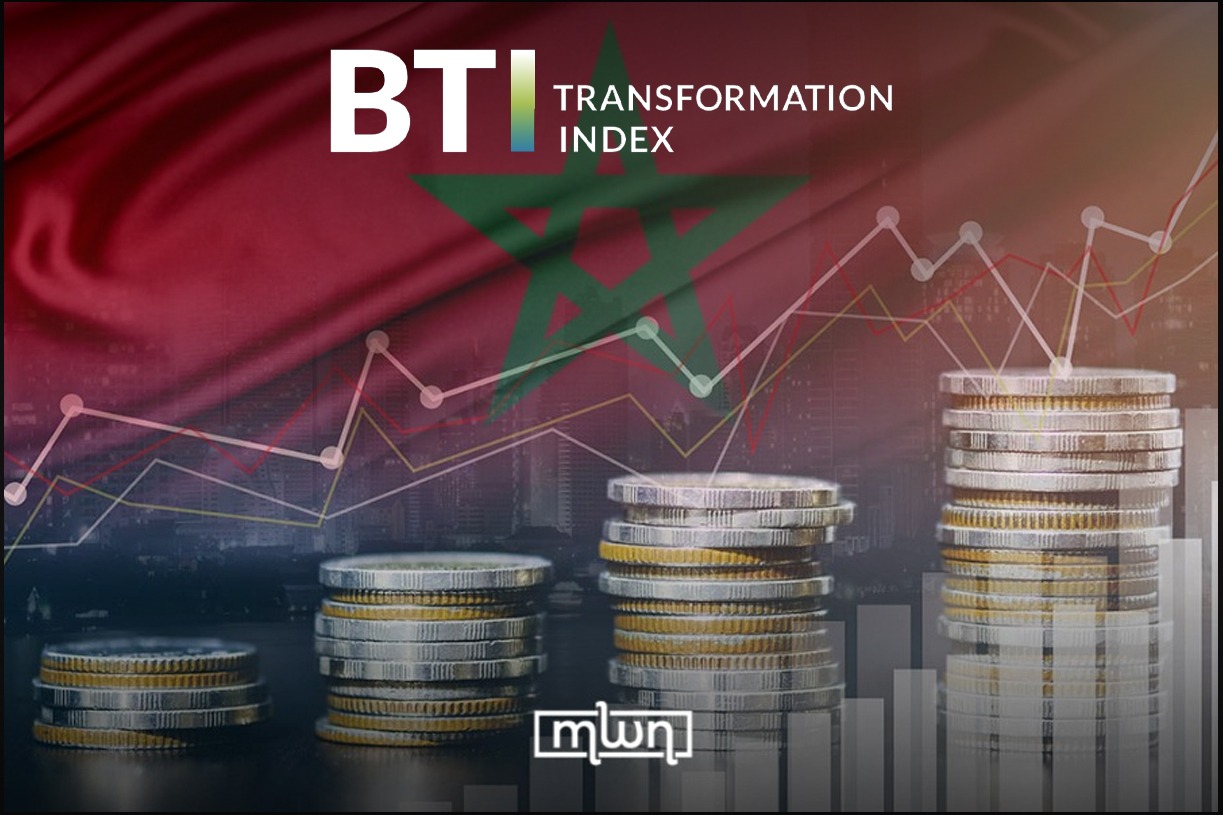
The Bertelsmann Stiftung’s Transformation Index (BTI) 2026 claims to assess countries’ progress toward democracy and a market economy. As with previous editions, the Morocco report measures the country against a predefined Western model of transformation, treating any deviation from that model as a failure.
This reflects a normative bias: one model fits all. The index is built on a linear assumption that successful countries must combine liberal democracy with market liberalization, treating this model not as one path among others, but as the inevitable endpoint.
The problem, in Morocco’s case, is that it follows a hybrid governance model, combining a constitutional monarchy, centralized strategic decision-making, and gradual reform. From a neoliberal and Western-centric perspective, BTI frames this model as falling short of liberal democratic standards and highlights a ‘weak separation of powers.’ Yet analytically, this reflects not failure, but a different model of governance.
This leads to a fundamental misreading of state effectiveness. BTI tends to equate decentralization and institutional autonomy with effectiveness. However, Morocco demonstrates a strong capacity for state continuity and strategic execution, particularly in infrastructure, diplomacy, and energy. While the report acknowledges some of these achievements, it places disproportionate emphasis on formal institutional independence, thereby overlooking actual delivery capacity.
BTI tends to assess Morocco without sufficiently integrating geopolitical constraints. This reflects a form of context blindness, where regional dynamics are underweighted in the overall analysis. Morocco’s strategic environment includes persistent tensions with Algeria and the instability of the Sahel, both of which have direct implications for national security.
In such a context, centralization is not merely a political choice—it is a mechanism of stability. By ignoring geopolitical constraints, BTI interprets this centralization as an authoritarian tendency, rather than as a rational and strategic response to a complex security environment.
Yet a long tradition of scholarship suggests otherwise. As Clifford Geertz showed, political authority in Morocco is rooted in symbolic and religious legitimacy. John Waterbury highlighted the monarchy’s capacity to integrate historical authority and controlled pluralism, while Samuel Huntington emphasized that legitimacy in developing contexts often rests on order and performance as much as on procedural democracy.
By reducing legitimacy to formal electoral and institutional criteria, BTI underestimates the historical and religious legitimacy of the monarchy, as well as the national cohesion surrounding the Sahara issue. More broadly, its reliance on formal indicators—laws, institutions, and codified freedoms—leads it to underweight informal governance systems, political culture, and negotiated power structures, where much of Morocco’s political legitimacy actually resides.
This is where the concept of the Makhzen becomes essential. As I argue in my article ‘Moroccans, the Makhzen, and the Reality of Power,’ it is a historical and sociological system embedded in Moroccan society, functioning as a mechanism of legitimacy, mediation, and continuity. For BTI, this implies a fundamental blind spot: political authority in Morocco cannot be understood solely through formal institutions or electoral competition, but operates through layered forms of legitimacy—historical, religious, and social—that Western analytical frameworks often fail to capture.
The BTI report on Morocco rests on a recurring dichotomy between policy intention and implementation gaps. It repeatedly acknowledges that sound policies exist, yet concludes that execution remains weak. Implementation deficits are a universal feature of governance, including in OECD countries. What is problematic, however, is that BTI does not calibrate its expectations to Morocco’s stage of development. The same implementation gaps that would be considered transitional elsewhere are, in Morocco’s case, interpreted as structural shortcomings. This creates an implicit asymmetry in evaluation that skews the overall judgment.
The report also reveals a deeper economic inconsistency. On the one hand, it recognizes Morocco’s sustained export growth, its increasing ability to attract foreign direct investment, the progressive upgrading of its industrial base in sectors such as automotive and aerospace, as well as the resilience of its banking system. While acknowledging progress, the report ultimately concludes that the country has undergone only ‘limited transformation’. This raises a fundamental question: how can strong economic performance coexist with a limited transformation? The answer lies less in the data than in the interpretive framework. BTI appears to privilege distributional outcomes over productive transformation, while also struggling to account for lag effects—the temporal gap between structural reforms and their full social and territorial impact.
This interpretive bias extends to the report’s reading of Morocco’s strategic positioning. By interpreting elements such as football diplomacy, the World Cup, and the Sahara primarily through a lens of political instrumentalization, BTI reduces complex statecraft to simplified narratives. In reality, these are not distractions but deliberate instruments of strategy. They function sources of diplomatic leverage, investment, and national cohesion. The inability to recognize these dynamics reflects a broader analytical limitation: a failure to understand how contemporary states transform symbolic capital into tangible economic and geopolitical returns.
A more troubling issue emerges in the selective use of evidence. The report places considerable emphasis on inequality, governance deficits, and political constraints, yet gives comparatively limited attention to Morocco’s measurable progress in poverty reduction over the past two decades, the scale of its infrastructure expansion, the sustained development of its southern provinces, and its growing role as a regional economic and diplomatic actor in Africa. This creates a narrative imbalance, where certain indicators are amplified while others are under-contextualized.
This tendency is further reinforced by BTI’s methodological approach. The report relies heavily on a small number of country experts whose qualitative judgments inevitably shape the narrative. In such a configuration, analytical outcomes are highly sensitive to ideological priors. This creates a risk of bias and selective framing, where analysis risks being shaped by narrative rather than balance.
At a deeper level, the limitations of the BTI report stem from a structural mismatch between its analytical model and the Moroccan reality. The framework remains normatively anchored in Eurocentric assumptions about governance, legitimacy, and political development, and is therefore ill-equipped to capture hybrid systems. Morocco, however, does not conform to binary categories such as democratic transition or authoritarian persistence. Rather, it embodies a layered model that combines historical legitimacy, religious authority, centralized coordination, and gradual economic liberalization. This hybridity is not a deviation from a norm; it is a distinct mode of governance that reflects the country’s historical trajectory and strategic choices.
Ultimately, the issue is conceptual. BTI evaluates Morocco against a model that Morocco has never sought to emulate. What the report identifies as limitations are often deliberate design choices aimed at preserving stability, sequencing reforms, and balancing modern institutional development with enduring forms of legitimacy. Morocco is not underperforming; it is operating according to a different development logic. In this sense, BTI functions less as an index of transformation than as an index of conformity to a predefined normative model—one that struggles to accommodate alternative pathways to modernization and state effectiveness.
The post The Bertelsmann BTI: Evaluating Morocco… or Imposing a Model? appeared first on Morocco World News.