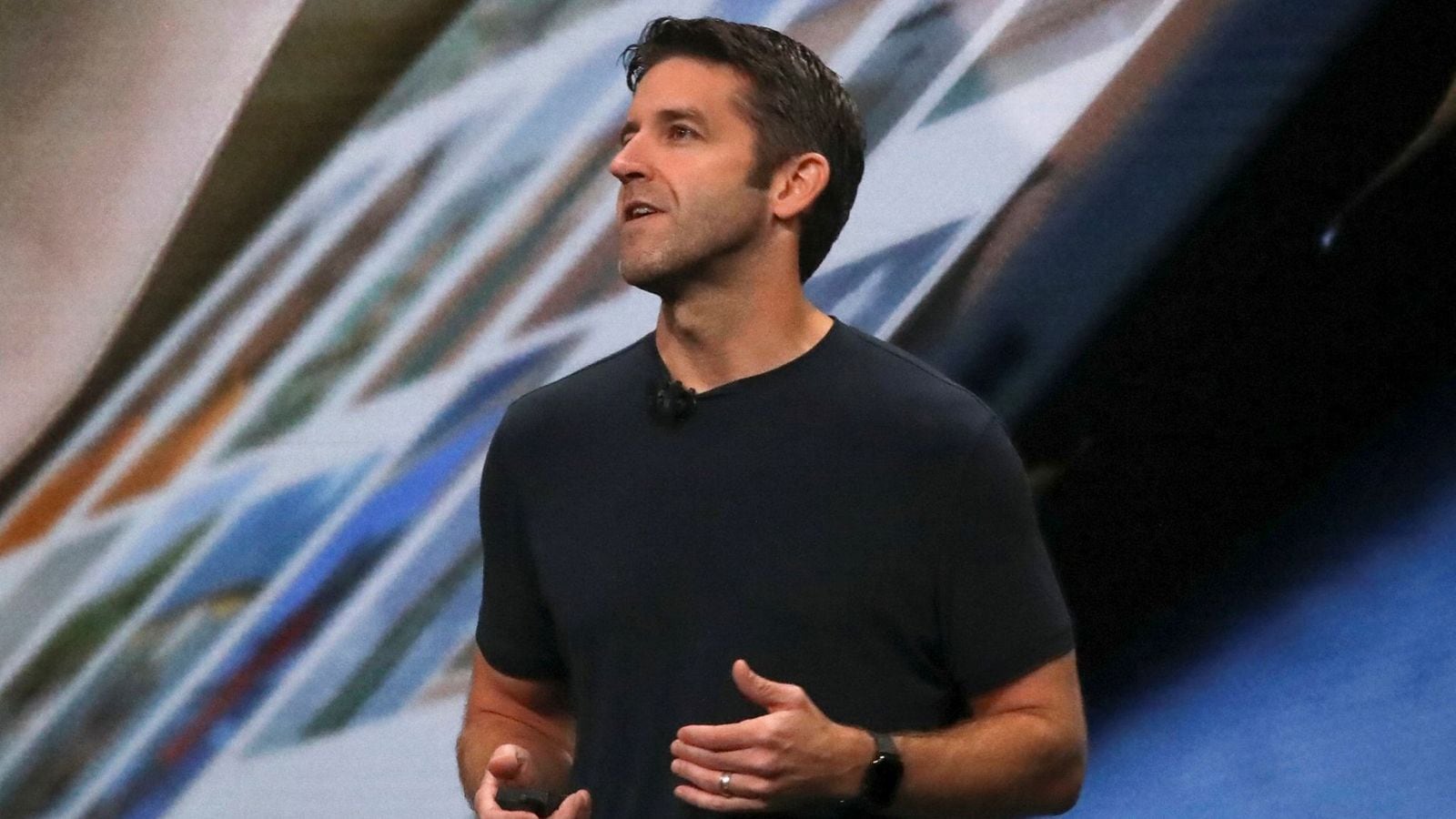
Weather ePaper Today’s Paper Journalism of Courage Home ePaper Politics Explained Opinion India Business Premium Cities UPSC Entertainment Sports World Lifestyle Tech Subscribe Sign In TrendingUPSC OfferIPL 2026US NewsPuzzles & GamesLegal NewsFresh TakeHealthResearch🎙️ Podcast Advertisement function checkAndLoadWindowSizeScript() { if (window.jQuery) { // jQuery is loaded, include your script jQuery(document).ready(function($) { // Your existing script for checking window width if (window.innerWidth) var page_w = window.innerWidth; else if (document.all) var page_w = document.body.clientWidth; if (page_w > 1024) { $(".add-left, .add-right").show(); } else { $(".add-left, .add-right").hide(); } }); } else { // jQuery is not loaded, check again after 0.2 seconds setTimeout(checkAndLoadWindowSizeScript, 200); } } // Initial call to the function checkAndLoadWindowSizeScript(); NewsTechnologyOpinionTernus’ major test as Apple CEO: bringing product-first thinking back to the company Ternus’ major test as Apple CEO: bringing product-first thinking back to the company Having witnessed both the Jobs and Cook eras up close, Ternus may need to draw on the qualities that made them two of Apple’s most influential CEOs. Written by: Anuj Bhatia10 min readNew DelhiApr 22, 2026 03:37 PM IST Ternus is taking over a company with a strong balance sheet, high growth margins, and the reputation of a tech giant. What it unfortunately lacks at this point in time are bold ideas and someone who can execute them. (AP Photo/Bebeto Matthews, File) Make us preferred source on Google Whatsapp twitter Facebook Reddit PRINT In a few months, Tim Cook will retire as CEO of Apple, and the hardware engineering head, John Ternus, will take over and run the day-to-day operations of one of the world’s most valuable tech companies. Cook is leaving behind a stable, cash-rich company that has been operationally well-managed for over a decade. However, Ternus, 51, who has been with Apple for over 25 years and is being handed the most coveted position, will need to “think differently” from his predecessor, Cook, much like co-founder Steve Jobs did during his time. Ternus, who has witnessed both Jobs’ and Cook’s eras at Apple up close before becoming CEO, may need to imbibe the qualities that made them two of the greatest CEOs of all time. However, at this point, Ternus should be looking at Jobs more than Cook. Not to say Cook shouldn’t be credited for what has made Apple what it is today. When Cook became CEO in 2011, Apple was valued at around $350 billion; now it’s worth roughly $4 trillion. During his leadership, the iPhone became the most profitable consumer product in history. Services revenue, a category that barely existed when he took over, now generates more than $100 billion annually. Ternus is taking over a company with a strong balance sheet, high growth margins, and the reputation of a tech giant. What it unfortunately lacks at this point in time are bold ideas and someone who can execute them. Apple has smart people who can handle finances and operations, but where Ternus’ expertise will be most valuable in taking the company out of the “comfort” it has built for itself is his years of experience as a product leader. For average consumers who follow Apple product launches held at its campus in Cupertino, Ternus is a familiar face. Over the past five years, Ternus has overseen the design and performance of many new Apple products, including the iPad and AirPods. He has also played a major role in Apple’s Silicon chip initiative as it transitioned away from Intel. Last year, he unveiled the company’s new iPhone Air. Ternus is familiar with Apple inside and out. He knows the hardware development of key Apple products. Cook was never a product guy — he was the mastermind behind Apple’s supply chain and never acted like Jobs, as he passed the company on to Ternus. Truth be told, during Cook’s 15-year tenure as Apple’s CEO, the company largely focused on iterative updates to the iPhone, iPad, and Mac. Although the Apple Watch was a new product, Cook’s vision of turning a smartwatch into a health tool has not fully materialised. In between, however, Apple’s newer products, such as the Vision Pro mixed-reality headset and the HomePod smart speaker, were not major hits and were too flawed to become significant categories of their own. Perhaps the biggest miss Apple has had under Cook has been sidelining artificial intelligence, despite the company having pioneered the technology long ago with Siri. Right now, Apple is nowhere to be seen in the AI race, and instead, the company is relying on Google to improve Siri. Ternus can make internal changes that Cook did not, and bring back Apple’s culture of innovation. Under Jobs’ leadership, Apple was an eccentric and somewhat unconventional company that focused on a small range of products that nobody thought they would want or need. The iPod, iPhone, and iPad are the prime examples. Even lesser-known products that came during the Jobs era were fun and had a personality. And a major credit goes to famed industrial designer Jony Ive, who was Jobs’s biggest spiritual collaborator. Under Cook, however, the iPhone became the dominant product and, to this day, remains much the same as it was in 2007, when the late Steve Jobs introduced the first iPhone to the world. Nothing has really changed with the iPhone over the years, and that is a fact. Apple under Cook has become somewhat predictable, and as someone who has followed the company since I began writing about it, it has disheartened me. Before every product launch event, one can predict what is about to come. While this strategy may work to an extent, it has been recycled so often that what once made Apple so special has lost some of its meaning. A company the size and scale of Apple can’t rely solely on the iPhone and its ecosystem. A company that once took pride in entering categories late and then defining them is now known as the “iPhone company.” It’s great that the iPhone generates billions in revenue and helps Apple break into new markets such as China and India, but consumers there also begin to question what’s new about the iPhone after a point, especially as the market starts to saturate. Can you call an orange iPhone colourway an innovation? No, it isn’t, and even Apple employees know this, but they have been given the mandate to sell as many iPhones as possible. Cook’s Apple was more about “expansion” and less about taking “risks,” something Ternus will have to change. Apple knows how to make a “premium” product mainstream, and that will be handled under Ternus, but as a product person, he can also bet on newer product categories that actually solve consumers’ problems. The iPhone, for example, solved the consumer pain of carrying a computer the size of a palm. The foldable iPhone, reportedly in the works and set to launch this year, doesn’t really solve anything. Just because others entered a new product category, Cook’s Apple also ventured into it. Take the case of the HomePod or the Vision Pro headset, both of which commercially failed and did not change the market as Apple would have hoped. Sure, new ideas may fail (and failure is part of the journey), but under Cook, Apple lacked the courage to step out of its cocoon and pursue ambitions it could have led but did not. One of the constant complaints I hear from Apple fans (I don’t mean YouTubers and paid influencers) and insiders who genuinely care about the company is that it makes too many products. Once you enter the Apple Store, you get overwhelmed by the multiple models of iPhones, iPads, and Macs. As an average consumer, it becomes confusing, and you need to visit Apple’s website to spot the differences. At times, you wonder why Apple sells an iPad Pro and an iPad Air when the differences are minimal. It reflects the mindset of a CEO who wants to sell FMCG products rather than the “cool” tech products Apple is known for. Cutting down SKUs and unnecessary models should be Ternus’ first priority as CEO. Simplifying the lineup will only help Apple sell its products more effectively to targeted consumers. Oh, and if Apple tones down its product marketing to “content creators” and brings “average consumers” back into the conversation, it would be great for the company. The iPod, iPhone, Mac, and even the Apple Watch were always meant for normal consumers. We, in the tech industry, seem to be too obsessed with creators. Ternus has the experience to shift Apple’s leadership from “accountants” to a technical leader, but whether he brings that decisive change remains to be seen. As insiders say, Cook’s biggest “product” achievement was Apple’s transition from Intel to making its own chips for Macs. Ternus played a significant role in driving that change, reflecting a product-focused approach. The recent launch of the MacBook Neo, an entry-level Mac that runs an iPhone chip, is what Apple has always been known for, right from the beginning. It highlights Apple’s strengths as a company and the combination of hardware and software that no other consumer tech company has managed to replicate, not even Google. Apple needs more products like the Neo; it’s unusual but also very mainstream. Windows PC makers will have a hard time creating a product like the Neo. Cook rightly said that Ternus has “the mind of an engineer, the soul of an innovator, and the heart to lead with integrity and honour,” but Ternus also has a difficult job as CEO: to bring about change as quickly as possible and fix the things Apple has missed as a company. That’s what a leader of a $4 trillion company needs to do. Apple may have missed the bus in artificial intelligence, but Ternus, as a technical and product-focused leader, can drive meaningful change. In consumer tech, AI has, to say the least, not been valuable, and no company has clearly demonstrated its true value yet. Chatbots have been more widely abused to create deepfakes than used as tools for meaningful benefit to humanity. Apple can change that and make AI genuinely useful, bringing positive change to society. Ternus should think like Steve Jobs: treating it as a problem to solve rather than something to avoid, or stepping away from the space and focusing on a game-changing idea that has not yet been explored. Anuj Bhatia is an Assistant Editor at indianexpress.com with a career spanning over a decade. Active in the domain since 2011, he has established himself as a distinct voice in tech journalism, specializing in long-form narratives that bridge the gap between complex innovation and consumer lifestyle. Experience & Career: Anuj has been a key contributor to The Indian Express since late 2016. Prior to his current tenure, he served as a Senior Tech Writer at My Mobile magazine and held a role as a reviewer and tech writer at Gizbot. His professional trajectory reflects a rigorous commitment to technology reporting, backed by a postgraduate degree from Banaras Hindu University. Expertise & Focus Areas: Anuj’s reporting covers the spectrum of personal technology, characterized by a unique blend of modern analysis and historical context. His key focus areas include: Core Technology: Comprehensive coverage of smartphones, personal computers, apps, and lifestyle tech. Deep-Dive Narratives: Specializes in composing longer-form feature articles and explainers that explore the intersection of history, technology, and popular culture. Global & Local Scope: Reports extensively on major international product launches from industry titans like Apple and Google, while simultaneously covering the ecosystem of indie and home-grown tech startups. Niche Interests: A dedicated focus on vintage technology and retro gaming, offering readers a nostalgic yet analytical perspective on the evolution of tech. Authoritativeness & Trust Anuj is a trusted voice in the industry, recognized for his ability to de-jargonize trending topics and provide context to rapid technological advancements. His authority is reinforced by his on-ground presence at major international tech conferences and his nuanced approach to product reviews. By balancing coverage of the world's most valuable tech brands with emerging startups, he offers a holistic and objective view of the global technology landscape. Find all stories by Anuj Bhatia here. You can find Anuj on Linkedin. ... Read More
المصدر: Indian Express
| Source: Indian Express