
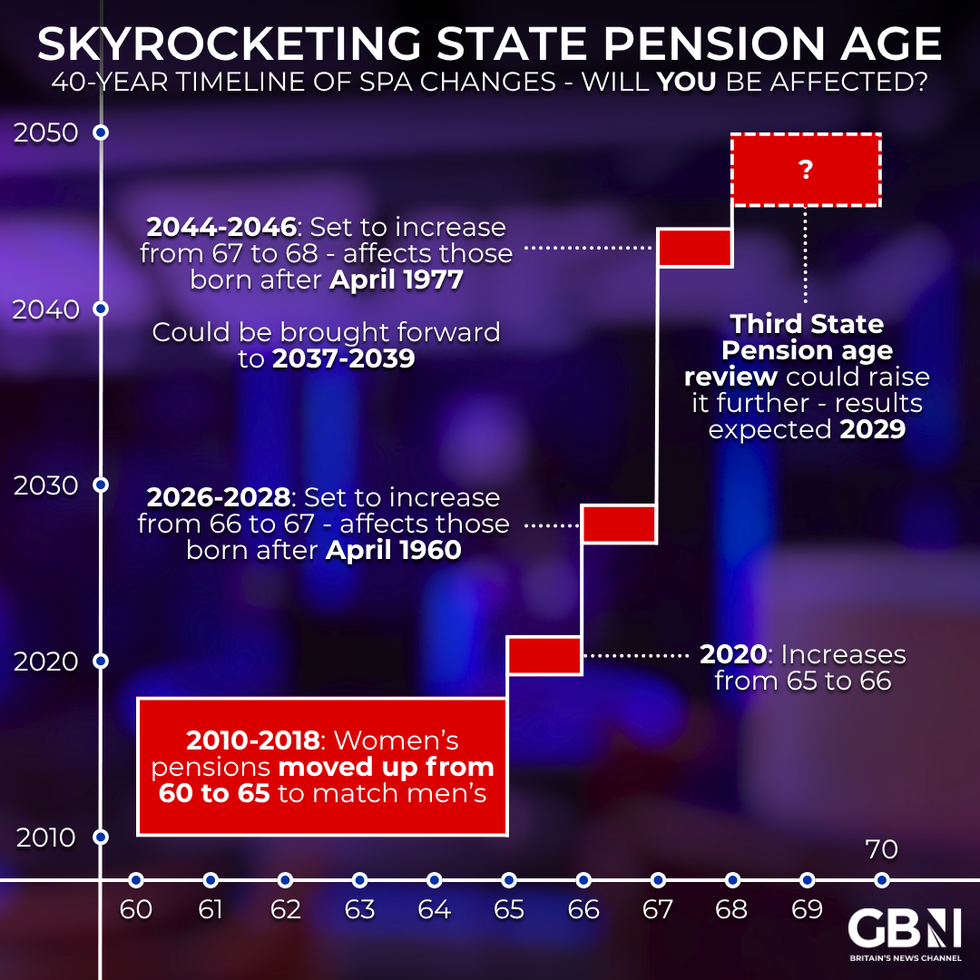
The state pension age is gradually rising from 66 to 67, affecting millions of Britons approaching retirement.
The increase is being phased in over two years, with eligibility now determined by an individual’s exact date of birth rather than a universal age of 66.
Labour says the change reflects rising life expectancy across the UK.
People born between April 6, 1960 and April 5, 1977 fall within the transition period.
Under the old rules, everyone qualified for the state pension at 66. Now, those born after April 6, 1960 face a stepped increase in the age at which they can begin claiming.
The first group affected, those born between April 6 and May 5, 1960, will qualify at 66 years and one month. For people born between May 6 and June 5, 1960, the age rises to 66 years and two months.
The qualifying age then increases by one month for each subsequent birth bracket.
People born between December 6, 1960 and January 5, 1961 will reach eligibility at 66 years and nine months. Anyone born between March 6, 1961 and April 5, 1977 must wait until 67.

Campaign groups such as Women Against State Pension Inequality (Waspi) have long raised concerns about the level of notice given to those affected by pension‑age changes.
Experts have also warned of rising pension‑poverty risks for people approaching retirement, particularly those who planned their finances around receiving the state pension at 66.
Critics argue the transition risks leaving some vulnerable workers facing months without expected income, increasing financial pressure at the end of their working lives.
Younger workers are also expected to face further rises in future decades, with some projections suggesting people early in their careers may not receive the state pension until 70.
A cross‑party group of MPs has launched an inquiry into the financial challenges facing people nearing retirement during the transition.
LATEST DEVELOPMENTS
- Older homeowners could unlock more cash under mortgage shake-up
- Pensioners face £4,262 tax increase as retirement costs continue rising
- Pension tax raid from Rachel Reeves 'more damaging than admitted' as millions at risk
Debbie Abrahams, chair of the Work and Pensions Committee, said: “In our Pensioner Poverty report, we called on the Government to create a coherent cross‑governmental strategy that would get ahead of the consequences of an ageing society.”
She said the Government’s response pointed to “standalone policies” but lacked a guiding framework, leaving people “exposed to falling between the cracks”.
Ms Abrahams highlighted the strain on workers approaching retirement age.
“Pre‑pensioners are particularly exposed. You could’ve worked a gruelling 45 years as a skilled tradesperson, paying taxes only to find yourself short of cash as you limp from day‑to‑day for more years until the pension payoff.”
She added: “It’s only natural that this situation would make you feel a sense of injustice, facing hardship, having been independent and contributing for decades.”
Our Standards: The GB News Editorial Charter