⚡ عاجل: كريستيانو رونالدو يُتوّج كأفضل لاعب كرة قدم في العالم●⚡ أخبار عاجلة تتابعونها لحظة بلحظة على خبر●⚡ تابعوا آخر المستجدات والأحداث من حول العالم●
AI اقتراحات ذكية
AI مباشر|--مشاهد مباشر
962,674مقال401مصدر نشط228قناة مباشرة4,462خبر اليوم
آخر تحديث:منذ 6 ثواني
‘Society Needs to Approach Us and Learn Our Language’: The Deaf Side of Marrakech
•Rabat—Marrakech’s Sign Language Café is among the most important of the city’s resources for the deaf community.
•Recently renovated and in an inviting, if somewhat removed, side street in the city, it employs five deaf chefs and offers a slew of accommodations, including lights that catch the workers’ attention...
•Here is where Saida Ammar, a deaf line cook, has worked since 2018.
هذا الخبر من Morocco World News. خبر يقدم أدوات ذكاء اصطناعي للتلخيص والترجمة والاستماع.
Rabat—Marrakech’s Sign Language Café is among the most important of the city’s resources for the deaf community. Recently renovated and in an inviting, if somewhat removed, side street in the city, it employs five deaf chefs and offers a slew of accommodations, including lights that catch the workers’ attention and illustrated, not written, recipes.
Here is where Saida Ammar, a deaf line cook, has worked since 2018. She is grateful for the accommodations at the café. Outside of employment here, her life is complicated by a lack of accessibility.
“I always [have] to have someone with [me] who can explain things to me,” signed Ammar to Morocco World News (MWN). “It’s easier to deal with… when you know how to write, but [not many deaf people] know how to write.”
Before she came to the Sign Language Café, her work opportunities were limited and insufficient for her needs. She not only provides for herself, but also helps to provide for her husband, who is also deaf, and her aging parents.
She described her offer of employment at the Sign Language Café as her “first call of hope.” Here, she finds a stable source of work and adequate payment. For deaf people in Morocco, this is unusual. Deaf Moroccans are still fighting for basic access to education, work, and public services—despite decades of promised reforms and a recent push to standardize Moroccan Sign Language.
Big-picture changes, small individual impact
Morocco has taken several critical national steps towards equality for people living with disabilities, including the deaf community. In 2009 Parliament ratified the UN Convention on the Rights of Persons with Disabilities and its Optional Protocol, thereby committing itself to equal rights and non-discrimination. But, the wheels of government spin slowly, and it was not until 2015 that Parliament took its next major step, adopting Framework Law 97-13 on the “protection and promotion of the rights of persons with disabilities.” This law called for administrators to begin closing the gap between the 2009 law and lived reality for deaf Moroccans—meaning taking steps towards accessibility and benefits in schools, jobs, and public spaces.
Following the ratification of these two laws that have called for change, little data exists on the actual changes. But not much data exists on the disabled population of Morocco in general. This segment of the population remains largely unknown to statisticians and lawmakers. What data does exist finds that, in 2014, 5.1 percent of Moroccans lived with disability, and that 66 percent of those people had never received any formal education—a far higher rate than the rest of the population.
For deaf Moroccans specifically, the numbers are stark. Estimates quoted in 2023 put hearing disabilities at over 300,000 people, including 30,000 children aged 5–15—only about 1,000 of whom are in school. A 2024 study on deaf education estimates roughly 4,000 deaf pupils in primary schools and suggests that around 78% of the deaf population is illiterate, compared to about 30% among hearing Moroccans. This is because very few formal or well-publicized educational resources exist for deaf children—meaning much of the deaf community never learns how to read.
Administrators at the school, including Wahid Jamal and Hafsa Al-Alawi and Soufiane Al-Alawi, and
These statistics echo what families and educators in Marrakech describe on the ground.
“In the beginning there were no special departments for sign language,” Wahid Jamal — an educator at one of the country’s few deaf schools, based in Marrakech — said to MWN. “We used to call [deaf] children ‘lost and confused’ in society… We had to come together, form an association, and start. The first steps were to teach our children sign language.”
Jamal and Hafsa Al-Alawi work at the Koutoubia Association for the Deaf and Mute in Marrakech. Both administrate and teach at the deaf school run by the association. Al-Alawi is also the parent of a deaf child. In her time outside school, she works as a sign-language expert and an interpreter for deaf people in courts.
Both Jamal and Al-Alawi have worked extensively to support the deaf community in Marrakech.
“We have a partnership with the Ministry of National Education, which provides us with classrooms,” Jamal said, describing the school for the deaf located to the side of a little street in Marrakech.
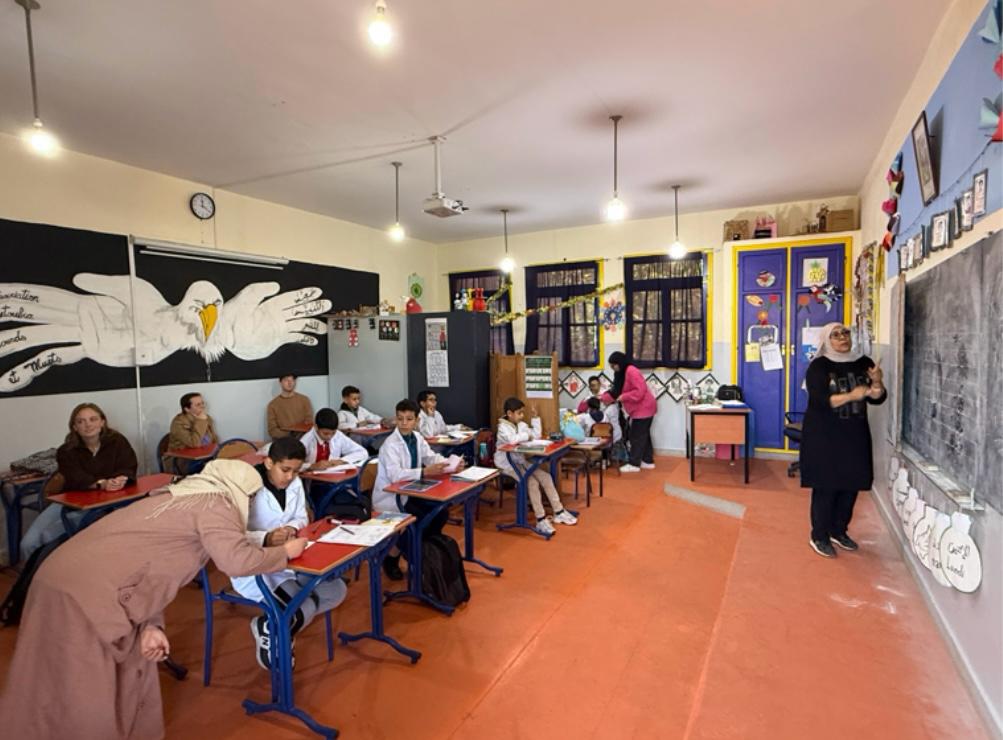
These classrooms are old and in need of some repair—though educators have made an effort to brighten up the school with cheerful paintings and vivid primary colors in the classrooms. The classrooms are all that the government provides, according to Al-Alawi; the rest is made possible through charitable donations.
There are schools for the deaf here in Morocco. But Marrakech is one of Morocco’s largest municipalities and it is only serviced by Koutoubia’s deaf school. And many deaf children are born outside of major cities; it is therefore difficult for families to traverse long distances for their children to access school, meaning it is better if children can enter classes in their local school districts.
To that end, Koutoubia has brokered agreements with the Ministry to allow deaf children to enter regular classes with interpreters. But many challenges obstruct this path, too. There are few teachers and private tutors who are not only proficient in all the languages spoken in Moroccan schools—usually Arabic, Darija, French, and English—on top of sign language. And even if such an educator can be found, they are too expensive for many families to afford for a child’s whole education.
For this reason, many deaf children in Morocco are never educated at all. Even Koutoubia’s resources only extend to grade 6. They do not have the financial resources to go further.
“It would be better if [public school] teachers first learned sign language, then started integrating. The teacher should deal with everyone, hearing and deaf,” said Al-Alawi. She says that interpreters do not adequately help deaf students integrate into hearing classrooms. Further, they are too expensive to be a viable solution for most families.
And according to Al-Alawi, who is mother to a now-adult deaf son, no collegiate resources for deaf people exist in Morocco.
Roads to education and employment remain blocked
13-year-old Youssef and 12-year-old Ismail have both attended the school for the deaf in Marrakech for some time. Both their parents have made sacrifices for them to attend school in Marrakech. For Youssef’s father, that meant renting a tiny apartment close to the school so that Youssef does not have to make the two-hour trip from his home village to the city everyday.
According to Al-Alawi, most deaf children learn “home signs” with their families; then, when they come to Koutoubia, they learn standardized sign language, as well as how to read—in addition to other things. Both Youssef and Ismail say they love school because it sometimes offers swimming, yoga, and karate classes.
But this is not enough. Both Youssef and Ismail will soon age out of Koutoubia’s resources.
“I want to continue reading. I don’t want to be stuck at sixth grade,” signed Youssef. “Most young people [at the school for the deaf] are stuck at sixth grade.”
When asked what they wanted to do in the future, both boys mentioned manual trades; when asked what they would do if they had the chance to continue their education past Koutoubia, they dramatically changed their answers. Ismail would become a teacher for children; Youssef would become a professor of media studies. He already assists Al-Alawi in helping the other children in the school’s media classroom.
These routes are, of course, atypical—meaning unheard of—for deaf Moroccans.
Soufiane Al-Alawi, Hafsa Al-Alawi’s adult son, bore testimony to the lifetime of difficulty faced by deaf Moroccans—even when they have been provided with the most opportunity the country has to offer by way of his mother, who works as a sign language teacher and deaf advocate.
“Working with speakers is difficult. They don’t give us a chance… even though we have the same skills, the same abilities,” signed Soufiane. Though he received an education at the deaf school in his childhood, he did not have the means to attend college. Instead, he earned a barbering diploma and now works in a salon in Gueliz. But he says that legal protections and accommodations do not exist.
“The law that protects people with disabilities, especially the deaf, doesn’t exist in daily life,” he signed. “For people who can speak, there is a law that respects their rights… But for the deaf, to give them a chance to speak and express themselves—this doesn’t exist.”
He and students like Youssef and Ismail decry the limitations of the paths ahead of them.
“In America, you have deaf people in leading positions in politics, health, medicine, many fields. I have friends there who are deaf and have important and powerful positions. Deaf people have interpreters,” signed Soufiane. “But here in Morocco… our vision is limited. It’s not open to jobs for deaf people.”
Bochra Al-Hajjam, the hearing cook at the Sign Language Café, said that “almost all” deaf Moroccans become barbers or tailors—things they can do just with their hands, without their ears.
“This work is [isolating for] them,” she said. “Either society gets involved and brings them into work with a partner, or nothing happens [they don’t find work].”
Koutoubia, in partnership with other foundations like the Amal Foundation, which is directly over the Sign Language Café, have made major shifts in recent years to advance employment opportunities for deaf people. There are culinary courses and sign language classes and even initiatives like the “coffee bikes”—hot drinks stands that deaf men man out on Marrakech’s street corners. But these are not the jobs that at least some of the deaf students at schools like the one in Marrakech would set out to do if they had more educational opportunities.
Pleas for integration
A notable theme among the deaf community is the lack of standard resources and educated awareness.
“We have interpreters here in Morocco, but people don’t understand because they use local signs,” signed Soufiane. “That’s why we come to school to learn the sign language that everyone knows, instead of each person staying at home with his own private signs.”
There are schools for the deaf here in Morocco. But Marrakech is one of Morocco’s largest municipalities and it is only serviced by Koutoubia’s deaf school.
But when parents have deaf babies, there are no immediately available resources or pathways available.
“The parents are confused, the relatives are confused, everyone is hearing and the child is deaf,” signed Ammar. “The parents don’t know how to deal with him, they don’t know how to be with him… They have to find their own way.”
A lack of awareness and quality support led Fadoua, the mother of a 12-year-old student at the deaf school, to refuse a cochlear implant for her son at birth and then forming a home sign system until they finally found Koutoubia, where her son learned standardized sign language, thereby gaining the ability to communicate at least with other deaf people.
“Al-hamdulillah, we learned sign language. We learned a lot of things, and… our [son] opened up to us a lot,” Fadoua said. “[Now,] the important thing is awareness. Awareness is what we want to achieve.”
Until recently, Moroccan Sign Language (MSL) was an informal mix of Arabic, French, and American sign languages, with local variations in each city—and in each home, depending on each family’s education level. In 2019 the Moroccan government officially standardized MSL and began programs to support the education of deaf children in that language. USAID and the Ministry of Education produced televised and online lessons in MSL for grades 1–6, trying to make remote learning accessible for deaf pupils.
Even with a slash in USAID funding brought about by the administration of US President Donald Trump earlier in 2025, the Moroccan government has made significant strides in serving the deaf community in recent weeks. In December 2025, Princess Lalla Asmaa presided over the opening ceremony of the First African Congress on Pediatric Cochlear Implantation; not long before that, her foundation launched the Princess Lalla Center in Meknes, where nearly 90 students suffering from a degree of hearing loss receive general education or vocational training.
But in most of Morocco, resources for the deaf are still hard to come by. When children grow up in homes without awareness or educational opportunities, they grow up without MSL, anyway, and instead rely on home signs that are untranslatable to the rest of the deaf community—much less outside of it.
Further, resources like MSL and online lessons don’t solve what many deaf people described as the real problem: a lack of interest from the hearing community.
“Society needs to approach [us] and learn [our] language. That [would mean] there is communication, and if there is communication, the problem is solved,” signed Youssef. “If there is communication with the speaking community, we will definitely find job opportunities.”
“I try to manage so that [others] understand me,” signed Soufiane. “There are many means. I use my brain, I show them on my phone so that they understand, I try to be that dialogue between us.” But, he said, it is exhausting to continually not “be himself”—to not be able to present himself in his own language. For this reason, he appeals to the hearing to make an effort to understand him on his own terms.
“I have many hearing friends… we try to understand each other’s signs so they too, can learn,” he signed. “We must be complete, whether we are in the institution or outside it, in society… We must be complete. Not deaf or half-deaf, not speakers and non-speakers.”
Photos:
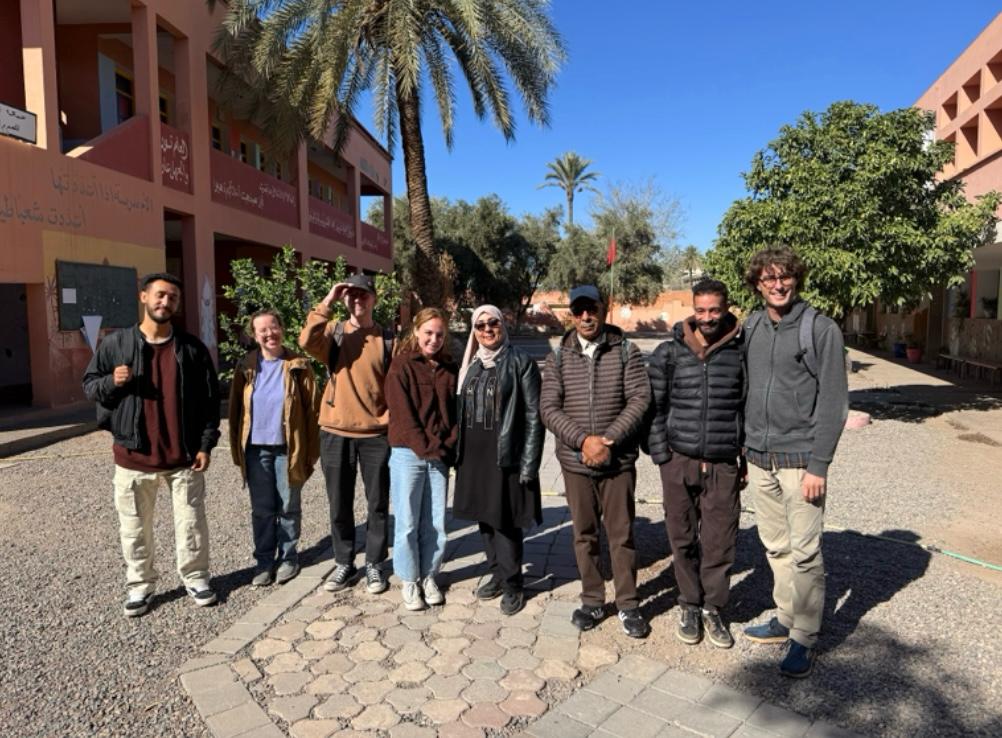
Our student group, Wahid Jamal, Hafsa Al-Alawi, Soufiane Al-Alawi, students Youssef and Ismail, and Zakaria, a worker at the Koutoubia foundation
ملاحظة تحريرية | Editorial Note:
نُشر هذا المقال في الأصل بواسطة Morocco World News.
خبر (Khabr) هي منصة إعلامية أردنية مرخّصة تعمل بالذكاء الاصطناعي.
نضيف قيمة تحريرية من خلال: تحليل ذكي للأخبار، ملخصات تلقائية، رواية صوتية بالذكاء الاصطناعي، ترجمة متعددة اللغات، وتدقيق الحقائق.
هدفنا جعل الأخبار أكثر وضوحاً وسهولةً للقارئ العربي.
This article was originally published by Morocco World News.
Khabr is a licensed Jordanian AI-powered news platform (Registration #82086).
We add editorial value through: AI-powered news analysis, automated summaries, AI audio narration, multi-language translation (Arabic, English, French, Turkish), and AI fact-checking.
Our mission is to make news more accessible and understandable for Arabic-speaking audiences worldwide.
هذا الخبر ضمن تغطية خبر لقسم تعليم.
نقدّم لك تحليلات ذكية وملخصات يومية لأهم الأخبار من مصادر موثوقة متعددة.
المصدر: Morocco World News.
يوجد 6 مقالات مرتبطة بهذا الموضوع.
This article is part of Khabr's coverage of Education.
We provide AI-powered analysis, summaries, and multi-source aggregation to keep you informed.
Source: Morocco World News.
Tags: deaf community, Marrakech, language, society.
🍪 نستخدم ملفات تعريف الارتباط لتحسين تجربتك وعرض الإعلانات المخصصة. باستخدامك للموقع، فإنك توافق على سياسة ملفات تعريف الارتباط وسياسة الخصوصية.
We use cookies to enhance your experience and show personalized ads. By using this site, you agree to our Cookie Policy and Privacy Policy.
🔍
FREEFree 1GB Internet + Free International Calls
$1 trial — eSIM in 190+ countries — No roaming charges