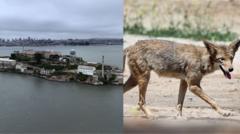
Researchers discover where coyote who made epic swim to Alcatraz really came from
•Researchers discover where coyote who made epic swim to Alcatraz really came from 1 hour agoShareSaveAdd as preferred on GoogleMax MatzaWatch: Coyote spotted swimming to Alcatraz IslandA coyote that g...
•But new DNA evidence now points to Angel Island, two miles from Alcatraz, the National Park Service said on Monday.
•However, its current whereabouts remain a complete mystery."We are surprised by the coyote's origin," National Park Service (NPS) wildlife ecologist Bill Merkle said in a news release.
هذا الخبر من BBC US & Trump News. خبر يقدم أدوات ذكاء اصطناعي للتلخيص والترجمة والاستماع.
Researchers discover where coyote who made epic swim to Alcatraz really came from 1 hour agoShareSaveAdd as preferred on GoogleMax MatzaWatch: Coyote spotted swimming to Alcatraz IslandA coyote that gained national attention for swimming to Alcatraz Island in California actually swam twice as far as originally thought to the infamous landmark, surprising researchers tracking the wild animal.The male coyote's sudden appearance in January at the site of the former federal prison in San Francisco Bay stunned scientists and tourists, marking the first time a coyote has been spotted there since 1972.Experts previously believed it swam from San Francisco, just over a mile away. But new DNA evidence now points to Angel Island, two miles from Alcatraz, the National Park Service said on Monday. However, its current whereabouts remain a complete mystery."We are surprised by the coyote's origin," National Park Service (NPS) wildlife ecologist Bill Merkle said in a news release. "Our working assumption was that the coyote made the swim from San Francisco because it is a significantly shorter distance." "We couldn't help being impressed by his accomplishment in making it to Alcatraz. Coyotes are known to be resilient and adaptable, and he certainly demonstrated those qualities."Video recorded by tourists in late January of the coyote swimming to shore through the cold, choppy waters of San Francisco Bay surprised researchers and city residents.Some took to calling him Floyd, the name of the getaway driver for gangsters Bonnie and Clyde in the eponymous movie.Officials quickly placed camera traps and audio recording devices around the island to track the animal. They also launched an effort to move him, due to concerns he would eat the native seabird population.Researchers analysed his tracks and scat, which was taken to a laboratory at the University of California (UC) Davis. The scat confirmed that the coyote was part of a population...المصدر: BBC US & Trump News | Source: BBC US & Trump News
ملاحظة تحريرية | Editorial Note: نُشر هذا المقال في الأصل بواسطة BBC US & Trump News. خبر (Khabr) هي منصة إعلامية أردنية مرخّصة تعمل بالذكاء الاصطناعي. نضيف قيمة تحريرية من خلال: تحليل ذكي للأخبار، ملخصات تلقائية، رواية صوتية بالذكاء الاصطناعي، ترجمة متعددة اللغات، وتدقيق الحقائق. هدفنا جعل الأخبار أكثر وضوحاً وسهولةً للقارئ العربي.
This article was originally published by BBC US & Trump News. Khabr is a licensed Jordanian AI-powered news platform (Registration #82086). We add editorial value through: AI-powered news analysis, automated summaries, AI audio narration, multi-language translation (Arabic, English, French, Turkish), and AI fact-checking. Our mission is to make news more accessible and understandable for Arabic-speaking audiences worldwide.