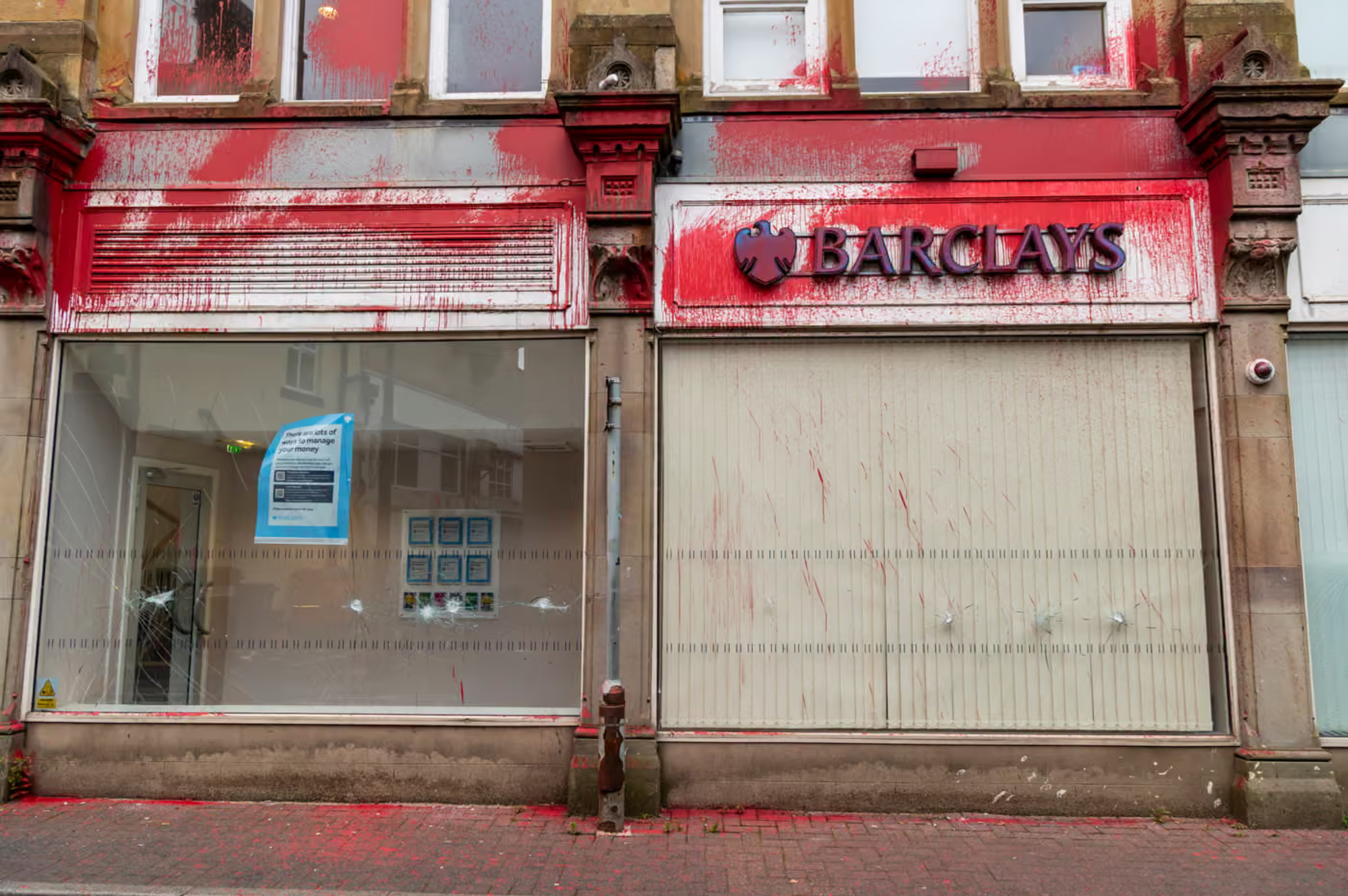
Palestine Action activists convicted of vandalising a Barclays bank branch in Burnley will not face sentencing under terrorism legislation.
Judge Altham, the Recorder of Preston, determined at Preston Crown Court that although the damage caused by the five defendants was significant, it fell short of the high threshold required for a terrorist connection to be applied.
The property targeted was not a sensitive site such as an arms manufacturer, and the scale of destruction did not compare with other incidents linked to Palestine Action, the judge found.
The group will instead be sentenced next month for criminal damage, meaning they face considerably shorter prison terms.
The five defendants, Brendon O'Hagan, 28; Amanda Kelly, 31; Hmeera Atiqnisar, 31; Mohammed Malik, 28; and Alma Yaniv, 70, were convicted in June of causing more than £200,000 in damage.
Their offence took place in August 2024.
The group smashed windows and hurled red paint at the Burnley branch in protest at Barclays holding shares in Israeli weapons firm Elbit Systems.
The prospect of terrorism sentencing only emerged after the guilty verdicts were returned.

Trial judge Philip Parry informed both sides that he planned to examine a possible "terrorist connection" to the offending.
The decision was reportedly prompted by new information that surfaced during proceedings.
Neither the activists nor the jury had been made aware that this was under consideration before the convictions were entered.
In a statement released after the ruling, the five said they were "extremely relieved that the court has seen sense".
LATEST DEVELOPMENTS
- Police arrest protesters supporting Palestine Action
- Palestine Action co-founder wins right to challenge group’s proscription
- China suspected of funding pro-Palestine marches across Britain in shocking revelation

They maintained that terrorism sentencing "should never have been an option."
The five also accused the state of "attempting to equate property damage to the Israeli war machine with terrorism."
They outlined the severe consequences a terrorism finding would have carried, including significantly harsher sentences, imprisonment under terrorist conditions, and notification obligations lasting more than 15 years after release.
These requirements would have compelled them to inform the police of any change of address, bank account, phone number, email, or relationship, with failure to comply, even accidentally, carrying a further five-year prison sentence.
The activists' legal representatives argued at Friday's hearing that four of the defendants, all except Yaniv, had acknowledged Palestine Action membership during the trial, but contended this was immaterial since the group was not proscribed as a terrorist organisation until a year after the vandalism took place.
Barclays reportedly divested all its Elbit shares in October 2024.
They previously maintained it held them solely in connection with client-driven transactions rather than as a direct investor.
Kerry Moscogiuri, chief executive of Amnesty International UK, welcomed the outcome and said: "No one should be treated more harshly under the law because their crimes were part of a protest against genocide or any other issue, and the misuse of terrorism powers in this way should never have even been considered."
Our Standards: The GB News Editorial Charter