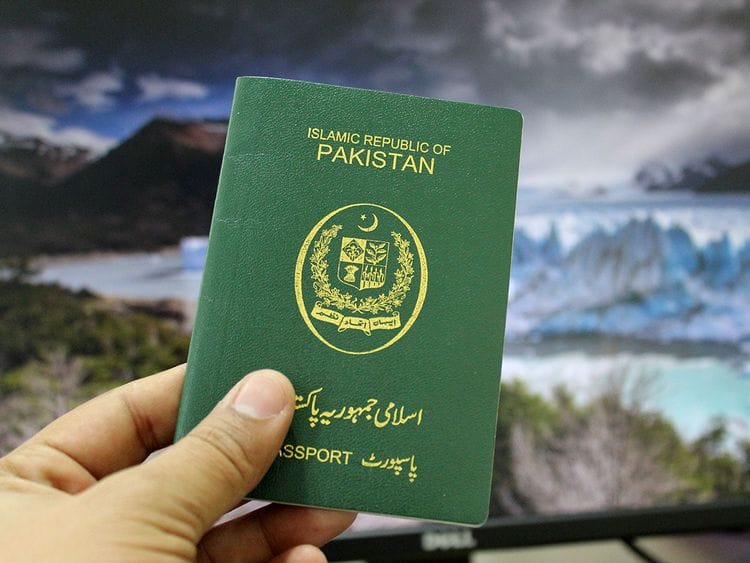
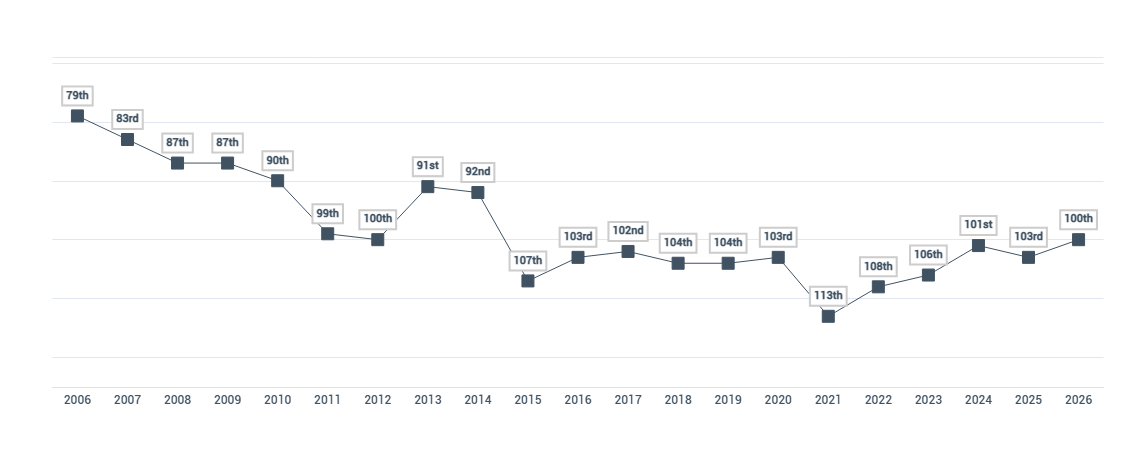
Pakistan’s passport ranking has fallen to 100th place in the latest Henley Passport Index May 2026 update, after improving earlier this year to 97th in February from 98th in January and 103rd in 2025, reflecting a year marked by fluctuating mobility performance.
Despite the latest decline, Pakistani passport holders continue to access 30 destinations through visa-free entry, visa-on-arrival (VOA), or electronic travel authorisation (ETA) systems.
Get updated faster and for FREE: Download the Gulf News app now - simply click here.
Access falls from February peak
In February 2026, Pakistani citizens had access to 32 destinations, up from 31 in January following the reinstatement of The Gambia.
However, the latest May update reduces the total to 30 destinations, highlighting ongoing adjustments in global visa policies and bilateral travel arrangements.
Year-on-year changes: 2025 vs 2026
Pakistan’s passport mobility has shown mixed movement over the past year, driven more by shifting global visa policies than a consistent upward or downward trend.
2025: Ranked 103rd globally, with access to around 31 destinations
January 2026: Improved to 98th, with 31 destinations
February 2026: Further rose to 97th, with 32 destinations
May 2026: Slipped to 100th, with 30 destinations
The trend underscores that Pakistan’s passport ranking remains highly sensitive to international visa policy changes, resulting in short-term fluctuations rather than sustained stability.
Visa-free destinations
Pakistani passport holders can travel visa-free to:
Barbados, Cook Islands, Dominica, Haiti, Micronesia, Montserrat, Rwanda, St Vincent and the Grenadines, The Gambia, Trinidad and Tobago, and Vanuatu.
Visa on arrival (VOA) destinations
VOA access is available in:
Burundi, Cambodia, Cape Verde Islands, Comoro Islands, Djibouti, Guinea-Bissau, Madagascar, Maldives, Nepal, Niue, Palau Islands, Samoa, Senegal, Sierra Leone, Timor-Leste and Tuvalu.
ETA destinations
Kenya, Seychelles and Sri Lanka require an electronic travel authorisation (ETA) prior to departure.
Full list of visa-friendly destinations
Barbados – Visa-Free
Burundi – VOA
Cambodia – VOA
Cape Verde Islands – VOA
Comoro Islands – VOA
Cook Islands – Visa-Free
Djibouti – VOA
Dominica – Visa-Free
Guinea-Bissau – VOA
Haiti – Visa-Free
Kenya – ETA
Madagascar – VOA
Maldives – VOA
Micronesia – Visa-Free
Montserrat – Visa-Free
Nepal – VOA
Niue – VOA
Palau Islands – VOA
Rwanda – Visa-Free
Samoa – VOA
Senegal – VOA
Seychelles – ETA
Sierra Leone – VOA
Sri Lanka – ETA
St Vincent and the Grenadines – Visa-Free
The Gambia – Visa-Free
Timor-Leste – VOA
Trinidad and Tobago – Visa-Free
Tuvalu – VOA
Vanuatu – Visa-Free
E-visa destinations
Electronic visa systems are increasingly simplifying travel, allowing applicants to secure entry permissions online before departure. These systems are now widely used across multiple regions.
Africa: Benin, Botswana, Burkina Faso, Cameroon, Democratic Republic of the Congo, Côte d’Ivoire, Equatorial Guinea, Ethiopia, Gabon, Guinea, Liberia, Malawi, Mauritania, Namibia, Nigeria, São Tomé and Príncipe, Somalia, South Africa, South Sudan, Tanzania, Togo, Uganda, Zambia and Zimbabwe.
Asia: Azerbaijan, Bahrain, Bhutan, Indonesia, Kyrgyzstan, Malaysia, Myanmar, Oman, Qatar, Singapore, Syria, Tajikistan, Thailand, United Arab Emirates and Vietnam.
Europe: Albania, Moldova, Türkiye and the United Kingdom.
Americas & Caribbean: Anguilla, Antigua and Barbuda, Bolivia, Colombia, Cuba, Ecuador, El Salvador, Nicaragua, St Kitts and Nevis, Suriname and The Bahamas.
Oceania / overseas territories: St Helena.
Why passport rankings change
The Henley Passport Index ranks 199 passports across 227 destinations, based on data from the International Air Transport Association (IATA). Rankings shift when countries revise visa policies, making global mobility a constantly evolving metric.
Global mobility gap remains wide
Singapore, Japan, South Korea and several European countries continue to lead the index, offering access to more than 180 destinations worldwide, highlighting the gap between top and lower-ranked passports.
What the ranking means for travellers
Experts note that changes in rankings often reflect global policy adjustments rather than sharp declines in travel freedom. Despite fluctuations, Pakistani travellers continue to benefit from access to dozens of destinations through simplified entry systems, keeping short-term travel options broadly stable.