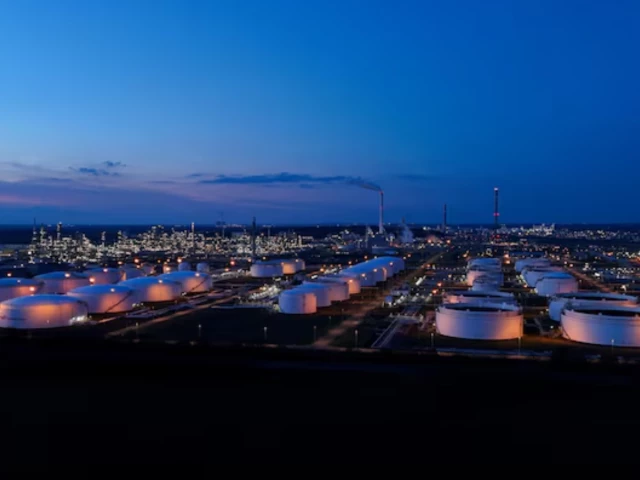
Oil rebounds as fragile Gulf ceasefire, constrained Hormuz keep supply risks elevated
Oil prices rose on Thursday as doubts over a fragile two-week Middle East ceasefire raised concerns that energy flows through the crucial Strait of Hormuz will remain restricted. Brent crude futures were up $1.96, or 2.07%, at $96.71 a barrel at 0325 GMT, while US West Texas Intermediate (WTI) crude rose $2.60, or 2.75%, to $97.01 a barrel. Both benchmark prices fell below $100 per barrel in the previous trading session, with WTI recording its biggest decline since April 2020, on initial expectations for the ceasefire to result in a reopening of the strait. However, analysts said market participants are hesitant to fully unwind pricing for geopolitical risk, and there is no clarity on what negotiations between the US and Iran would mean for oil flows. "The chances of a meaningful reopening (of the Strait of Hormuz) any time soon look dim," said Vandana Hari, founder of oil market analysis provider Vanda Insights, predicting continued volatility in oil prices. "The futures market looks a bit broken," she said. Otherwise, "prices should have snapped right back to pre-ceasefire levels by now". Read: Oil dives below $100, stocks jump after two-week ceasefire agreed The vital waterway connects supply from Gulf producers such as Iraq, Saudi Arabia, Kuwait and Qatar to global markets, and typically carries about 20% of global oil and gas supply. The viability of the ceasefire is in question with Israel continuing to attack Lebanon on Wednesday, causing Iran to suggest it would be "unreasonable" to proceed with talks to forge a permanent peace deal. Shippers on Wednesday also said they needed more clarity on the terms of the ceasefire before resuming transit through the Strait of Hormuz. Iran has issued maps to guide ships around mines in the waterway and designated safe paths for passage in coordination with the country's Revolutionary Guards, Iranian media reported. "Logistic disconnects, security fears, elevated insurance premiums and operational constraints mean that very little additional energy is likely to be supplied via the Strait of Hormuz in the next two weeks," analysts at Standard Chartered said in a note. Regional oil facilities also remain under threat, with Iran striking sites in nearby countries after the ceasefire, including a pipeline in Saudi Arabia that has been used to bypass the blockaded Strait of Hormuz, according to an oil industry source. Kuwait, Bahrain and the UAE also reported missile and drone attacks. Meanwhile, Goldman Sachs kept its third- and fourth-quarter oil price forecasts unchanged at, respectively, $82 and $80 for Brent, and $77 and $75 for WTI. The investment bank lowered its second-quarter forecasts for Brent to $90 and WTI to $87, "given the reduction in risk premium at the front of the curve", with oil flows through the Strait of Hormuz "already edging up".المصدر: Express Tribune | Source: Express Tribune
ملاحظة تحريرية | Editorial Note: نُشر هذا المقال في الأصل بواسطة Express Tribune. خبر (Khabr) هي منصة إعلامية أردنية مرخّصة تعمل بالذكاء الاصطناعي. نضيف قيمة تحريرية من خلال: تحليل ذكي للأخبار، ملخصات تلقائية، رواية صوتية بالذكاء الاصطناعي، ترجمة متعددة اللغات، وتدقيق الحقائق. هدفنا جعل الأخبار أكثر وضوحاً وسهولةً للقارئ العربي.
This article was originally published by Express Tribune. Khabr is a licensed Jordanian AI-powered news platform (Registration #82086). We add editorial value through: AI-powered news analysis, automated summaries, AI audio narration, multi-language translation (Arabic, English, French, Turkish), and AI fact-checking. Our mission is to make news more accessible and understandable for Arabic-speaking audiences worldwide.