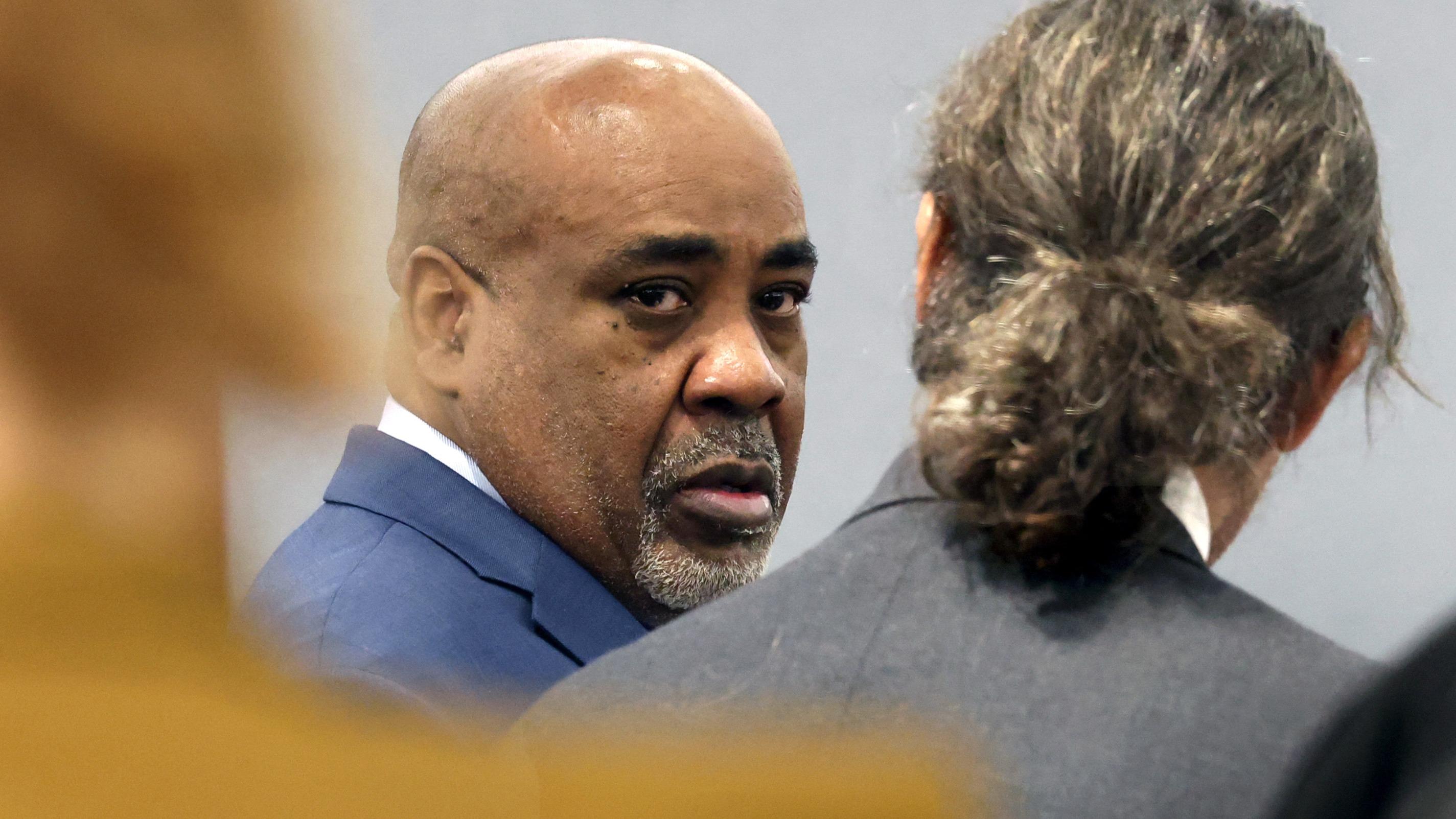
The Portland Trail Blazers of the late 1990s and early 2000s were called the "Jail Blazers" for their conduct on and off the court. Jonathan Ferrey / Getty Images Share full articleThe Portland Trail Blazers of the late 1990s and early 2000s were one of the NBA’s great experiments. The team was talented enough to win a championship, but it also was a combustible combination of parts, players with checkered pasts and off-court run-ins with the law that alienated fans. Those years were chronicled in “Untold: Jail Blazers,” a documentary that debuted Tuesday on Netflix. The documentary details how the team picked up the infamous “Jail Blazers” moniker and includes former general manager Bob Whitsitt explaining why he continued to add roster players with problematic backgrounds, in addition to why a team that nearly derailed the 2000 NBA champion Los Angeles Lakers was broken up. It’s also a look at how a player’s culture can clash with a community, as well as why a team that didn’t win a championship remains topical 26 years later. The film focuses on three of the team’s biggest stars at the time — Rasheed Wallace, Damon Stoudamire and Bonzi Wells — along with Whitsitt. It’s a fascinating look at how a group of players who became a symbol for all, at the time, considered wrong with the NBA reflected on what it meant to wear that label then, and what it means now as men in their late 40s and early 50s. There were several stories involving legal matters. Wallace and Stoudamire were passengers in a car that was stopped for speeding after a December 2001 game in Seattle and later cited for marijuana possession. Wallace already had a reputation of racking up technical fouls during games. He has the single-season record with 41 during the 2000-01 season. Stoudamire was arrested again on marijuana charges in 2003 and then suspended by the Blazers. Six-time All-Star Shawn Kemp, who was drafted in 1989 by the Seattle SuperSonics when Whitsitt was there as GM, was acquired by Portland via trade in 2000. Kemp, however, checked into a drug rehab center because of cocaine use during the 2000-01 season, one which Portland lost 10 of its final 13 games. Additionally, Ruben Patterson had to register as a sex offender in 2001 after being charged with attempted rape. And though other players were not criticized for any crime, Wells had to answer to an article suggesting that he hated the Portland fans. There was a noticeable reputation, one of notoriety, for a group of athletes whose off-court incidents got in the way of their on-court abilities. “In the moment, you kind of wore it as a badge of honor. We had the Bad Boys of Detroit and the Showtime Lakers,” Wells told The Athletic. “But when you get older, you’re just like, man, that really wasn’t cool.” Stoudamire, a Portland native, was the 1995-96 NBA Rookie of the Year with the Toronto Raptors. He was traded to the Blazers in February 1998. Stoudamire had three legal situations involving marijuana during his time in Portland. In 2002, it was ruled that police illegally entered his Lake Oswego, Ore., home and found marijuana after citing an alarm as reason for entering. It’s the same community where Stoudamire said he was once pulled over by police three times in one day. Stoudamire said he, Wallace and other Blazers did a lot of positive work in the community. And while he’s not naive to think their troubles wouldn’t make the news, he thinks the “Jail Blazers” tag overshadowed a lot of the good. “I looked at it a little bit differently from Portland, because that’s like a mark on the city,” Stoudamire told The Athletic. “I thought it was disrespectful, at times, with a little racial undertone with it.” There was clearly a disconnect between Portland fans and the team. And the chasm grew with each incident. A post shared by Chapman Way (@chapmanway) The documentary reminds viewers that the Blazers arrived as a force during a time when Michael Jordan had long been the face of the league. Culturally speaking, stars were transitioning from wearing suits to throwback jerseys and flashy jewelry. Shows like “MTV Cribs” highlighted how the hip-hop lifestyle was becoming preeminent in the NBA, before the league’s dress code would arrive to somewhat curb the impact in 2005. But the Blazers were good on the court, peaking by reaching the 2000 Western Conference finals. After rallying from a 3-1 deficit to force a Game 7 in Los Angeles, the Blazers blew a 16-point lead late in the third quarter to lose 89-84 at the Staples Center. The Lakers went on to beat the Indiana Pacers in the NBA Finals. The Lakers then swept the Blazers in the first round of the playoffs the next two years. The film shows how Whitsitt became a target of anger. His nickname, “Trader Bob,” led him to make deals that didn’t keep the team together. Whitsitt, in the film, said he had to “be innovative” and “young in your thinking” to find success. “I don’t think we needed to fix anything; it wasn’t broke,” Stoudamire said. “We just … we had some bad breaks. “I don’t think people understood back then how tough that was, to adjust when you bring new guys in. It just was a matter of them not adjusting. I just don’t think that off-the-court stuff had to do with it. We were good enough.” In what may be considered an unexpected turn, some of the players from those teams eventually became coaches. Stoudamire was the head coach at Georgia Tech from 2023-26 and is now an assistant at LSU. He was also the head coach at Pacific from 2016-21. Stoudamire said after rehabilitating from his marijuana issues, he studied addiction and worked with former NBA player John Lucas, believing he can connect with players dealing with similar personal issues. Stoudamire went to rehab following a July 2003 arrest in Arizona. “When I talk to these guys about the trouble that I actually got into, it allows me to be one of them,” Stoudamire said. “If they get into trouble, I sit back and just tell them, ‘You know my story.’” Wells was an assistant on Stoudamire’s staff and was head coach at Division II LeMoyne-Owen College, a historically Black college in Memphis. Wells’ ability to bounce back from what Stoudamire called unfair scrutiny during their days with the Blazers has been useful in his coaching career. He’s able to help younger players channel negative energy and turn it into a positive. “That’s kind of my superpower, being relatable to these kids, kind of being able to get on their level,” Wells said. “Understanding them, being able to get in where I could talk to them and then being able to (have them) trust me enough to talk to me … that’s bigger than basketball.” The “Jail Blazers” moniker still being a topic of discussion more than two decades later serves as a reminder of multiple things. NBA fans remember both their talent and the off-the-court issues. There was no social media in the late 1990s and early 2000s, so players weren’t able to tell their stories as readily. There was also a different stigma with marijuana then. The NBA stopped testing for cannabis prior to the NBA bubble in 2020 and no longer tests players as part of the new collective bargaining agreement. Whitsitt, however, noted in the film that, from his perspective, there’s a reason why the name stuck. “You can’t have a moniker with a bad team,” he said. Wells hopes viewers of the film will see everything beyond the “Jail Blazers” talk. “I want people to understand that we were good dudes, community dudes, family dudes,” Wells said. “I mean, there’s dudes that really understand that they have self-awareness of themselves and the family they represent. And people don’t truly understand that was so important to us.” “I hope viewers see the human interest,” Stoudamire added. Spot the pattern. Connect the terms Find the hidden link between sports terms Jason Jones is a staff writer for The Athletic, covering Culture. Previously, he spent 16 years at the Sacramento Bee, covering the Sacramento Kings and Oakland Raiders. He's a proud Southern California native and a graduate of the University of California at Berkeley Follow Jason on Twitter @mr_jasonjones
المصدر: The Athletic
| Source: The Athletic
ملاحظة تحريرية | Editorial Note:
نُشر هذا المقال في الأصل بواسطة The Athletic.
خبر (Khabr) هي منصة إعلامية أردنية مرخّصة تعمل بالذكاء الاصطناعي.
نضيف قيمة تحريرية من خلال: تحليل ذكي للأخبار، ملخصات تلقائية، رواية صوتية بالذكاء الاصطناعي، ترجمة متعددة اللغات، وتدقيق الحقائق.
هدفنا جعل الأخبار أكثر وضوحاً وسهولةً للقارئ العربي.
This article was originally published by The Athletic.
Khabr is a licensed Jordanian AI-powered news platform (Registration #82086).
We add editorial value through: AI-powered news analysis, automated summaries, AI audio narration, multi-language translation (Arabic, English, French, Turkish), and AI fact-checking.
Our mission is to make news more accessible and understandable for Arabic-speaking audiences worldwide.