Myanmar Military Regime Sanitary Towel Ban Highlights Gender-Based Violence of War
•Rabat – Myanmar’s military regime is broadening its ban on sanitary pads, claiming the resistance People’s Defense Force (PDF) are using them as first aid.
•The military is “saying menstrual products are used by the People’s Defence Force for medical reasons and as support for their feet and boots to absorb sweat and blood,” said Thinzar Shunlei Yi, a dir...
•While the government has not officially confirmed the policy, reports indicate a blockade on sanitary products since August.
هذا الخبر من Morocco World News. خبر يقدم أدوات ذكاء اصطناعي للتلخيص والترجمة والاستماع.
المصدر: Morocco World News | Source: Morocco World NewsRabat – Myanmar’s military regime is broadening its ban on sanitary pads, claiming the resistance People’s Defense Force (PDF) are using them as first aid.
The military is “saying menstrual products are used by the People’s Defence Force for medical reasons and as support for their feet and boots to absorb sweat and blood,” said Thinzar Shunlei Yi, a director at Sisters2Sisters, a women’s rights collective that supports fighters.
While the government has not officially confirmed the policy, reports indicate a blockade on sanitary products since August.
The restrictions fueled a black market for sanitary pads, which skyrocketed the price of a single pad from around 2,000 kyat to around 6,000 kyat. This surge puts an enormous burden on women as the average daily income for a person is only 15,000 kyat.
“Banning of the menstrual products in Myanmar is an act of gender-based violence,” Sisters2Sisters said in a post.
Meredith Bunn, an aid in Myanmar and founder of the medical aid charity Skills for Humanity (SFH), also spoke out against the ban on social media, calling it “yet another form of oppression against women.”
Bunn further dismissed the military’s excuse that resistance fighters are using them for first aid as “ignorant and completely uneducated.” Instead, she elaborated, “most medics in combat understand the use of tampons or sanitary pads is a dangerous myth if anything … they would quickly saturate, and are not effective for packing to stop bleeding.”
Henriette Ceyrac, founder of a period education organisation, Pan Ka Lay, in Myanmar before its forced closure, said women were now forced to use unsafe alternatives including rags, leaves, and newspapers.
Sisters2Sisters indicated they receive regular requests for antibiotics to treat UTIs, likely stemming from the women’s use of unsanitary materials. Shunlei Yi said women were uncomfortable with some choosing to stay indoors during their periods.
Activists have long argued that the ban is a deliberate attempt to further limit women’s mobility and ability to contribute to resistance fights.
The Office of the United Nations High Commissioner for Human Rights found “alarming” levels of sexual violence committed by both the military and resistance forces.
According to the UN office, “rape and other forms of sexual violence were part of a deliberate strategy to intimidate, terrorize, and punish a civilian population, and were used as a tactic of war,” particularly targeting Rohingya and ethnic groups in northern Myanmar.
Widespread humanitarian crisis
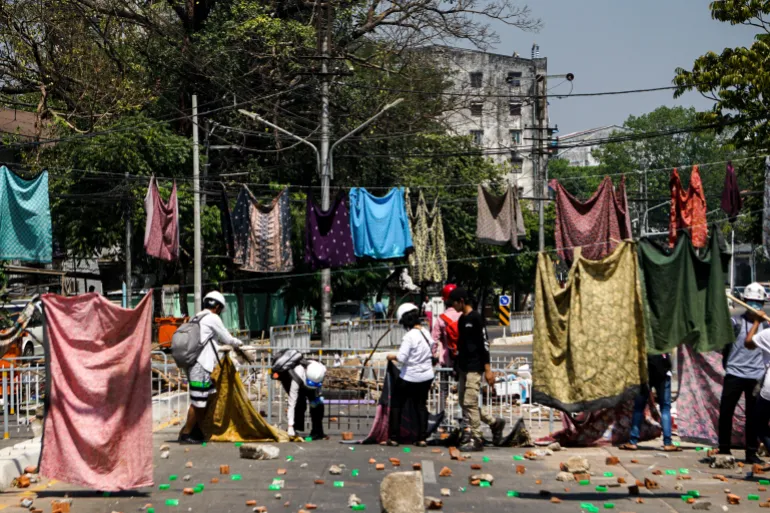
Myanmar’s military seized power from the elected Aung San Suu Kyi government in a February 2021 coup, triggering mass protests that were met with lethal force, and saw many civilians taking up arms with the PDF, as well as varied ethnic armed resistance groups.
A 2024 investigation by the BBC indicated that the military only controlled 21% of territory. The military’s repeated bombing of civilian sites, mass killings and torture have been described as a desperate attempt to cling to power.
Since the coup, more than 3.2 million people have been internally displaced since the coup. The majority live in makeshift shelters and open fields with limited access to food, health care, and water.
Sister2Sister volunteers were recently blocked from administering aid in the Sagaing region, an area doubly affected by war and a catastrophic 7.7 magnitude earthquake last year which left at least 3,700 dead and significantly damaged farmland and infrastructure.
Monsoon rains and Typhoon Yagi caused widespread flooding in September, killing hundreds and affecting an estimated 1 million.
Even prior to the flooding, at least 18.6 million people were in need of humanitarian assistance.
Monasteries largely opened their doors as emergency shelters, but recent attacks show that nowhere is safe for civilians.
In the past weeks, there have been increased reports of the military air striking monasteries, killing monks and civilians in what Shunlei Yi told ABC was an attack on “the heart of our faith: the Buddhist monkhood and our religious spaces.”
“Once they bomb monasteries — places that support the community — it’s an attack on people’s mindset, the mindset of resistance,” she said.
The post Myanmar Military Regime Sanitary Towel Ban Highlights Gender-Based Violence of War appeared first on Morocco World News.
ملاحظة تحريرية | Editorial Note: نُشر هذا المقال في الأصل بواسطة Morocco World News. خبر (Khabr) هي منصة إعلامية أردنية مرخّصة تعمل بالذكاء الاصطناعي. نضيف قيمة تحريرية من خلال: تحليل ذكي للأخبار، ملخصات تلقائية، رواية صوتية بالذكاء الاصطناعي، ترجمة متعددة اللغات، وتدقيق الحقائق. هدفنا جعل الأخبار أكثر وضوحاً وسهولةً للقارئ العربي.
This article was originally published by Morocco World News. Khabr is a licensed Jordanian AI-powered news platform (Registration #82086). We add editorial value through: AI-powered news analysis, automated summaries, AI audio narration, multi-language translation (Arabic, English, French, Turkish), and AI fact-checking. Our mission is to make news more accessible and understandable for Arabic-speaking audiences worldwide.