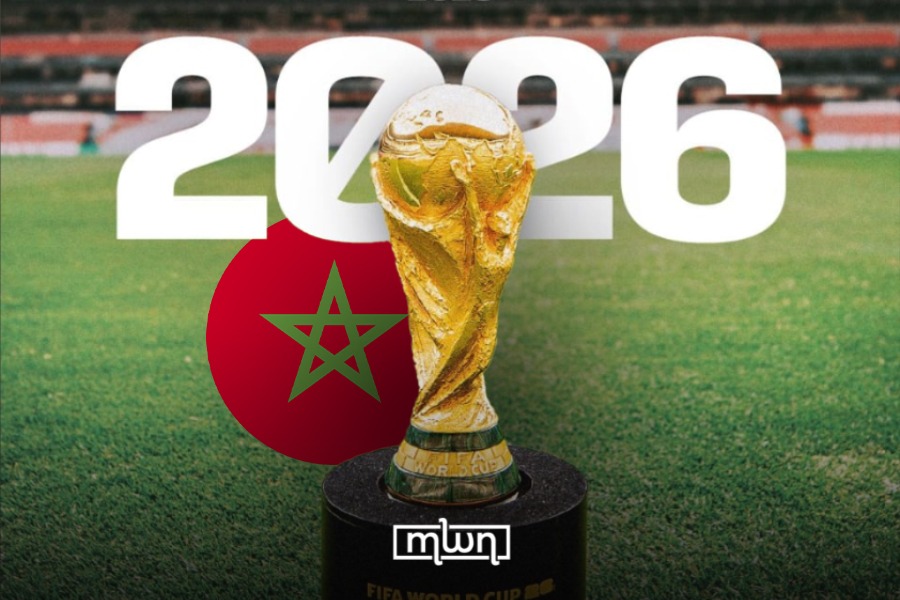
Rabat – For the first time in history, eight Arab nations will take part in a single World Cup, marking a defining shift in the global football stage. Beyond the numbers, and just by looking at the bigger picture, the growing influence of Moroccan football philosophy is not to be neglected.
The 2026 FIFA World Cup, hosted by the US, Canada, and Mexico, will be remembered not only for its expanded format but also for its historic inclusivity. The expansion from 32 to 48 teams has significantly increased opportunities for both African and Asian nations, allowing Arab football to reach unprecedented visibility.
In previous editions, Arab participation remained limited. Only four Arab teams qualified for the 2018 FIFA World Cup and the 2022 FIFA World Cup. Earlier tournaments saw even fewer representatives, with just one Arab nation flying the flag in the 2014 FIFA World Cup and the 2010 FIFA World Cup.
That number has now dramatically changed. Eight Arab teams: Morocco, Tunisia, Egypt, Algeria, Saudi Arabia, Qatar, Iraq, and Jordan, will take part in the 2026 edition, a direct result of the tournament’s expansion.
Jordan’s historic breakthrough under Sellami
While the expansion can be explained by the numbers, the story behind each team’s qualification is what gives history its meaning. One of the most remarkable stories of this edition is that of Jordan, which qualified for the first time in history under the leadership of head coach Jamal Sellami.
Jordan has qualified for the World Cup for the first time since the tournament was launched in 1930. Sellami’s work reflects what many now describe as “the Moroccan school of coaching,” a term used by CAF itself, describing an approach built on tactical discipline, modern training methodologies, and strong player management. Jordan’s qualification under his guidance reinforces the idea that Moroccan expertise is no longer confined to the national level but is actively shaping football development across the region.
It is noteworthy that Sellami is the second Moroccan head coach in a row for the Jordanian team, preceded by Hussein Ammouta, who led the squad to a historic AFC Asian Cup campaign in 2024, reaching the final for the first time after a 2-0 semi-final victory over South Korea.
Beyond that tournament, Ammouta orchestrated a successful campaign in the 2026 World Cup qualifiers, guiding the team to the top of their group in the second round ahead of Saudi Arabia. Through a high-intensity tactical system that maximized stars like Mousa Al-Tamari and Yazan Al-Naimat, he laid the essential groundwork for Jordan’s eventual successful qualification for their debut World Cup.
Morocco: an example for the Arab World
At the center of this transformation stands Morocco, a nation whose footballing experience is now head and shoulders above the rest in the Arab world.
Morocco’s historic run to the semi-finals of the 2022 FIFA World Cup was not a coincidence but the result of years of strategic planning, investment in infrastructure, and the development of world-class talent. Today, Morocco is no longer just an African, and Arab powerhouse; it is also emerging as a serious force on the global stage.
This dominance is also reflected in coaching. Alongside Sellami, Morocco will be represented on the bench by national team coach Mohammed Ouahbi, further emphasizing the country’s growing technical leadership.
Notably, only three of the eight Arab teams, Morocco, Egypt, and Tunisia, will be coached by managers of the same nationality.
History of the eight Arab teams at the World Cup
1 – Morocco:
Morocco has established itself as the most successful Arab country in World Cup history. After becoming the first African team to top a group in 1986, the Atlas Lions reached new heights in 2022 by defeating Spain and Portugal en route to a historic semi-final finish, the first ever by an African and Arab country.
2 – Tunisia:
A consistent presence on the global stage, Tunisia made history in 1978 by becoming the first African team to win a World Cup match. Despite multiple appearances, they are still chasing a place in the knockout rounds, though their victory over France in 2022 proved their competitiveness.
3 – Egypt:
Egypt holds a historic legacy as the first African and Arab nation to participate in a World Cup in 1934. Despite their continental dominance, including multiple AFCON titles, their World Cup journey has been marked by limited success and long absences.
4 – Algeria:
Algeria is known for its iconic 1982 victory over West Germany and its impressive 2014 campaign, where it reached the Round of 16 and pushed eventual champions Germany to extra time in a memorable clash.
5 – Saudi Arabia:
Saudi Arabia has been one of Asia’s most regular representatives. Their best performance came in 1994 when they reached the Round of 16, while their shock win over Argentina in 2022 remains one of the tournament’s greatest upsets.
6 – Qatar:
Qatar made its World Cup debut as host in 2022. Although their campaign ended in the group stage, their rapid football development continues to attract attention.
7 – Iraq:
Iraq participated in its only World Cup in 1986. Their return to the global stage marks a significant moment for a nation with a passionate football culture.
8 – Jordan:
Jordan’s qualification for the 2026 FIFA World Cup is a historic first. Under the leadership of Jamal Sellami, the team has achieved an unprecedented milestone, symbolizing both national progress and the growing influence of Moroccan coaching abroad.
A regional rise led by a Moroccan model
The presence of eight Arab nations at the 2026 FIFA World Cup is a reflection of a region in transformation. Yet within this collective rise, one model clearly stands out.
The post Morocco’s Football Model Shapes Arab Representation At The 2026 World Cup appeared first on Morocco World News.