Everything in the world is about food, apart from restaurants, which are about real estate. That’s what Jeremy King, the Pater Patriae of the London restaurant scene, would have you believe, anyway. Building first, menu second, chef third – it’s the formula for making a success of a place, he tells me. He would know: he might have the best CV in the ecosystem. Just don’t tell Alain Ducasse or Keith McNally. Or any of the other ego-forward characters of the hospitality world, for the matter. King is 6ft 5in at the very least, taller than the rest of them.
In the 1980s he was looking after Princess Diana at Le Caprice, around the back of the Ritz in Green Park, with his business partner Chris Corbin. He is the brains behind the Wolesley just a few doors down, the vaulted bank-cum-restaurant famous for breakfast and the ambient presence of AA Gill. The pair also created the Delaunay, off the Strand, a kind of Mitteleuropa grand café; and Brasserie Zedel in a basement in Picadilly Circus. They made the Ivy the locus of London’s B-list scene in the 1990s. At J Sheekey’s they served lobster to the West End enthusiasts. Among their diners? Lucian Freud, Joan Collins, the Beckhams, Salman Rushdie. All of this has conspired to make King very beloved indeed. That, and the attendant patrician manners.
We are sitting at a corner table of his new restaurant, Simpson’s in the Strand. It is a Friday before 10am, and he seems anxious to tell me that it is busier at lunch. The enormous room – perhaps only the Hagia Sophia has higher ceilings – is already 75 per cent full. In another manicured understatement, he says dinner is “oversubscribed”. I check. The only table I can get for this week is 9.45pm on a Tuesday. King – white-haired, phlegmatic, Saville Row’d, 71 – is expounding his philosophy (or trotting out platitudes) about the industry (“the beauty of restaurants is they defy the formulaic method”) before pausing.
“Oh, so you turn it to its side,” he says, watching me struggle with an ergonomically unintuitive tea strainer. “Like this,” he mimes slowly and theatrically in the air. “They are confusing,” he reassures me quietly, though his eyes add “doofus”. King has never actually said anything so bad-mannered out loud, of course. I look down at my phone, which is recording the conversation on the table between us, and feel embarrassed by the state of it: grimy, the plastic case weathered by the elements, peeling off around the corners. Then I see the black ink stains I have idly inflicted on the white tablecloth. Forgive me, Jeremy!
And then, oh no, there it is, the worst thing that can happen to a professional interlocutor: I realise that I want him to like me. Such is the by-product of conversation with anyone so studied in the art of charm. But it is not just me: a steady stream of customers stop by our table on their way out and personally thank him (who knew breakfast could inspire such devotion?); one woman was particularly touched to have received an “Anniversary Plate” (no idea) from the kitchen – “well, it’s a special occasion,” he demures. You would be forgiven for thinking she was a plant, but customers really do love King. He inspires something of the parasocial – that one-sided intimacy, where the clientele really believe they know the restaurateur. I might think someone was my friend if they remembered my anniversary too. But for King, that’s the quotidian work. In a speech given to the Association of Jewish Refugees five years ago he admitted as much. How does one run a restaurant? “You learn your lines, you practice, you rehearse and then suddenly it’s makeup, costumes and the curtain’s up and you’re performing.”
He’s been performing since 1981, when Caprice – shuttered for six years –reopened. But in 2022 King lost it all in a bidding war to the majority stakeholder, Thai billionaire William Heinecke’s Minor International. He and Corbin were ousted from the Corbin & King group and had to say goodbye to the Wolseley, Delaunay, et al. But King was not in exile for long – something about his stoicism, experience or possibly self-regard made his return to the scene inevitable.
First he opened Arlington in early 2024 in the same building as Caprice, the whole thing an homage to the Diana years. Months later he opened the Park in Queensway: a kind of contemporary take on the Delaunay, or maybe “an American Wolseley” as Giles Coren raved in the Times. Simpson’s, though, is the real middle finger. First opened in 1828, it closed during the pandemic, only for King to swoop in and reopen it this spring with his new group, Jeremy King Restaurants. For King, the inspiration for a project comes from the building – too many bad restaurateurs ruin real estate, he says, by forcing a culinary concept that is not sympathetic to the architecture. Who would put, say, the Ritz on Swiss Cottage roundabout? Or a contemporary Italian bistro in an English thatched pub?
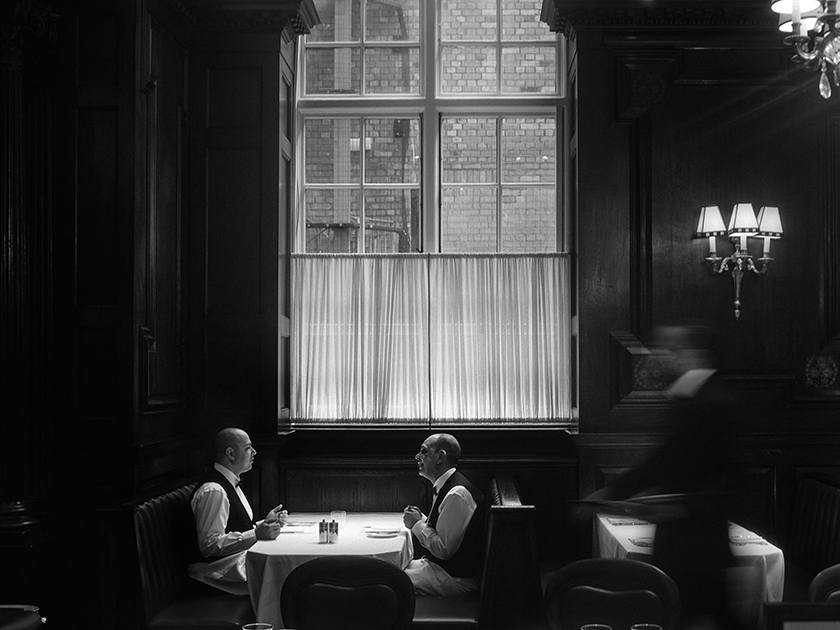
Well, if the building is an expression of something deeper about the restaurant then we might learn something about King’s ambitions (or resentments?) from number 100 on the Strand too. It’s huge – enough to contain two restaurants and two bars, and possibly a train station. We are in the Grand Divan: banquettes, oak panel, white linen, oysters, quail, Woolton pie, boiled ham and parsley sauce. This is reactionary dining, the spiritual opposite of pan-European small plates. No one in here knows what yuzu is or would tolerate cloudy orange wine. At breakfast, a condiment trolley trundles past – King singles out the mustard. “I have never seen that before,” I remark. “Soon, Finn, there will be a lamb trolley!” he replies. “Maybe salmon…” he stares into the middle distance.
King is a man who thinks in analogies and speaks in tangents. Our conversation is discursive, meandering. I ask about the process of appointing a head chef, and soon he is explaining the migratory patterns of European Jews in the Thirties, with a few sideline comments about the design ethic of mid-century Vienna. And what has it been like setting up three restaurants in such close succession, so soon after being ousted from your own company? This question returns three similes: restaurants are like foals learning to walk; the daunting task of learning to drive stick; the process of maintaining dramaturgical standards across a long run on the West End.
It is not always so abstract. “You run restaurants from the floor,” he says imperiously. If you spend too much time away or in the boardroom, things get out of hand. I understand – minor adjustments to service here, an extra crack of black pepper there, all of a sudden the restaurant has Theseus-ly shipped itself into a new thing entirely. Precisely, he responds. You must be present, just as a director is of a play. There’s that theatre analogy again. It’s a time-worn tale: when Masayoshi Takayama of (beloved New York sushi spot) Masa fame opened a second location in London, he lost a Michelin star. Constrained by the laws of time travel, unable to be in both cities, his standards slipped.

Trolley mecca or not, King’s food is not designed with a star in mind. The New York Times glibly predicted that the “hottest dining trend” of 2025 would be “hospitality” (how recherché). And King might be the ultimate embodiment of that principle: the rooms are warm, the menus unchallenging, the manners impeccable, the staff uniform perfectly pressed, the conviviality is studied and precise. Jeremy – and do call him Jeremy – will bring you a newspaper by hand while you wait for a tardy friend. No, what we have here is not a restaurant for people who like food but a restaurant for people who like restaurants.
That used to be the norm. The concept of the “signature dish” didn’t really emerge until the 1980s, the celebrity chef only came into his full powers in the 1990s. After 2008, restaurateurs and landlords alike became anxious about taking out long leases – the customary 25 years became compressed to an average of ten. Interiors became parsimonious and minimal – why pour cash into a space you are only guaranteed to have for such a short time? And so, that bare wall, concrete floor, A12 paper menu and bland aesthetic emerged. The economics begot the tastes, and places like Simpson’s began to read as terribly unfashionable altogether.
Pendulum swing alert! Maybe Simpson’s present popularity is an overcorrection. It is, in the very least, evidence that all styles fall in and out of favour, that everyone is vulnerable to looking dated eventually. Were you to ask King, he might say that the turbo-foodie, “cheffy” incarnations of the restaurants – the foams, the sea moss, the eight courses – are modern aberrations. “Those restaurants are of no interest to me,” he says. “I find them actually intrusive. You’re interrupted to be told everything about one little mouthful. I find it boring.” He is insistent – or as insistent as someone so mild-mannered can be – that customers would be more likely to return somewhere with average food and great service, and never the other way round. “We are in a realm where people really want to be looked after” he said. Was that a subconscious self-defence?
Maybe he is right. The restaurant world undulates, skipping through trend cycles at a clip; passing off fads as permanent fixtures (now everyone talks about Planque; has anyone spoken of Dabbous for a decade?). In fact, the shelf life of popular places is increasingly shorter – blame rents, blame the hastening effects of the internet. But the point of scenes is that they change, migrate and move on. King, save a few missteps, has endured, even if no one is writing home about the contents and precise quality of their lunch. King has leveraged his innate sentimentality into a profit-making empire.
“I have an inherent egalitarian streak,” King tells me. He is keen to stress the “parsimonious” diner receives the same treatment as the “more affluent”– he has a soft spot for the solo eater, an annoyance to most restaurants. Maybe that’s just the kind of guy he is. But I think of the Oxonian neo-Marxist GA Cohen’s 2000 treatise, If You’re an Egalitarian, How Come You’re So Rich?. Or more specifically, I am minded to ask if a man so famed for his ability to cultivate scenes and “safe spaces” for celebrities could really be cast as someone so democratic? I am even less convinced when he tells me he may turn the downstairs bar into a members-only spot (to avoid entertaining “difficult people”). That is, I suspect, just the catch when it comes to running good restaurants. But I am still trying to work out if Simpson’s is a relic, or a mausoleum – is it just a fun gimmick to step into the high-ceilinged, roast beef-trolleyed past, as the rest of the world moves on? Or, is King at the cutting edge of a movement? A vanguard of the reactionary dining revolution that will see all this “pressed Fuseau artichoke” and “aerated mussels” fall out of fashion?
We know that King is a performer first. What does that make Simpson’s? A pre-crash, pre-globalised mise-en-scène for the performance. A comforting set piece for those troubled by modernity. Which might be everyone, now.
[Further reading: The British Museum: is the bread here older than the exhibits?]