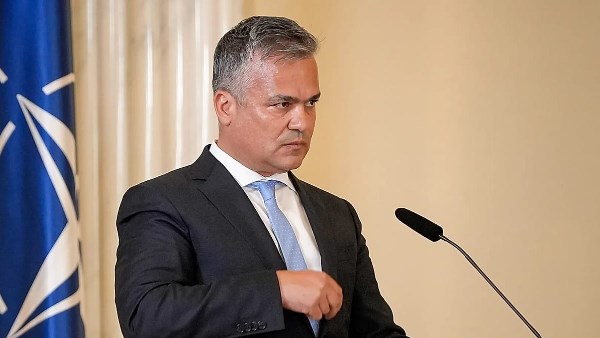
Iran's Hormuz chokehold shrewd but illegal move — former Austrian foreign minister
russian news agencyRUSearchSectionsCloseEconomySportsCulture CloseRussian Politics & DiplomacyRussian Politics & DiplomacyInto section →FOREIGN POLICYDOMESTIC POLICYWorldWorldInto section →Business & EconomyBusiness & EconomyInto section →Oil & gas industryInternet & TelecomTrade & CooperationTransportMilitary & DefenseMilitary & DefenseInto section →Science & SpaceScience & SpaceInto section →Emergencies Emergencies Into section →Society & CultureSociety & CultureInto section →Press ReviewPress ReviewInto section →SportsSportsInto section →Special projectsTASSAgencyTASS todayHistoryManagementContactsProjects & ServicesTASS-PHOTONEWS TERMINALPersonal data processing policy TASSPress ReleasesPrivacy Policy tass.comTerms of useANTI-CorruptionSubscribeSocial MediaTelegramSubscriptionsRSSAdvertisingContacts{{dayPoint.date | date : 'd MMMM yyyy'}}{{newsPoint.date * 1000 | date : 'HH:mm'}} {{newsPoint.mark}}{{newsPoint.title}}{{newsPoint.title+ ' '}}{{newsPoint.subtitle}}All newsStrait of Hormuz developmentsIran's Hormuz chokehold shrewd but illegal move — former Austrian foreign minister Karin Kneissl noted that "free passage of ships" through the Strait of Hormuz is currently effectively "impossible"MOSCOW, May 7. /TASS/. It makes sense why Tehran moved to establish control over shipping in the Strait of Hormuz in response to US-Israeli aggression, but what it's doing is still illegal, former Austrian Foreign Minister and head of the G.O.R.K.I. Center at St. Petersburg State University Karin Kneissl said in an interview with TASS. "In part, I understand Iran, because in this way it can give a response to the brutal attack by Israel and the United States. On the one hand, Iran has attacked US bases in Arab countries in the Persian Gulf; on the other, it has established partial control over the Strait of Hormuz," she said. Kneissl noted that "free passage of ships" through the Strait of Hormuz is currently effectively "impossible." "On one side you have Iran, on the other Oman. Iran and Oman exercise a certain degree of territorial control there. But this does not mean the Strait of Hormuz is Iran’s national waterway. Under international maritime law, the principle of free passage applies there," the former foreign minister said. "Iran has effectively taken control of the Strait of Hormuz. As such, it is allowing ships bound for China and other Asian countries to pass through. It is also permitting passage for ships that pay a certain fee. In other words, this is not exactly a blockade, but rather a form of control. And it violates international law," Kneissl stated. Commenting on Operation Project Freedom, previously announced by US President Donald Trump and later suspended, she suggested that such a move "could have led to clashes." "But I don’t want to speculate on the possible consequences," the analyst added.المصدر: TASS | Source: TASS
ملاحظة تحريرية | Editorial Note: نُشر هذا المقال في الأصل بواسطة TASS. خبر (Khabr) هي منصة إعلامية أردنية مرخّصة تعمل بالذكاء الاصطناعي. نضيف قيمة تحريرية من خلال: تحليل ذكي للأخبار، ملخصات تلقائية، رواية صوتية بالذكاء الاصطناعي، ترجمة متعددة اللغات، وتدقيق الحقائق. هدفنا جعل الأخبار أكثر وضوحاً وسهولةً للقارئ العربي.
This article was originally published by TASS. Khabr is a licensed Jordanian AI-powered news platform (Registration #82086). We add editorial value through: AI-powered news analysis, automated summaries, AI audio narration, multi-language translation (Arabic, English, French, Turkish), and AI fact-checking. Our mission is to make news more accessible and understandable for Arabic-speaking audiences worldwide.