Iran war: Over $1 billion made from suspiciously timed oil price tips—who's behind them?
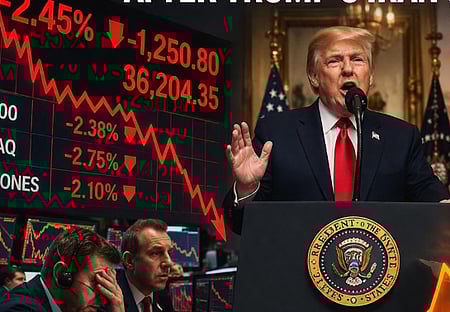
Dubai: A string of unusually timed oil trades totalling over $1 billion is drawing scrutiny from U.S. regulators and lawmakers, after they were placed just before major war-related announcements that sent global prices sharply lower.
These were not routine trades. They were large, high-risk predictions placed in financial markets where investors try to profit by predicting where prices will move next.
Get updated faster and for FREE: Download the Gulf News app now - simply click here.
Reuters, Bloomberg, the Financial Times and The Guardian have reported multiple instances where traders appeared to position themselves ahead of major developments during the Iran conflict.
The question is whether these trades reflect sharp market insight—or access to information not yet public.
$760m on Hormuz news
The clearest example came on April 17.Investors placed a roughly $760 million short position—effectively a financial prediction that oil prices would fall—about 20 minutes before a key announcement.
Data from the London Stock Exchange Group showed that 7,990 Brent crude futures contracts—agreements to buy or sell oil at a fixed price on a future date—were sold between 12:24 and 12:25 GMT.
At 12:45 GMT, Abbas Araghchi—Iran’s foreign minister and top diplomat—announced on X that the Strait of Hormuz—a narrow waterway through which a large share of the world’s oil supply passes—was “completely open” following a ceasefire.
The market reaction was immediate. Brent crude, the global benchmark for oil prices, fell from above $100 to around $88 per barrel. U.S. crude dropped about 10%, meaning traders who invested against the market stood to profit.
LSEG analysts said the trading burst was “completely atypical for that period,” with volumes nearly nine times higher than normal.
Sign up for our daily business newsletter, Cheques & Balances.
Pattern keeps repeating
The April 17 trade was not an isolated event. Reuters and the Financial Times reported two earlier cases:
In early March, traders placed about $500 million just 15 minutes before the White House delayed planned strikes on Iran’s energy sector
On April 7, investors placed roughly $950 million on falling oil prices three hours before a US-Iran ceasefire announcement
These trades took place in the oil futures market, where investors buy and sell contracts based on where they expect prices to move.
The April 7 trade involved exactly 6,200 Brent contracts—matching volumes seen in the earlier March spike. Each time, prices moved in the direction of the financial predictions soon after the announcements became public.
Predicting with precision
The same timing patterns have appeared in multiple online platforms. Reports from The Guardian and The New York Times show that traders placed highly accurate wagers on geopolitical events before they happened. On February 27, around 150 accounts placed $855,000 predicting U.S. airstrikes on Iran the next day.
Sixteen accounts each made more than $100,000. Soon after, a user on Polymarket—a platform where people predict real-world outcomes—made over $550,000 after predicting that Ali Khamenei—the country’s highest political and religious authority—would be removed from power shortly before he was killed in an Israeli strike.
A complaint filed with the Commodity Futures Trading Commission—the U.S. regulator overseeing futures and derivatives markets—by Public Citizen cited a crypto analytics firm that identified six “suspected insiders” who made a combined $1.2 million from similar predictions.
On April 7, at least 50 accounts again predicted a ceasefire hours before it was announced. These financial predictions, along with the oil trades, “accurately predicted the precise timing of major developments,” according to the complaint, raising concerns about insider trading—using non-public information to gain a financial advantage.
Regulators demand answers
The repeated timing has drawn formal attention in Washington. Ritchie Torres—a US lawmaker—has asked the Securities and Exchange Commission and the Commodity Futures Trading Commission to investigate.
Craig Holman of Public Citizen told Bloomberg: “It is difficult to believe they would place that amount of money, moments before an official announcement, based on simple chance.”
He added: “We are looking at a potential cross-market synchronized signal that suggests someone in the room is talking to the traders.” Reuters and Bloomberg reported that the CFTC has begun examining some of the trades, though it has not publicly confirmed a formal investigation.
Hard to prove insider trading
Experts say the issue is being complicated by the rapid growth of financial prediction markets. Platforms like Polymarket and Kalshi allow users to bet on outcomes of political decisions, conflicts or economic events.
Craig Holman described the sector as: “a wild west phase… now it’s spilled over into the stock market as well.” Even when trades look suspicious, proving wrongdoing is complex.
Much of the activity takes place through anonymous or crypto-based systems, where identities are hidden and transactions are difficult to trace.
Andrew Verstein—a law professor at the University of California, Los Angeles—told The Guardian: “We can’t say from the outset whether any of these trades were illegal… But many of them bear the hallmarks of suspicious trades that would naturally warrant investigation.”
Joshua Mitts—a law professor at Columbia University—said enforcement faces practical limits: “To have a law that can’t really be enforced effectively… it’s sort of putting the cart before the horse.”
His research found traders linked to suspicious activity achieved nearly a 70% success rate, generating $143 million in profits from well-timed wagers.
High stakes for markets
The Strait of Hormuz plays a critical role in global energy supply, making any disruption or reopening a major market-moving event. Its closure during the conflict pushed oil prices above $100 per barrel. Its reopening triggered a sharp decline.
But analysts say the bigger concern now is not just price volatility. If traders are consistently able to act before major announcements, it raises questions about whether global markets are operating fairly—or whether some participants are trading with an unseen advantage.
For regulators, the issue goes beyond oil prices. It is about whether global markets reflect publicly available information—or whether key decisions are being priced in before the public even knows they exist.