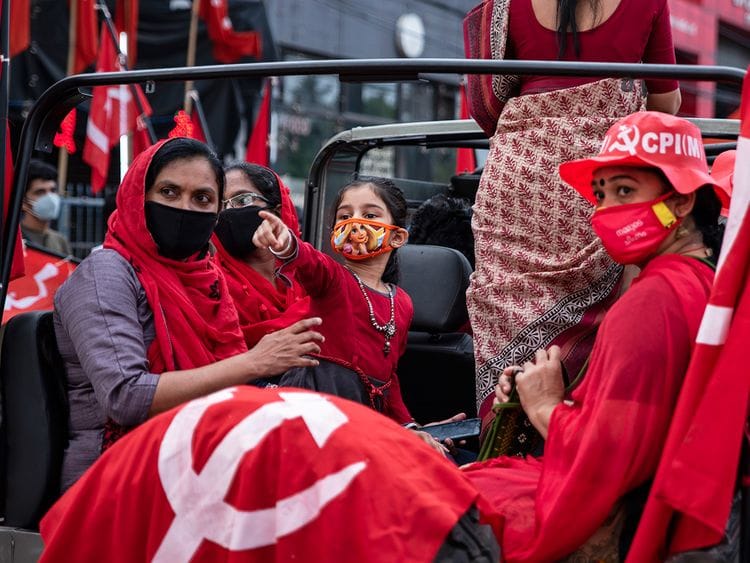
India’s Left parties face political wipeout as Kerala slips away
المصدر: Gulf News | Source: Gulf NewsThe Left Democratic Front (LDF) led by Chief Minister Pinarayi Vijayan has lost power in Kerala, ending the last remaining state ruled by a Communist-led government in India.
The setback means that, for the first time since around 1970, no Left party holds office in any Indian state. It is a symbolic and political blow for a movement that once shaped governance in multiple regions.
The defeat comes on the back of a weak showing in West Bengal for the Communist Party of India (Marxist), where the Left has struggled to remain relevant in recent elections.
Get updated faster and for FREE: Download the Gulf News app now - simply click here.From dominance to decline in key states
The Left’s decline has been long and steady rather than sudden. West Bengal, once its strongest base, was ruled by the Left Front from 1977 to 2011 under leaders such as Jyoti Basu and later Buddhadeb Bhattacharya.
That era came to an end in 2011 when Mamata Banerjee’s Trinamool Congress swept to power following widespread protests over land acquisition issues in Singur and Nandigram.
Tripura, another long-time stronghold, followed in 2018 when the Bharatiya Janata Party ended 25 years of Left rule with a decisive victory.
Kerala remained the final exception, with the LDF returning to power in 2016 and breaking the state’s long-standing pattern of alternating governments by winning again in 2021. That continuity has now been broken.
West Bengal setback deepens crisis
In West Bengal, the Left’s electoral presence has collapsed further. In the 294-member Assembly, the alliance has managed to lead in only a single seat in the latest trends.
The rise of the BJP in the state has added to the Left’s difficulties, as voter support has shifted away from traditional ideological lines towards newer political choices.
A movement that once shaped national politics
There was a time when the Left played a central role in national decision-making. In 1996, CPI(M) leader Jyoti Basu was even considered for the post of Prime Minister as part of the United Front coalition. The party, however, rejected the idea, which Basu later described as a “historic blunder”.
In 2008, Left parties still held enough influence to support the Congress-led United Progressive Alliance government in Parliament. That arrangement collapsed over the Indo-US nuclear deal, forcing a trust vote and marking a turning point in their national relevance.
Steady fall in Parliament strength
The decline at the national level has been equally sharp. After winning 59 Lok Sabha seats in 2004 and playing a key role in government formation, the Left’s numbers have steadily fallen.
By 2009, their tally dropped to 24 seats. It fell further to 10 in 2014, and just five in 2019. At present, the Left holds only six seats in the Lok Sabha.
Several factors have contributed to the decline. Analysts point to a lack of fresh leadership, unclear positions on economic reforms, and difficulty in adapting to a rapidly changing economy shaped by globalisation and privatisation.
The party has also struggled to maintain strong ties with workers and rural voters, groups that once formed its core support base.
From early rise to present uncertainty
The Communist Party of India was once the largest opposition force in Parliament after the first general elections in 1951–52. Kerala’s 1957 election of a Communist government was a global first, marking a high point for the movement.
West Bengal and Tripura later became symbols of sustained Left governance, with decades of uninterrupted rule in both states.
Today, however, that legacy has been reduced to history.
The loss of Kerala signals more than just an electoral defeat. It marks the end of an era in which the Left maintained a foothold in state politics.
With its influence shrinking across Parliament and states, the movement now faces its most uncertain phase in modern Indian politics.
- With inputs from agencies
ملاحظة تحريرية | Editorial Note: نُشر هذا المقال في الأصل بواسطة Gulf News. خبر (Khabr) هي منصة إعلامية أردنية مرخّصة تعمل بالذكاء الاصطناعي. نضيف قيمة تحريرية من خلال: تحليل ذكي للأخبار، ملخصات تلقائية، رواية صوتية بالذكاء الاصطناعي، ترجمة متعددة اللغات، وتدقيق الحقائق. هدفنا جعل الأخبار أكثر وضوحاً وسهولةً للقارئ العربي.
This article was originally published by Gulf News. Khabr is a licensed Jordanian AI-powered news platform (Registration #82086). We add editorial value through: AI-powered news analysis, automated summaries, AI audio narration, multi-language translation (Arabic, English, French, Turkish), and AI fact-checking. Our mission is to make news more accessible and understandable for Arabic-speaking audiences worldwide.