I was at the snooker for the longest frame in Crucible history. This is why the referee was heckled
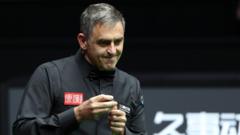
•Referee Marcel Eckardt did not handle Friday's farcical frame well George Wood/Getty Images Share articleAs someone who spends much of my working life frustrated at the obsessive focus on officiating...
•But having sat through the longest frame in Crucible history, and read some criticism of the crowd for rather atypical snooker spectator behaviour, here’s an explanation.
•The afternoon session on Friday was largely excellent, with Mark Allen battling back from a 6-2 overnight deficit to win five straight frames and lead Wu Yize 7-6.
هذا الخبر من The Athletic. خبر يقدم أدوات ذكاء اصطناعي للتلخيص والترجمة والاستماع.
Referee Marcel Eckardt did not handle Friday's farcical frame well George Wood/Getty Images Share articleAs someone who spends much of my working life frustrated at the obsessive focus on officiating in football, I didn’t expect to spend the latter part of my annual trip to the snooker World Championships at the Crucible Theatre heckling the referee — or writing an article justifying doing so. But having sat through the longest frame in Crucible history, and read some criticism of the crowd for rather atypical snooker spectator behaviour, here’s an explanation. The afternoon session on Friday was largely excellent, with Mark Allen battling back from a 6-2 overnight deficit to win five straight frames and lead Wu Yize 7-6. And then came the frame which was described as “an embarrassment to snooker” by six-time world champion Steve Davis and “the dark side of snooker” by his fellow commentator Stephen Hendry, who won seven world titles. The fact it lasted 100 minutes doesn’t even tell the story — the more significant statistic is that there was a 55-minute period where not a single ball was potted. The problem started when Allen missed a black, and left it over the corner pocket, leaving the table looking like this as Wu came to play his shot. The situation here unfolded in classic fashion. Initially, it’s a simple safety battle, with both players clipping the edge of a red, going around the angles and leaving the cue ball back near the baulk cushion (at the top of the picture). This was perfectly entertaining. The problem, of course, comes after a couple of dozen of these shots, when the reds have all been prodded towards the black. This type of exchange usually resolves itself when one player makes a mistake and sends a red into a black, and the black into the pocket, conceding seven points and essentially resetting the frame. But neither player did so, which is a testament to their concentration and excellent tactical play. The situation went from intriguing, to frustrating, to amusing, to simply farcical. As everyone waited for a mistake and the black to drop, three reds ended up wedged together around the pocket. There was no chance of the black moving. It was a complete stalemate. The BBC gave up, cut coverage, showed another programme and then eventually returned to the same frame half an hour later. There are three things which might not have been obvious from watching on television, which resulted in the crowd getting stuck into referee Marcel Eckardt, who surely should have intervened sooner. First, we were very much encouraged to do so by the commentators, with Davis trying to rally the crowd with some gestures presumably only seen at the Crucible in pantomime season. Second, there was a basic logistical issue, here. It’s worth pointing out that Crucible tickets are extremely hard to come by. The capacity is just 980. You have to desperately refresh the ticketing website a full year in advance. The cheapest tickets for this session were £120. This was the sixth frame of the session, when eight were scheduled, and it soon became clear that, due to the evening session starting at 7pm, and the venue needing to get everyone out and the next lot in, this was going to be the final frame of the session. The fans had essentially been robbed of two frames. That, in itself, is acceptable: these things happen, and you’re really paying for a time period rather than a set number of frames. But the frame overran by so much that those attending the evening session would have their experience compromised. That session had to be delayed, even after the belated intervention of Eckardt. And that brings us to the third issue. Eckardt handled the situation badly. After about 15 minutes of the impasse, someone in the crowd shouted out — politely enough — “Don’t you think it’s time for re-rack?” (essentially calling it quits and restarting the frame). The problem was that Allen had a 30-point lead in the frame, so wouldn’t have agreed. Clearly, shouting out to the referee isn’t the done thing at the Crucible. But Eckardt’s mistake was calling back something along the lines of, “I am managing fine without your advice.” And with that, really, Eckardt snookered himself. After another five minutes or so, Eckardt had the look of a man who wanted to change his mind, but would now look foolish doing so. Had his response been the usual, “Thank you, settle down,” he surely would have got involved sooner. In the end, the decisive advice came from tournament director, Rob Spencer, sitting beside the table, before Eckardt finally told the players that if there wasn’t some development after around three shots each, he would order a re-rack. This was half an hour too late. Eventually, Allen — whose points advantage meant he queried Eckardt’s decision, and didn’t want a re-rack — felt obliged to open things up and get the frame going. You could understand his bitterness when Wu launched a comeback, and after a considerably more intriguing safety battle late on, won the frame to leave things 7-7 at the close of play. But there can be no real blame attached to the players, who played the situation both logically and efficiently. It’s easy to feel sympathy for Eckardt, who found himself in a near-unprecedented situation. The crowd were hardly abusing him, simply shouting “come on ref!” after 55 minutes without a ball going in the pocket. The real question is whether snooker should have an established solution for this kind of situation. A traditional re-rack would have been unfair on Allen, who had built up a points lead legitimately. One possible compromise would be a re-rack with the existing points total standing, and only the reds remaining on the table placed into an incomplete triangle (and perhaps a coin-toss for who breaks off). It’s an imperfect solution, but desperate times call for desperate measures. Ultimately, the impasse was to no-one’s benefit. The two frames left unplayed mean there’s more chance of today’s sessions overrunning, and in such a tight contest, an increased likelihood that the eventual winner will find himself exhausted for the final on Sunday and Monday — which was already an obvious issue in recent years, due to the gruelling nature of the three-day semi-finals and the quick turnaround for the final. It was, to some extent, nice to witness a piece of history. But I don’t want to witness anything similar again. Spot the pattern. Connect the terms Find the hidden link between sports termsالمصدر: The Athletic | Source: The Athletic
ملاحظة تحريرية | Editorial Note: نُشر هذا المقال في الأصل بواسطة The Athletic. خبر (Khabr) هي منصة إعلامية أردنية مرخّصة تعمل بالذكاء الاصطناعي. نضيف قيمة تحريرية من خلال: تحليل ذكي للأخبار، ملخصات تلقائية، رواية صوتية بالذكاء الاصطناعي، ترجمة متعددة اللغات، وتدقيق الحقائق. هدفنا جعل الأخبار أكثر وضوحاً وسهولةً للقارئ العربي.
This article was originally published by The Athletic. Khabr is a licensed Jordanian AI-powered news platform (Registration #82086). We add editorial value through: AI-powered news analysis, automated summaries, AI audio narration, multi-language translation (Arabic, English, French, Turkish), and AI fact-checking. Our mission is to make news more accessible and understandable for Arabic-speaking audiences worldwide.