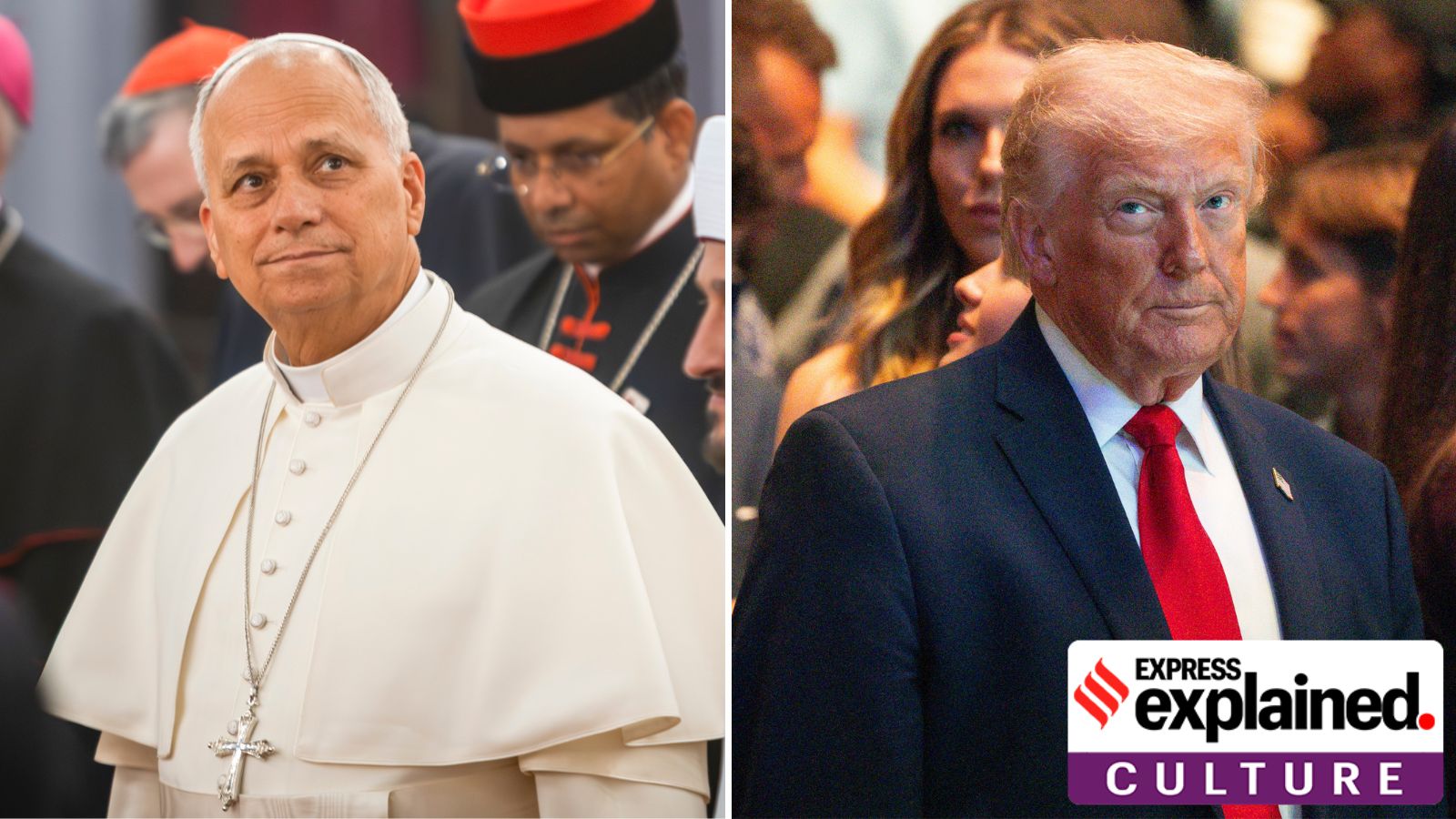
How the Iran war pitted the most American Pope against the most ‘Christian’ President
•Weather ePaper Today’s Paper Journalism of Courage Home ePaper Politics Explained Opinion India Business Premium Cities UPSC Entertainment Sports World Lifestyle Tech Subscribe Sign In TrendingUPSC Of...
•We explain Written by: Anagha Jayakumar8 min readNew DelhiApr 19, 2026 06:57 AM IST A week after Easter, the US President took to Truth Social to criticise Pope Leo for being “weak on crime” and “terr...
•(NYT) Make us preferred source on Google Whatsapp twitter Facebook Reddit PRINT With the war against Iran and Lebanon in its eighth week, Donald Trump had found a new antagonist worthy of his ire: Pop...
هذا الخبر من Indian Express. خبر يقدم أدوات ذكاء اصطناعي للتلخيص والترجمة والاستماع.
Weather ePaper Today’s Paper Journalism of Courage Home ePaper Politics Explained Opinion India Business Premium Cities UPSC Entertainment Sports World Lifestyle Tech Subscribe Sign In TrendingUPSC OfferIPL 2026US NewsPuzzles & GamesLegal NewsFresh TakeHealthResearch🎙️ Podcast Advertisement function checkAndLoadWindowSizeScript() { if (window.jQuery) { // jQuery is loaded, include your script jQuery(document).ready(function($) { // Your existing script for checking window width if (window.innerWidth) var page_w = window.innerWidth; else if (document.all) var page_w = document.body.clientWidth; if (page_w > 1024) { $(".add-left, .add-right").show(); } else { $(".add-left, .add-right").hide(); } }); } else { // jQuery is not loaded, check again after 0.2 seconds setTimeout(checkAndLoadWindowSizeScript, 200); } } // Initial call to the function checkAndLoadWindowSizeScript(); NewsExplainedExplained CultureHow the Iran war pitted the most American Pope against the most 'Christian' President How the Iran war pitted the most American Pope against the most ‘Christian’ President The confrontation unfolding this week highlights a classic conundrum: the showdown between the quest for absolute political power and the Vatican’s moral authority, in which the Trump administration seeks legitimacy. We explain Written by: Anagha Jayakumar8 min readNew DelhiApr 19, 2026 06:57 AM IST A week after Easter, the US President took to Truth Social to criticise Pope Leo for being “weak on crime” and “terrible for foreign policy”. (NYT) Make us preferred source on Google Whatsapp twitter Facebook Reddit PRINT With the war against Iran and Lebanon in its eighth week, Donald Trump had found a new antagonist worthy of his ire: Pope Leo XIV, the supreme head of the Catholic Church. The 70-year-old pontiff has been critical of the war waged by the US and Israel. What Leo found egregious were Defense Secretary Pete Hegseth’s remarks calling on the American people to pray for victory “in the name of Jesus Christ”. The Pope directly expressed his dislike in the Holy Thursday mass, saying Jesus “does not listen to the prayers of those who wage war, but rejects them.” A week after Easter, the US President took to Truth Social to criticise Pope Leo for being “weak on crime” and “terrible for foreign policy”. The confrontation unfolding this week highlights a classic conundrum: the showdown between the quest for absolute political power and the Vatican’s moral authority, in which the Trump administration seeks legitimacy. We explain. The Pope is the visible head of the Catholic Church, which regards Jesus Christ as its invisible head. He is also the Bishop of Rome. As the supreme pontiff, the Papacy or the Pope’s office presides over the Holy See, the central governing body of the Church and Vatican City, which enjoys formal diplomatic relations with other nations. Its jurisdiction empowers it to make decisions on matters of faith and morality for 1.3 billion Catholics located worldwide. In international law, the Holy See occupies the status of a sovereign juridical entity. The Holy See possesses a full legal personality in international law by virtue of the diplomatic relations it enjoys with 180 states and its membership in several international organisations. Additionally, the Holy See is “treated as a subject of international law having the capacity to engage in diplomatic relations and to enter into binding agreements with one, several, or many states under international law that are largely geared to establish and preserving peace in the world.” (Papal Diplomacy and the Quest for Peace, John A. Lucal and Robert John Araujo, 2005) Most notably, the Holy See continues to function as a non-territorial institution even when there is no pope. Thus, Trump’s attacks on Leo do not negate the institution of the Papal office. The most Christian-branded administration Curiously enough, the present conflict puts the most “Christian-friendly” administration at odds with the largest institution of Christianity. This discrepancy, however, can be explained by the narrow Christian base that helped return Trump to the White House – white, evangelical Protestant Christians. The 2025 Public Religion Research Institute Survey revealed that this subset held strongly authoritarian views; the same survey also correlated high authoritarianism with lower education and income. A Pew Research Centre study from April 2025 noted that white evangelical Christians remain Trump’s strongest supporters, with nearly two-thirds supporting his spending cuts and tariffs on the US’s trading partners. However, this share has declined from 66% in February 2025 to 58% in January 2026. Trump has sought to cement this relationship, creating a White House Faith Office led by long-time supporter and pastor Paula White-Cain. He has also created a Task Force to “Eradicate Anti-Christian Bias”, led by Attorney-General Pam Bondi. (Bondi was fired from the post this month; the task force remains active.) Also relevant is Pete Hegseth’s ties with the denomination through the Communion of Reformed Evangelical Churches, a 20th-century movement calling for the implementation of biblical law and a theocratic state structured on Christian patriarchy. This movement is opposed to religious pluralism or divergent viewpoints, wrote Samuel Perry, Associate Professor of Rhetoric, Baylor University, in an article for The Conversation earlier this month. At its core, this brand of Christianity is at odds with what the Pope represents. The Vatican’s tradition seeks to check state power through moral authority. Leo’s American origins make this tension harder to miss. Unlike Pope Francis, whom Trump’s base could dismiss as a foreign progressive, Leo grew up in Chicago, is a Chicago White Sox fan and speaks the same cultural language. While Trump’s attacks on the Pope are backed by a supporter base that looks to the US President as their moral authority, there is no clean answer for a man who is as American as Trump. Pope Leo is not the lone pontiff to disagree with a global leader over geopolitical tensions. The tussle between the authority of the Church and the State is a tale as old as time. In 1076, Henry IV, the Holy Roman Emperor, insisted that he had the authority to appoint bishops, while Pope Gregory VII argued that the Church held the authority. The ruler ordered the Pope to be deposed, while Gregory excommunicated Henry in turn. In the recent past, Pope Francis, regarded by conservatives as divisive for his views on migration and the LGBTQ+ community, found himself at the receiving end of the ire of conservative leaders, including Donald Trump. In his first term, Trump signed an executive order for the “immediate construction of a border wall” with Mexico, a key campaign promise. Without directly naming Trump, Pope Francis addressed the issue in a weekly sermon at the Vatican, saying it was a Christian calling “to not raise walls but bridges, to not respond to evil with evil, to overcome evil with good”. However, Trump chose to de-escalate. Pope Leo’s ascension last May was viewed as an opportunity to unify the divided Catholic Church, whose numbers have declined in the US over the past decade. His choice of name was rooted in tradition, signalling continuity with papal tradition. He has also consistently advocated against war, saying: “War is never holy, only peace is holy”. His appeal was not limited to Catholics: a Gallup poll in August 2025 ranked Leo as having the most positive image among 14 prominent US and global figures. God does not bless any conflict. Anyone who is a disciple of Christ, the Prince of Peace, is never on the side of those who once wielded the sword and today drop bombs. Military action will not create space for freedom or times of #Peace, which comes only from the patient… — Pope Leo XIV (@Pontifex) April 10, 2026 Until March, Leo was widely regarded as a mild-mannered Pope who spoke deliberately and often relied on scripted speeches. Arguably, Trump forced Leo’s hand into taking the administration head-on: be it his criticisms of the removal of Nicolas Maduro as Venezuela’s President, or his more recent remarks on the war against Iran. Vice President JD Vance, a practising Catholic and a convert, explicitly laid down the administration’s position in back-to-back appearances this week, drawing a line between the papacy and foreign policy: He told Fox News on Monday (April 13) that the Vatican should “stick to matters of morality”. He told a University of Georgia audience on Tuesday (April 14) that the Pope should “be careful when he talks about matters of theology.” However, this remark landed poorly among American Catholics, with Bishop James Massa, chairman of the US Catholic Bishops’ Doctrine Committee, censuring Vance. “When Pope Leo XIV speaks as supreme pastor of the universal Church, he is not merely offering opinions on theology, he is preaching the Gospel,” Bishop Massa said on Wednesday.المصدر: Indian Express | Source: Indian Express
ملاحظة تحريرية | Editorial Note: نُشر هذا المقال في الأصل بواسطة Indian Express. خبر (Khabr) هي منصة إعلامية أردنية مرخّصة تعمل بالذكاء الاصطناعي. نضيف قيمة تحريرية من خلال: تحليل ذكي للأخبار، ملخصات تلقائية، رواية صوتية بالذكاء الاصطناعي، ترجمة متعددة اللغات، وتدقيق الحقائق. هدفنا جعل الأخبار أكثر وضوحاً وسهولةً للقارئ العربي.
This article was originally published by Indian Express. Khabr is a licensed Jordanian AI-powered news platform (Registration #82086). We add editorial value through: AI-powered news analysis, automated summaries, AI audio narration, multi-language translation (Arabic, English, French, Turkish), and AI fact-checking. Our mission is to make news more accessible and understandable for Arabic-speaking audiences worldwide.