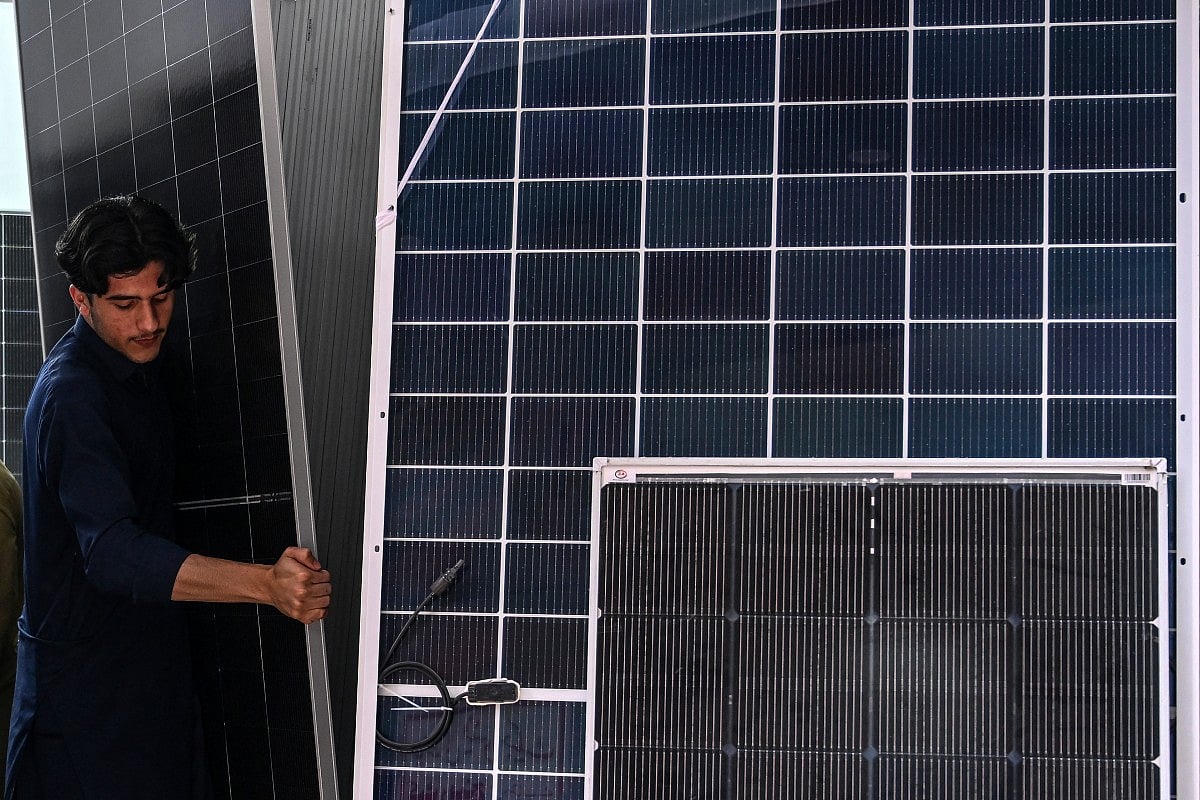
How Pakistan’s solar boom became a geopolitical buffer
المصدر: Gulf News | Source: Gulf NewsDriven by spiralling electricity tariffs, erratic supply, and policy uncertainty, Pakistan citizens — particularly the urban middle and upper classes — opted out of a failing electricity grid. What began as a private coping mechanism has, quite unexpectedly, evolved into a strategic national buffer at a moment of acute geopolitical stress.
Today, following the US–Israel confrontation with Iran and fears mounting over disruptions in the Strait of Hormuz — through which a significant portion of global oil and gas flows — Pakistan finds itself less exposed than in previous crises - because of citizen initiative and adaptation.
Pakistan’s urban classes are rapidly going solar. The scale of this transformation is striking. Solar energy now accounts for roughly 25 percent of Pakistan’s total electricity consumption when both grid and off-grid generation are included. This is not merely incremental growth — it represents a structural shift in how energy is produced and consumed.
Macroeconomic dividends
More importantly, this shift is already yielding macroeconomic dividends. According to recent analysis cited by Dr Manzoor Ahmed, currently serving as a trade arbitrator at WTO Geneva, increased solar adoption reduced Pakistan’s oil and gas import bill by around 40 per cent between 2022 and 2024, generating savings exceeding $12 billion by early 2026, with further savings expected. In a country chronically constrained by foreign exchange shortages, such savings are transformative.
When global LNG prices spiked in 2022 following the Russian attack of Ukraine, Pakistan’s energy model — heavily reliant on imported fuels — came under severe strain. Electricity prices surged, outages intensified, and the inadequacy of centralised planning was laid bare. Households and businesses responded rationally: invest once in rooftop solar or continue paying indefinitely for an unreliable and increasingly unaffordable service.
Redistribution of energy generation
The result has been a silent but powerful redistribution of energy generation — from the state to the citizen.
This redistribution is now cushioning Pakistan against the current oil and gas shock emanating from war in the Gulf region. Solar generation has sharply reduced daytime reliance on gas-fired power plants, which were previously a major consumer of imported LNG. As Dr Ahmed notes, dependence on imported fuels has declined significantly, while the share of fuel oil in electricity generation has collapsed from nearly 35 percent a decade ago to less than 1 percent today.
In effect, Pakistan’s vulnerability to external supply disruptions — once acute — has been partially mitigated.
Profound implications
The implications are profound. Energy security, long treated as a function of state contracts and geopolitical alignments, is increasingly being shaped by dispersed, citizen-owned infrastructure. Solar panels on rooftops in Lahore, Karachi, and Islamabad are now doing what long-term LNG contracts and fuel import strategies could not: insulating the economy from external shocks.
Yet this transformation is deeply uneven. The benefits of solarisation accrue primarily to those who could afford the initial capital investment. For them, electricity has become cheaper, more reliable, and largely immune to tariff shocks. For the rest — particularly lower-income households still tied to the grid — the situation has worsened.
Two-tier energy system
As more affluent consumers exit or reduce reliance on the grid, the fixed costs of the power sector are redistributed among a shrinking base of consumers. This has contributed to rising tariffs for those least able to pay. In effect, the solar transition is creating a two-tier energy system: one of autonomy and resilience for the few, and one of rising costs and vulnerability for the many.
Even policy responses risk exacerbating this divide. Taxes on imported solar panels and reductions in net-metering incentives may slow adoption among middle-income households, entrenching inequality rather than broadening access.
Moreover, solar’s shielding effect has limits. While it reduces dependence on imported gas for electricity, it does little to offset Pakistan’s heavy reliance on petroleum for transport. Recent fuel price spikes — driven by geopolitical tensions — have already filtered through the economy, raising transport costs and food prices. The broader inflationary impact remains unavoidable.
Pakistan’s solar boom demonstrates that energy transitions in developing countries are no longer solely policy-driven or climate-motivated. They are increasingly crisis-driven and citizen-led. Individuals innovate — and in doing so, reshape national outcomes.
If properly harnessed, this citizen-led transition could form the backbone of a more resilient and equitable energy system. This would require investment in grid modernisation, incentives for battery storage, and policies that extend access to lower-income households rather than penalising adoption.
At a time when geopolitical conflict once again threatens global energy markets, Pakistan is being shielded by necessity - by its citizens.
And that may be the most important energy lesson of all.
Sajjad Ashraf was a member of Pakistan Foreign Service from 1973 to 2008 and served as an ambassador to several countries.
ملاحظة تحريرية | Editorial Note: نُشر هذا المقال في الأصل بواسطة Gulf News. خبر (Khabr) هي منصة إعلامية أردنية مرخّصة تعمل بالذكاء الاصطناعي. نضيف قيمة تحريرية من خلال: تحليل ذكي للأخبار، ملخصات تلقائية، رواية صوتية بالذكاء الاصطناعي، ترجمة متعددة اللغات، وتدقيق الحقائق. هدفنا جعل الأخبار أكثر وضوحاً وسهولةً للقارئ العربي.
This article was originally published by Gulf News. Khabr is a licensed Jordanian AI-powered news platform (Registration #82086). We add editorial value through: AI-powered news analysis, automated summaries, AI audio narration, multi-language translation (Arabic, English, French, Turkish), and AI fact-checking. Our mission is to make news more accessible and understandable for Arabic-speaking audiences worldwide.