⚡ عاجل: كريستيانو رونالدو يُتوّج كأفضل لاعب كرة قدم في العالم●⚡ أخبار عاجلة تتابعونها لحظة بلحظة على خبر●⚡ تابعوا آخر المستجدات والأحداث من حول العالم●
AI اقتراحات ذكية
AI مباشر|--مشاهد مباشر
839,778مقال403مصدر نشط224قناة مباشرة5,382خبر اليوم
آخر تحديث:منذ ثانية
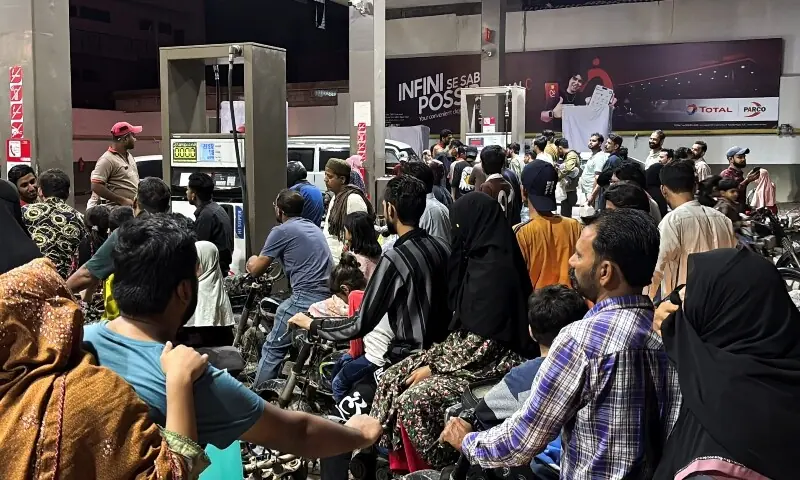
Fuel rates explode as govt withdraws blanket subsidy
• Petrol raised by Rs137 to Rs458 per litre; diesel up by Rs184 to Rs520 • Petroleum levy raised on petrol, cut to zero on HSD • Kerosene price increased by Rs34 to Rs458 per litre • Rs100 per litre subsidy for bikers capped at 20 litres per month • Small farmers to receive Rs1,500 per acre support • Early market closures planned to save 1,200MW of electricity
ISLAMABAD: The government on Thursday announced an unprecedented increase of 43 per cent and 55pc in the prices of petrol and high-speed diesel (HSD), respectively, along with early market closures and targeted subsidies for bikers, farmers and transporters to cushion the impact of global oil price shocks amid the US-Israel war on Iran.
Under the revised rates, the ex-depot price of petrol has been increased by Rs137.23 per litre (42.7pc) to Rs458.41 from Rs321.17, while HSD has been raised by Rs184.49 per litre (55pc) to Rs520.35 from Rs335.86, with immediate effect.
The price of kerosene was also increased by Rs34.08 per litre to Rs457.80.
Petroleum levy rates were adjusted to limit the increase in diesel prices and its impact on transportation and freight costs. The levy on petrol was increased to Rs160 per litre from Rs105, while it was reduced to zero on diesel from Rs55, sources told Dawn.
Speaking late at night in a national broadcast along with the finance minister, Petroleum Minister Ali Pervaiz Malik said the “difficult and responsible” decisions were taken after a national-level consultation involving the president, prime minister, military leadership and provincial chief ministers.
He said the objective was to restrict subsidies to the most deserving segments while maintaining fiscal discipline and preserving economic stability achieved over the past two years under international commitments, a reference to the IMF programme.
The government also announced targeted relief measures, including a subsidy of Rs100 per litre for two-wheeler users, capped at 20 litres per month for three months. Small farmers will receive a one-time subsidy of Rs1,500 per acre as immediate support during the harvest season.
For diesel-dependent inter-city and goods transport, a subsidy of Rs100 per litre would be provided; its price will also be reviewed every month.
In addition, trucks carrying 80-85pc of food items would receive direct support of Rs70,000 per month. Large transport vehicles would be given Rs80,000 per month, while inter-city public service vehicles would receive Rs100,000 per month to help keep fares stable.
The federal government would also extend subsidies to Pakistan Railways to ensure affordable passenger and freight services, the minister said, adding that all relief measures would be reviewed monthly in light of evolving global conditions.
As part of energy conservation efforts, the government also decided to enforce early market closures to save around 1,200MW of peak electricity demand. In consultations with the provinces, the government would separately announce the timings for reduced business hours as part of conservation and demand management.
Finance Minister Muhammad Aurangzeb said the decisions were taken with consensus among the national leadership to address energy and food security challenges, noting that other countries were facing more severe pressures. He highlighted that fertiliser prices in Pakistan remained around Rs4,000 per bag compared to international levels of about Rs15,000.
The petroleum minister said the government had initially attempted to provide blanket subsidies but global energy markets had become highly volatile and unpredictable, requiring a shift towards targeted support and national discipline.
He added that Pakistan had managed to secure energy supply lines despite a sharp increase of 80-90pc in crude oil prices in Oman and Dubai benchmarks, while diesel prices touched a record high of around $250 per barrel on Thursday.
He noted that several countries with stronger financial resources had faced fuel shortages and law and order issues due to panic buying, forcing authorities to deploy security forces.
The minister said the decision to end blanket subsidies and focus on targeted relief was taken jointly by civil and military leadership to ensure the country stayed within its fiscal limits and avoided slipping back into a financial crisis.
Aurangzeb meets US envoy
Earlier on Thursday, the government decided to seek flexibility in its International Monetary Fund (IMF) programme to create fiscal space for evolving regional and global challenges amid the US-Israel war on Iran.
The development was announced by the Ministry of Finance after a meeting between Finance Minister Aurangzeb and US Chargé d’Affaires in Islamabad Natalie Baker ahead of the upcoming spring meetings of the IMF and the World Bank later this month.
In a statement, the finance ministry said both sides discussed Pakistan’s ongoing engagement with international financial institutions and development partners, including efforts to maintain reform momentum under the IMF programme.
“The finance minister reiterated Pakistan’s commitment to fiscal discipline while seeking flexibility in light of evolving global and regional challenges,” the statement said.
The minister briefed the US diplomat on ongoing efforts to manage energy sector challenges, including procurement, pricing mechanisms and targeted subsidies.
The Ministry of Finance said discussions also covered developments in the energy sector and the broader economic outlook, with emphasis on maintaining stability while protecting vulnerable segments of society.
The minister highlighted the impact of rising global oil prices on Pakistan’s import bill, inflation outlook and overall macroeconomic stability.
Ms Baker reaffirmed US support for Pakistan’s economic reform agenda and appreciated the government’s efforts to stabilise the economy under challenging circumstances.
ملاحظة تحريرية | Editorial Note:
نُشر هذا المقال في الأصل بواسطة Dawn.
خبر (Khabr) هي منصة إعلامية أردنية مرخّصة تعمل بالذكاء الاصطناعي.
نضيف قيمة تحريرية من خلال: تحليل ذكي للأخبار، ملخصات تلقائية، رواية صوتية بالذكاء الاصطناعي، ترجمة متعددة اللغات، وتدقيق الحقائق.
هدفنا جعل الأخبار أكثر وضوحاً وسهولةً للقارئ العربي.
This article was originally published by Dawn.
Khabr is a licensed Jordanian AI-powered news platform (Registration #82086).
We add editorial value through: AI-powered news analysis, automated summaries, AI audio narration, multi-language translation (Arabic, English, French, Turkish), and AI fact-checking.
Our mission is to make news more accessible and understandable for Arabic-speaking audiences worldwide.
هذا الخبر ضمن تغطية خبر لقسم اقتصاد.
نقدّم لك تحليلات ذكية وملخصات يومية لأهم الأخبار من مصادر موثوقة متعددة.
المصدر: Dawn.
يوجد 6 مقالات مرتبطة بهذا الموضوع.
This article is part of Khabr's coverage of Economy.
We provide AI-powered analysis, summaries, and multi-source aggregation to keep you informed.
Source: Dawn.
Tags: fuel rates, subsidy, government.
🍪 نستخدم ملفات تعريف الارتباط لتحسين تجربتك وعرض الإعلانات المخصصة. باستخدامك للموقع، فإنك توافق على سياسة ملفات تعريف الارتباط وسياسة الخصوصية.
We use cookies to enhance your experience and show personalized ads. By using this site, you agree to our Cookie Policy and Privacy Policy.
FREEFree 1GB Internet + Free International Calls
$1 trial — eSIM in 190+ countries — No roaming charges