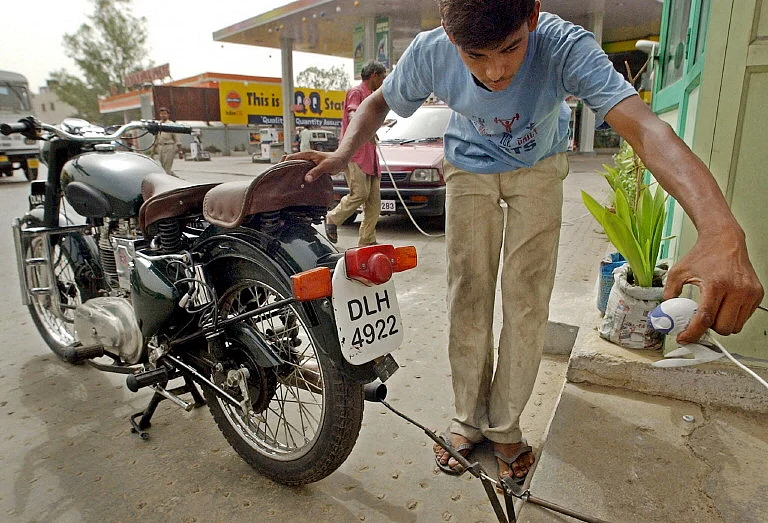
Explained: Why Delhi is banning petrol-powered two-wheelers in two years
المصدر: Khaleej Times | Source: Khaleej TimesDelhi has been suffering from alarming pollution levels during winters in recent decades, with smog covering the national capital of India and its surrounding areas, and millions of residents face daunting health challenges.
To tackle this crisis, the Delhi government has recently released the draft Electric Vehicle (EV) policy 2026-2030, which aims to reduce vehicle pollution. Chief minister Rekha Gupta said the proposed draft is a major initiative taken to ensure a clean, accessible and sustainable transport system in the Indian capital.
According to official figures, Delhi has more than 15 million registered vehicles, which add up to almost the combined vehicle population of India’s three other large cities (Mumbai with 5.63 million vehicles, Chennai with 5.71 million, and Kolkata with 3.73 million). Worse, the National Capital Region (NCR), which includes Delhi, Gurgaon, Noida, Greater Noida and many other smaller cities, is home to 33 million registered vehicles.
Stay up to date with the latest news. Follow KT on WhatsApp channels.
We take a look at the major steps being worked out to tackle the crucial challenge that pollution poses to millions of residents in the NCR:
What is the new EV policy the government has formulated in Delhi?
The new policy has been designed to ensure a clean, accessible and sustainable transport system in the capital. Two-wheelers add up to 67 per cent of the total number of vehicles in Delhi. Ensuring rapid electrification of these two-wheelers will ensure meaningful reduction in vehicle emissions.
Besides two-wheelers, three-wheelers, commercial cars and N1 category goods vehicles (those carrying goods and having a gross vehicle weight not exceeding 3.5 tonnes) also have a disproportionately high contribution to urban air pollution. The government believes that prioritised electrification of these vessels is essential to achieve sustained improvements in Delhi’s air quality.
How has the government formulated its policy objectives?
The objective is to accelerate adoption of EVs across all major vehicle segments. It supports installation of a comprehensive public and private charging network across Delhi.
It also enables a robust EV supply chain including battery recycling, servicing, and component recovery. The aim is to improve air quality by reducing reliance on internal combustion engine (ICE) vehicles. The new policy aims to ensure fiscal efficiency and transparent implementation.
Which vehicles are being primarily targeted by the government?
The draft Delhi Electric Vehicle Policy proposes a complete ban on new registrations of petrol and CNG (compressed natural gas) two-wheelers from April 1, 2028. Only electric two-wheelers will be sold in the national capital by dealers.
From January 1, 2027, only electric three-wheelers will be allowed for new registrations. However, existing vehicles will not be affected by this move. For commercial vehicles, no new ICE vehicles will be allowed in aggregator-based operations including two-wheelers and light good vehicles. This covers sectors including bike taxis and delivery services. Existing two-wheelers can continue till December 31, 2026; after that, operators will have to switch over to electric vehicles.
What are the incentives the government will offer under the EV policy?
The government has laid special emphasis on extensive financial incentives, tax exemptions, mandatory provisions and infrastructure development to promote electric vehicles.
All the purchase incentives will be provided directly to eligible beneficiaries through Direct Benefit Transfer (DBT). This will include individuals, proprietorship firms, agencies, and companies resident in Delhi and whose vehicles are also registered there.
How does the new policy cover the charging infrastructure and ecosystem?
The Delhi Transco Ltd has been designated as the nodal agency for planning, implementation and grid integration of charging and battery-swapping networks. A single-window clearance system will speed up clearances.
The new system will also include provisions for battery collection, recycling, traceability and reuse. A dedicated EV fund will finance the policy and will have a budget of Rs40 billion (about Dh1.6 billion).
ملاحظة تحريرية | Editorial Note: نُشر هذا المقال في الأصل بواسطة Khaleej Times. خبر (Khabr) هي منصة إعلامية أردنية مرخّصة تعمل بالذكاء الاصطناعي. نضيف قيمة تحريرية من خلال: تحليل ذكي للأخبار، ملخصات تلقائية، رواية صوتية بالذكاء الاصطناعي، ترجمة متعددة اللغات، وتدقيق الحقائق. هدفنا جعل الأخبار أكثر وضوحاً وسهولةً للقارئ العربي.
This article was originally published by Khaleej Times. Khabr is a licensed Jordanian AI-powered news platform (Registration #82086). We add editorial value through: AI-powered news analysis, automated summaries, AI audio narration, multi-language translation (Arabic, English, French, Turkish), and AI fact-checking. Our mission is to make news more accessible and understandable for Arabic-speaking audiences worldwide.