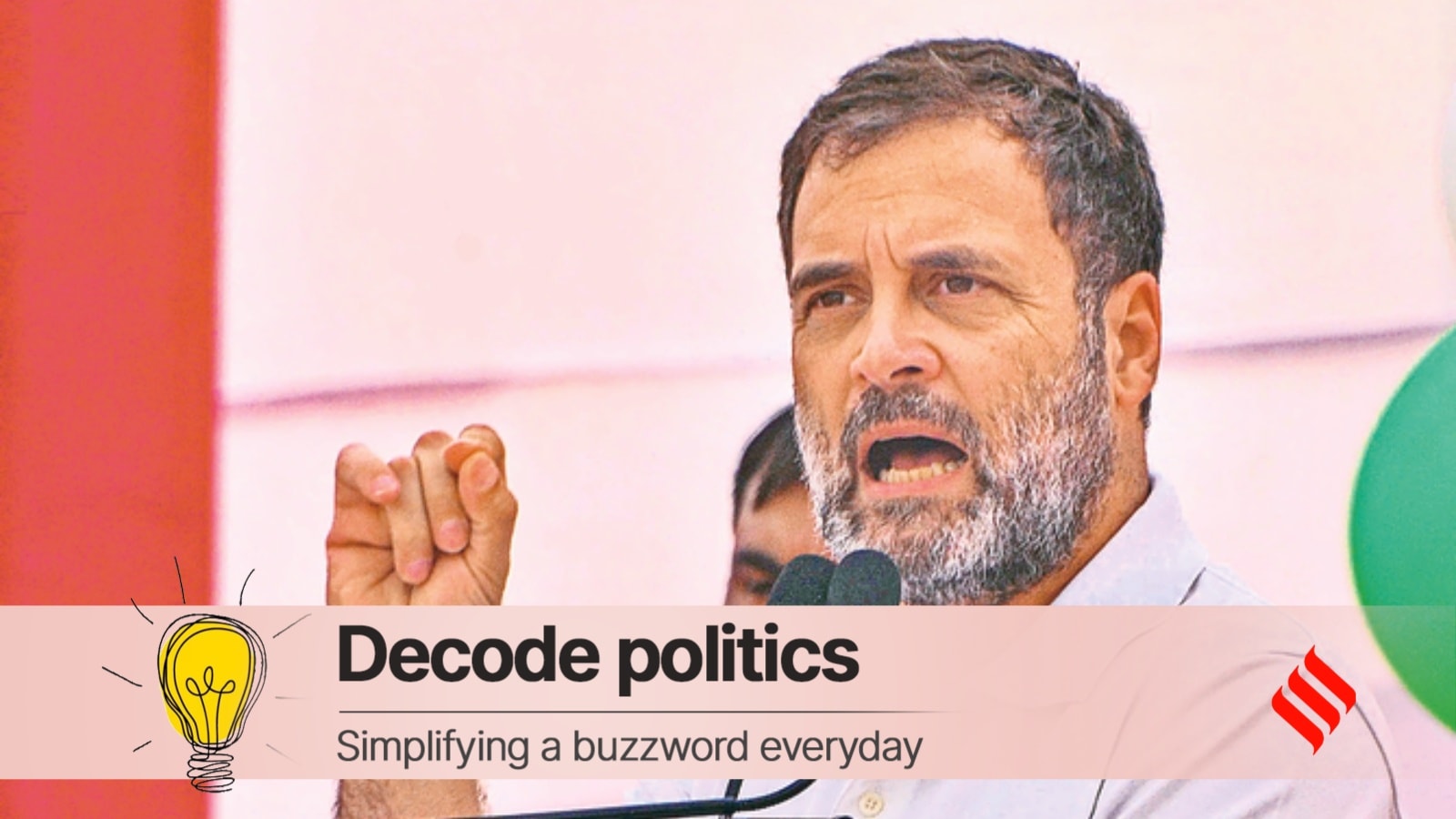
Decode Politics: Amid delimitation storm, how 2023 exercise shaped Assam elections
•The 2023 delimitation exercise in Assam – which played a crucial role in shaping the recently concluded state Assembly elections whose results will be declared on May 4 – is back in focus with the cur...
•Both Leader of the Opposition (LoP) in the Lok Sabha, Rahul Gandhi, and another senior Congress leader, Gaurav Gogoi, have accused the BJP-led Centre’s delimitation move of alleged “gerrymandering”, c...
•In 2023, the delimitation of Assam’s constituencies was carried out for the first time since 1976.
هذا الخبر من Indian Express. خبر يقدم أدوات ذكاء اصطناعي للتلخيص والترجمة والاستماع.
The 2023 delimitation exercise in Assam – which played a crucial role in shaping the recently concluded state Assembly elections whose results will be declared on May 4 – is back in focus with the current debate on delimitation raging in the country. Both Leader of the Opposition (LoP) in the Lok Sabha, Rahul Gandhi, and another senior Congress leader, Gaurav Gogoi, have accused the BJP-led Centre’s delimitation move of alleged “gerrymandering”, citing the 2023 exercise, in which Assam’s Lok Sabha and Assembly constituencies were redrawn, as a cautionary example. In 2023, the delimitation of Assam’s constituencies was carried out for the first time since 1976. While several states saw a fresh round of the exercise in the early 2000s, it was deferred in Assam multiple times because political parties had opposed it, citing the then updation of the National Register of Citizens (NRC). The delimitation exercise was carried out in Assam on the basis of the 2001 Census, amid resistance from Opposition parties against it being conducted before the NRC process was completed. Under this exercise, the number of Lok Sabha constituencies – 14 – and Assembly seats – 126 – in the state were not revised, but there were significant changes made to the contours of these seats. The delimitation reserved 19 Assembly seats for the Scheduled Tribes (STs) and nine for the Scheduled Castes (SCs), up from 16 and 8 earlier, respectively. It also reserved two Lok Sabha seats for the STs and one for the SCs. After the delimitation, one seat was added in the autonomous district of West Karbi Anglong and four more in the Bodoland districts. Accusing the BJP of planning to “gerrymander all Lok Sabha seats to its advantage for the 2029 parliamentary elections”, Gandhi said the BJP had “hijacked” the delimitation process in Assam and Jammu & Kashmir, “where it split anti-BJP regions and communities for electoral dividends”. Both Gandhi and activist-politician Yogendra Yadav, who recently wrote a piece in The Indian Express on Assam’s delimitation, have shared images of the newly created Kaziranga Lok Sabha seat as an example of “gerrymandering”. Yadav described the constituency as having a “weird, garland-like shape”. This Kaziranga seat is essentially the redrawn form of the erstwhile Kaliabor constituency, which had been represented by Gogoi since 2014 and was his family’s bastion. The redrawing in this particular area had had significant impact on both the former Kaliabor and Nagaon constituencies, both of which had been won by the Congress in the 2019 Lok Sabha polls. Three minority-dominated Assembly segments in Kaliabor – Dhing, Rupohihat and Samaguri, where the Congress had comfortable leads in the 2019 polls – were shifted to the new Nagaon seat, while three segments from Nagaon – Barhampur, Hojai and Lumding, where the BJP had substantial leads in 2019 – were shifted to the Kaziranga seat. As a consequence, Kaziranga was viewed by the Congress as an “unwinnable seat” while Nagaon also upset then sitting BJP MP Rajen Gohain – who has since left the party – over it being turned into a “minority-dominated seat handed over to the other party”. In the 2024 Lok Sabha polls, Kaziranga was won by the BJP’s Kamakhya Prasad Tasa, while the Congress’s Pradyot Bordoloi won Nagaon, even as Gogoi shifted to new ground in the Jorhat seat, which he won. Bordoloi has switched to the BJP just ahead of the recent Assembly polls. The Opposition’s key allegation is that the seats had been redrawn in such a way that minority voters had got concentrated in fewer constituencies in a bid to reduce their electoral influence. A similar pattern was seen in western Assam’s Barpeta and Dhubri Lok Sabha seats, which saw perhaps the most drastic changes. Both these were Muslim-majority constituencies, won by the Congress’s Abdul Khaleque and the AIUDF’s Badruddin Ajmal, respectively, in 2019. After delimitation, several Muslim-majority Assembly segments in Barpeta, such as Chenga and Mandia – comprising the earlier Jania and Baghbor Assembly segments – and a newly carved out Muslim-majority seat Srijangram in Bongaigaon were all shifted to the Dhubri Lok Sabha seat. The result was a geographically distended Dhubri seat, which is also Assam’s most populous Lok Sabha constituency: It had 26.43 lakh voters, more than 85% of whom are Bengali-speaking Muslims. It had over 4.5 lakh more voters than the second-most populous seat. On the other hand, Barpeta had 19.5 lakh voters, where the percentage of Muslim voters – also predominantly Bengali-speaking Muslims – had come down from around 50% to an estimated 30%-35%. In the 2024 polls, the Congress’s Rakibul Hussain swept Dhubri, while the BJP ally AGP’s Phani Bhusan Choudhury won Barpeta. While the outcome of the Assembly election is awaited, a number of parties and observers have estimated that the constituencies where minority voters play a decisive role have reduced from around 35 of the state’s 126 seats to about 23. For instance, in Barak Valley’s Muslim-majority Hailakandi district, there were three seats represented by AIUDF MLAs after the 2021 election. However, after delimitation, the number of these constituencies have been brought down to two, with observers noting that a majority of Muslim voters are concentrated in the new Algapur-Katlicherra seat, while the Hindu-dominated belts have been retained in the Hailakandi constituency. This has resulted in an unprecedented situation where all incumbent MLAs from the district – Nijam Uddin Choudhury, Suzam Uddin Laskar and Zakir Hussain – have contested from Algapur-Katlicherra. The Assembly constituency in Assam with the highest number of voters (3.15 lakh) is Dalgaon. In contrast, the other two constituencies in the same Darrang district, Sipajhar and Mangaldai, have a little over 2 lakh voters, with the minority voters in the district being seen as “lumped together” in Dalgaon. The state BJP has, however, maintained that the delimitation exercise has “protected the interests and aspirations of Assam and its indigenous people”. Sukrita Baruah is a Principal Correspondent for The Indian Expres... Read Moreالمصدر: Indian Express | Source: Indian Express
ملاحظة تحريرية | Editorial Note: نُشر هذا المقال في الأصل بواسطة Indian Express. خبر (Khabr) هي منصة إعلامية أردنية مرخّصة تعمل بالذكاء الاصطناعي. نضيف قيمة تحريرية من خلال: تحليل ذكي للأخبار، ملخصات تلقائية، رواية صوتية بالذكاء الاصطناعي، ترجمة متعددة اللغات، وتدقيق الحقائق. هدفنا جعل الأخبار أكثر وضوحاً وسهولةً للقارئ العربي.
This article was originally published by Indian Express. Khabr is a licensed Jordanian AI-powered news platform (Registration #82086). We add editorial value through: AI-powered news analysis, automated summaries, AI audio narration, multi-language translation (Arabic, English, French, Turkish), and AI fact-checking. Our mission is to make news more accessible and understandable for Arabic-speaking audiences worldwide.