• PTA to collect tax on imported mobile phones in instalments
• Digital monitoring mandatory for manufacturers
• Tax stamps, barcodes required for goods clearance
• Duty waiver on aircraft, parts import
• Zero duty on electric vehicles under $75,000, 92pc above 3000cc
• SBP to create tax data repository
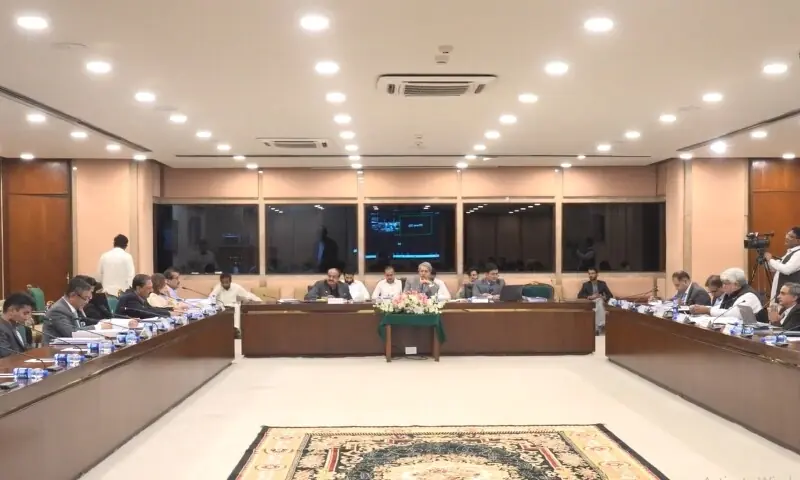
ISLAMABAD: The National Assembly Standing Committee on Finance approved the Finance Bill 2026 on Monday after making around 30 major amendments that reshaped key tax provisions through revisions to rates, enforcement mechanisms, deletions and new insertions.
The amended bill will now be presented before the National Assembly for final approval, where a clause-by-clause vote will determine its passage. The Senate committee had earlier submitted 123 recommendations on the bill.
The standing committee finalised its report earlier in the day, which will now be placed before the National Assembly for adoption ahead of the final budget vote.
The committee proposed an instalment-based tax on imported mobile phones via the Pakistan Telecommunication Authority’s device system, alongside easing penalty structures, expanding exemptions, reducing tax rates for wholesalers, and revising the import regime for electric vehicles.
Several proposed measures were dropped, including changes linked to the petroleum levy, while new enforcement tools were added to strengthen compliance. These include digital production monitoring, faceless tax assessments and an algorithm-based settlement mechanism intended to resolve disputes without direct interaction between taxpayers and officials.
In customs laws, the committee introduced tighter administrative controls requiring board-level decisions to obtain ministerial approval and mandating competitive procurement under public procurement rules. It also reduced the limitation period from 10 years to 5 years and introduced safeguards requiring that affected parties be heard before orders are issued, except in urgent cases involving risk of asset dissipation.
The affected parties were also granted the right to present their case before any assets are confiscated under customs law. The inclusion of chartered accountants as non-voting members in customs and tax proceedings was also approved.
A key feature of the amendments is mandatory digital production monitoring. Manufacturers will not be allowed to remove or sell taxable goods without tax stamps, barcodes or integration with production monitoring systems, including video-based analytics.
Taxation on steel sector
For the steel sector, the committee proposed linking sales tax collection to per-unit electricity consumption, including captive power use. The tax collected will remain adjustable, with provisions for reduced rates for compliant units to limit refund accumulation.
Special concessions were proposed for footwear businesses linked to digital systems and point-of-sale integration. Confiscated goods must be auctioned, including through electronic platforms, under public procurement rules.
The committee approved exempting Pakistani-registered airlines from aircraft and spare parts import duties from July 1. It also approved a facility allowing taxpayers to pay tax on imported mobile phones in instalments through the device identification system, subject to full payment within the financial year of import.
Additional measures include a 3pc value-added tax on imported goods sold without processing and a reduced 1pc rate on coal imports used by independent power producers.
In the income tax regime, relief was introduced for smaller businesses by allowing entities with a turnover of up to Rs200 million to opt out of the final tax regime from tax year 2027. Legal definitions were revised, several time limits were shortened, and rules governing inheritance and property transfer were updated.
Digital repository
A major structural change allows the State Bank of Pakistan to establish a centralised digital repository of banking data for tax purposes, enabling access to financial transaction records through unique identifiers.
Penalty provisions were tightened, with fines linked to turnover in some cases and higher penalties for repeat violations. Safeguards were also introduced, allowing taxpayers to challenge auditor appointments.
Tax policy changes include a 5pc withholding tax on income from social media platforms, along with revisions in rates for financial services and port operators. Exemptions were recommended for private equity and venture capital funds, subject to conditions including distribution of 90pc of income.
The exemption list was expanded to include provincial social security institutions, the Workers Welfare Fund, Make A Wish Foundation and the Quaid-i-Azam Mazar Management Board.
The committee also reduced minimum tax to 0.5pc for 14 categories of distributors, including pharmaceuticals, fertilisers, sugar, cigarettes, locally manufactured mobile phones, packaged food items, beverages, dairy products and consumer goods such as hygiene and household products.
Export-oriented businesses with exports exceeding 80pc of turnover were recommended for exclusion from the super tax.
In the federal excise regime, stricter language was introduced to target deliberate violations, with procedural changes aligned with other tax laws. Tax deducted on social media payments to non-residents was made subject to adjustment, while proof of intent was required for certain violations. Registered persons were also granted the right to raise objections within 15 days against nominated auditors.
In the automotive sector, revised duties were proposed for imported electric vehicles in the completely built-up form. Electric vehicles valued up to $75,000 will carry zero federal excise duty (FED), those between $75,000 and $110,000 will face 30pc duty, while vehicles above $110,000 will be subject to 40pc duty.
Separate changes were proposed for imported motor vehicles, including cars and sports utility vehicles. FED was proposed at 86pc for vehicles between 2000cc and 3000cc, and 92pc for vehicles above 3000cc.
The committee report was accompanied by dissenting notes from members Javed Hanif Khan and Sharmila Faruqi.
Published in Dawn, June 23rd, 2026