Barrister Salman Safdar meets Imran at Adiala jail following IHC’s directives
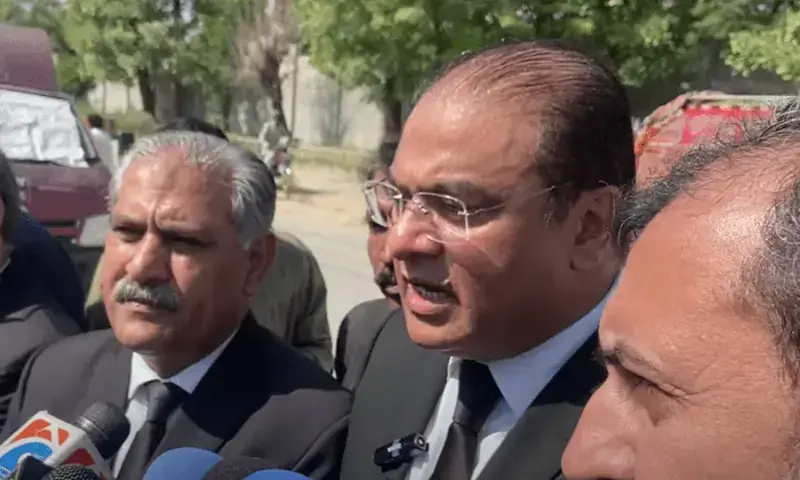
•ISLAMABAD: Barrister Salman Safdar on Thursday met PTI founder Imran Khan at Adiala jail, a day after the Islamabad High Court (IHC) directed authorities to arrange the meeting.
•However, the lawyer departed from the premises without sharing any details with the media.
•The IHC on Wednesday had allowed Safdar to discuss the proceedings of the Al Qadir case with Imran, in which he is representing the former premier.
هذا الخبر من Dawn. خبر يقدم أدوات ذكاء اصطناعي للتلخيص والترجمة والاستماع.
المصدر: Dawn | Source: DawnISLAMABAD: Barrister Salman Safdar on Thursday met PTI founder Imran Khan at Adiala jail, a day after the Islamabad High Court (IHC) directed authorities to arrange the meeting.
However, the lawyer departed from the premises without sharing any details with the media.
The IHC on Wednesday had allowed Safdar to discuss the proceedings of the Al Qadir case with Imran, in which he is representing the former premier.
It should be mentioned that this is the second time that Safdar has met Imran this year. The previous instance was also at the court’s direction when concerns were raised about Imran’s health.
TTAP meeting
Separately, a meeting of the opposition alliance Tehreek Tahafuz Aain-i-Pakistan (TTAP) was held in Islamabad at the residence of the Chairman and Leader of the Opposition in the National Assembly Mahmood Khan Achakzai.
The meeting was attended by prominent political leaders including Senator Allama Raja Nasir Abbas (Leader of the Opposition in the Senate), Salman Akram Raja (Secretary General PTI), Barrister Gohar Ali Khan (Chairman PTI), Firdous Shamim Naqvi, Sahibzada Hassan Raza (Head of Sunni Ittehad Council), Syed Zain Shah, Sajid Khan Tareen, Muhammad Zubair, Mustafa Nawaz Khokhar, Dr Ammar Ali Jan, Hussain Ahmed Yousafzai and Khalid Yousaf Chaudhry.
According to the declaration of the meeting, shared with the media, the meeting held detailed deliberations on the current political situation in the country, regional developments — particularly tensions involving Iran, Israel, and the United States — the evolving Middle East situation, the conditions in Balochistan, upcoming protest strategies, and the ongoing injustices faced by Imran.
Participants welcomed the two-week ceasefire between Iran and the United States and expressed hope that both sides would fully adhere to it, paving the way for lasting peace in the region. The meeting emphasised that sustainable peace in the Middle East required a just resolution of issues concerning not only Iran but also Lebanon, Syria, and Gaza. The movement reaffirmed its commitment to playing a constructive role in promoting global peace.
The participants also appreciated the Pakistan-Afghanistan dialogue held in China, stating that meaningful engagement and dialogue with neighbouring countries was the most effective path toward regional stability and development. The TTAP reiterated its stance that disputes must be resolved through dialogue rather than military confrontation, guided by principles of national security and regional peace.
The meeting urged the government of Pakistan to promote political dialogue, rule of law, and reconciliation, stressing that respect for public mandate was the foundation of national progress. It was emphasised that all political forces must unite and initiate serious negotiations to overcome internal crises.
Expressing grave concern over the situation in Balochistan, the participants called for the immediate release of the leadership and workers of the Baloch Yakjehti Committee. Furthermore, they demanded withdrawal of cases against Sardar Akhtar Mengal and an end to the exploitation of the province’s resources.
The meeting welcomed the IHC’s initiative regarding facilitating meetings with Imran and urged the Supreme Court and high court to conduct daily hearings on all cases, bail matters, and petitions related to meetings. It also demanded immediate restoration of meetings between the incarcerated PTI leader and his lawyers, family, and political associates, and called upon Adiala jail authorities to expedite completion of legal documentation required for Supreme Court proceedings.
The TTAP announced nationwide, district-level public gatherings on April 25 in support of constitutional supremacy, the release of political prisoners, including Imran, and the provision of economic relief to the public. The participants strongly condemned the treatment of detained leaders, including Sahibzada Hamid Raza, Iman Mazari, Hadi Ali Chattha, Ali Wazir and Samad Wazir, and demanded their immediate release.
On the occasion of May 1 (Labour Day), the movement announced that rallies will be organised nationwide in solidarity with workers, along with the presentation of an alternative economic agenda for national recovery. Expressing deep concern over the country’s economic situation, the meeting noted that inflation has severely impacted the poor, farmers, and labourers. It was decided to unite farmers and workers’ organisations for a joint struggle.
ملاحظة تحريرية | Editorial Note: نُشر هذا المقال في الأصل بواسطة Dawn. خبر (Khabr) هي منصة إعلامية أردنية مرخّصة تعمل بالذكاء الاصطناعي. نضيف قيمة تحريرية من خلال: تحليل ذكي للأخبار، ملخصات تلقائية، رواية صوتية بالذكاء الاصطناعي، ترجمة متعددة اللغات، وتدقيق الحقائق. هدفنا جعل الأخبار أكثر وضوحاً وسهولةً للقارئ العربي.
This article was originally published by Dawn. Khabr is a licensed Jordanian AI-powered news platform (Registration #82086). We add editorial value through: AI-powered news analysis, automated summaries, AI audio narration, multi-language translation (Arabic, English, French, Turkish), and AI fact-checking. Our mission is to make news more accessible and understandable for Arabic-speaking audiences worldwide.