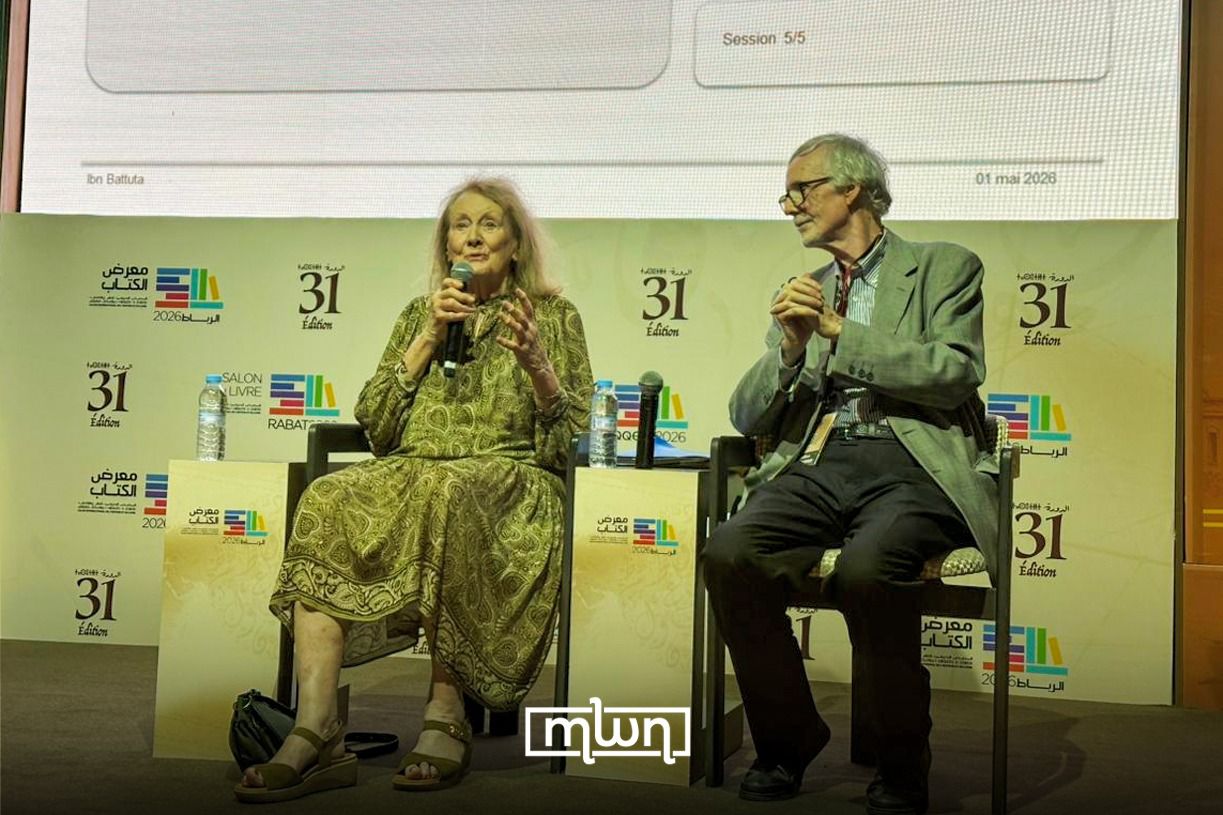
Rabat – There are writers who construct worlds, and there are those who dismantle the very conditions that make “worlds” narratable.
On the first evening of the International Publishing and Book Fair (SIEL) 2026, in the Salle Ibn Battuta, Annie Ernaux came to defend her own definition of literature as a radical practitioner of subtraction, someone for whom writing is an act of stripping language back to its social and material truth.
Moderated by Abderrahman Tenkoul, the encounter gradually unfolded as a slow and exacting undoing of literature’s most persistent myths, in which writing redeems, memory heals, and language can (or almost can) transcend the social structures from which it sprouts.
“Writing is much simpler than that,” Ernaux said, almost austerely. “It speaks of a life. Childhood, adolescence, and then we are in the world. Our identity never ceases.”
The sentence appears modest, even disarming. But beneath its clarity lies a decisive rebuke of transcendence. To say that writing “speaks of a life” is to strip it of metaphysical ambition and return it to the realm of the contingent, the historical, and the embodied.
Ernaux’s work has long occupied this territory, between autobiography and sociology, memory and material condition, what critics have come to call autosociobiography. Yet in Rabat, what resurfaced was the ethos of writing as a sincere act of resistance against aesthetic illusion.
On literary ‘desacralization’
Born in 1940 in Normandy to working-class parents who ran a café-grocery, Ernaux has spent decades interrogating the fault lines of class mobility, gender, and historical consciousness. From “Les Armoires vides,” her first novel, already grappling with abortion and the politics of female emancipation, to “Les Années,” her monumental “collective autobiography,” she has consistently refused the consolations of fiction.
“I want to desacralize,” she said, referring to the Nobel Prize in Literature she received in 2022. Ernaux has always written against consecration and the idea that literature exists above life, or that the writer occupies a privileged vantage point.
This refusal situates her within, yet also against, a French literary lineage that includes Jean-Paul Sartre and Simone de Beauvoir, among others. Like them, she understands writing as engagement; unlike them, she strips it of philosophical abstraction.
If Sartre posited literature as a moral project, Ernaux reduces it to a practice of exposure, of the self, yes, but also of the structures that produce the self.
Her affinity with Pierre Bourdieu might be even more explicit. “There are two ways of writing about those who are not from the bourgeoisie,” she said. “Either one glorifies them, the worker as hero, or one portrays them as dominated.” The two, she insists, are distortions, as they impose narrative paradigms that ultimately serve the reader’s expectations.
Her alternative is what she called écriture plate, or “flat writing,” though the translation fails to encapsulate its precision. “The writing is brought back to essentiality,” she explained. “It is factual writing.”
This factuality has nothing to do with neutrality, as many would like to argue or interpret. But it is more of an ethical stance. To refuse metaphor is to refuse embellishment; to refuse embellishment is to refuse the aestheticization of social reality. Ernaux’s prose does not seek to elevate experience, but rather seeks to expose it.
No longer human
Central to Ernaux’s project is the paradox that to write oneself is, ultimately, to erase oneself. It is a way of gesturing “from the human to the effacement of the human,” as she observed.
This movement is most evident in “La Place,” her account of her father’s life. “I did not want the reader, whom I defined internally as bourgeois, to judge,” she said. “I described not only my father’s life, but an entire culture.” The sentence perfectly describes the double bind of her writing. She must use the language of the dominant class to represent those excluded from it.
Fragmentation, too, is not merely stylistic but structural. “Fragment, discontinuity…” the terms recur as pure and radical conditions of experience. Identity, for Ernaux, is not a coherent narrative but an accumulation of moments, each shaped by historical forces.
The genealogy of objects
If Ernaux’s writing rejects metaphor, it does not reject meaning, but relocates it.
“The object, for me, holds a mnemonic power,” she said. “In writing, that is why objects are always present… they fix things. States of pain, or others.”
Objects, in her work, function as “archival traces.” They testify against us. A dress, a photograph, a kitchen utensil, each becomes a site where memory and materiality breathe life into one another. This attention to objects recalls the phenomenological precision of Georges Perec, yet Ernaux’s project is less playful, more forensic. She does more than simply catalog the everyday to celebrate. If anything, it is the preservation against erasure that she ultimately seeks to scratch.
In an age when memory is becoming more and more digitized, abstracted, and commodified, Ernaux’s insistence on the material acquires a particular urgency. Her writing resists the dematerialization of experience, grounding it in the tangible, the visible, the lived. But how much of life can the human actually “live”? And if the act of living is ever measured by some sort of unknown cosmic scale, I doubt Ernaux’s perception would even change.
The forsaken vessel
Nowhere is this grounding more evident than in her treatment of the body. Discussing the film adaptation of “L’Événement,” her account of abortion, Ernaux described her reaction with unusual intensity. A convincing explanation would be the autobiographical aspect of her novel and all the trauma enshrined within it.
“I was extremely shaken,” she said. “You see, through the actress’s body, that she hates being pregnant. She is inhabited by the role.”
Cinema, she acknowledged, possesses an immediacy that literature cannot replicate. Yet this immediacy comes at a cost. “There is always a loss,” she insisted. “A loss of writing.”
The distinction is crucial. For Ernaux, writing does more than just represent experience and instead structures it down to the last minute detail. The passage from text to image entails not just a change of medium, but a transformation of meaning. Film shows; writing thinks. Film embodies; writing interrogates.
This tension extends to her exploration of desire in “Une passion simple,” a text that provoked heavy controversy upon publication. “I remember the debate,” she said.
The reaction, she suggested, spoke more loudly about the cultural constraints on female expression than about the text itself. “Men have always had the right to write about love… but when a woman writes about her own desire in a direct manner, it was unbearable at the time.”
“The man is the object all the same, and I, who write, am the subject.” In reversing the traditional dynamics of desire, Ernaux exposes the gendered asymmetries that continue to shape literary reception. If feminism is simply the act of barren reclamation without a certain level of brain and words upheaval, then so be it.
Writing in the dark
If Ernaux’s prose appears controlled, even a hard pill to swallow, its origins are anything but. “It is very, very rare that I begin a book and it flows,” she said. Referencing “L’Atelier noir,” she described her writing process’s initial vision as “foggy, dark.”
Writing, for her, begins in obscurity. “But once I begin properly, I know I will go to the end.”
Yet this determination is not triumphalist in its essence. Rather, it is a strange form of endurance. Ernaux can write only three to four hours a day. Beyond that, she reaches what she called “an unbearable tension.”
Specters vs precedents
Among the most haunting moments of the evening was her reflection on “L’Autre fille,” addressed to the sister who died before her birth.
“Before my mother told me, that absence was already present,” she said. “Something I refused to believe.”
The paradox of a presence without existence runs through her work. It is here that her writing approaches the spectral, though never the mystical. Ernaux does not invoke ghosts; instead, she reshuffles the conditions that produce them.
“Truth always begins with the incarnation of someone,” she added.
This insistence on embodiment recalls the stark declaration of Arthur Rimbaud, “I am of an inferior race,” which Ernaux invoked in relation to material conditions. The phrase, stripped of its poetic context, sounds more like a sociological statement that speaks to the internalization of class and to the ways in which history inscribes itself onto the body. Etched. A modern-day scarlet letter.
‘I’ or ‘we’?
When asked to name her most cherished works, Ernaux cited “La Place” and “Les Années.” The former is anchored in the singular; the latter dissolves the singular into the collective.
“Les Années,” often described as a “collective autobiography,” replaces the “I” with an impersonal “we” while tracing the transformations of postwar France through the sediment of personal memory. It is, perhaps, her most ambitious attempt to reconcile the individual with history.
This movement, from the personal to the collective, defines her entire project. To write oneself is to write the structures that produce the self. There is no outside.
A moment, brief and unresolved
And yet, in her closing words, Ernaux allowed for something like immediacy.
“The moment I am living here is very strong,” she said. “I feel that I have encountered Morocco here, with you.”
The sentence lingers. For a writer who has spent decades dismantling the illusion of presence, to speak of encounter is almost paradoxical.
But perhaps this is where her work ultimately leads, not to the erasure of the self, but to its reconfiguration. The self as no longer sovereign, no longer singular, but relational, contingent, exposed.
At SIEL 2026, Ernaux did not so much inhabit the familiar posture of literary authority as unsettle its very premise. What she put forward was not the affirmation of a canonized voice but a far more exacting proposition, a way of attending to the world that treats perception itself as a form of ethical labor.
Literature, in this register, ceases to be performance or elevation and becomes instead a disciplined exposure to what is ordinarily left untheorized, unembellished, and often unseen.
In an era saturated with spectacle, where literature risks dissolving into self-display, Ernaux’s writing persists as a form of resistance without consoling or embellishing. Instead, her writing ultimately records, dissects, and endures.
And in that endurance lies its unsettling, enduring power.
The post At SIEL 2026, Annie Ernaux Dismantles the Fiction of Literature appeared first on Morocco World News.