As Mumbai launches two giant Tunnel Boring Machines, one lies abandoned 60 metres below Powai, and no one is coming for it
✨ AI Summary
🔊 جاري الاستماع
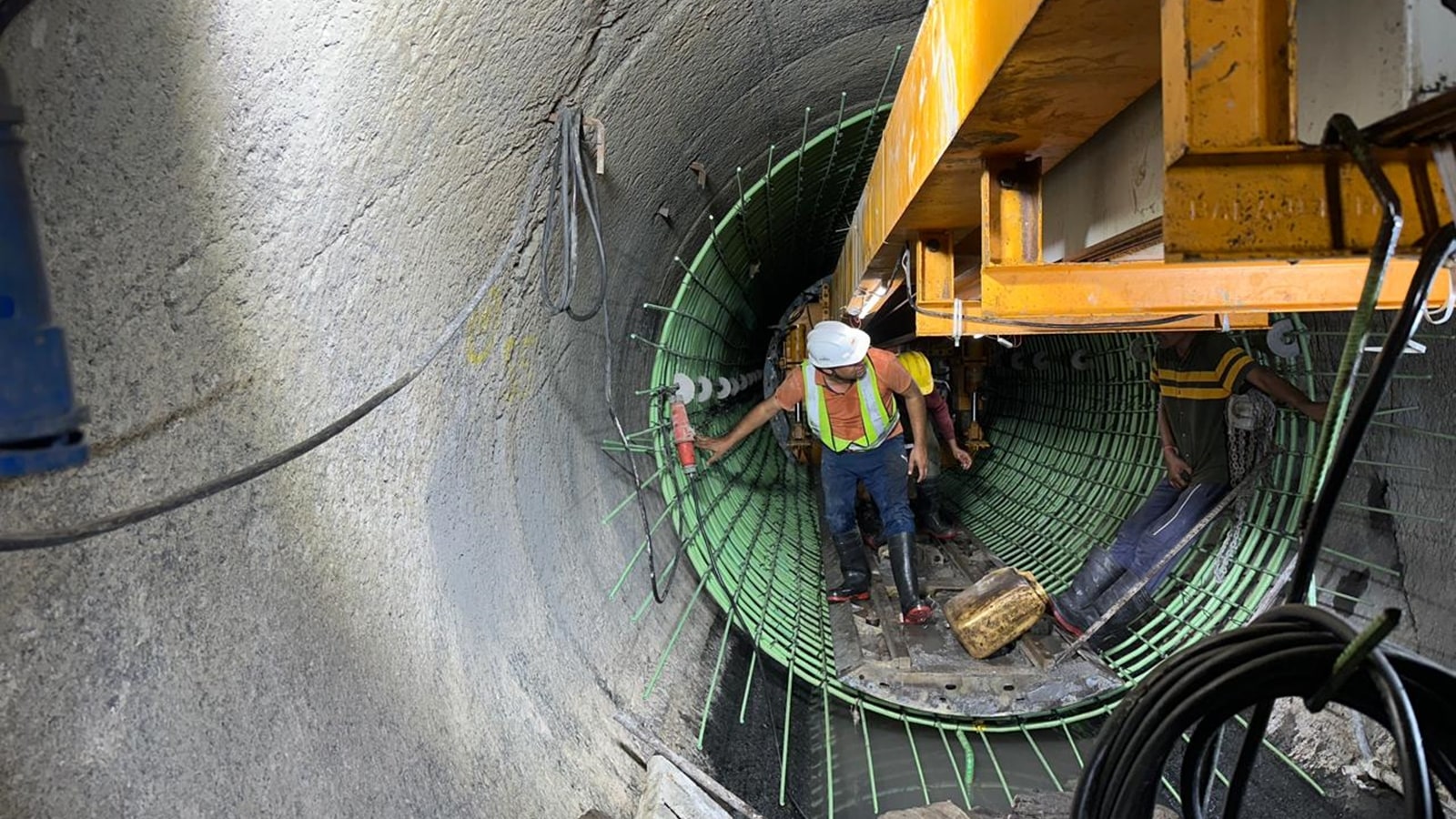
Weather ePaper Today’s Paper Journalism of Courage Home ePaper India Cities UPSC Premium Entertainment Politics Sports World Explained Opinion Business Lifestyle Tech Subscribe Sign In TrendingUPSC OfferIPL 2026US NewsPuzzles & GamesLegal NewsFresh TakeHealthResearch🎙️ Podcast Advertisement function checkAndLoadWindowSizeScript() { if (window.jQuery) { // jQuery is loaded, include your script jQuery(document).ready(function($) { // Your existing script for checking window width if (window.innerWidth) var page_w = window.innerWidth; else if (document.all) var page_w = document.body.clientWidth; if (page_w > 1024) { $(".add-left, .add-right").show(); } else { $(".add-left, .add-right").hide(); } }); } else { // jQuery is not loaded, check again after 0.2 seconds setTimeout(checkAndLoadWindowSizeScript, 200); } } // Initial call to the function checkAndLoadWindowSizeScript(); NewsCitiesMumbaiAs Mumbai launches two giant Tunnel Boring Machines, one lies abandoned 60 metres below Powai, and no one is coming for it As Mumbai launches two giant Tunnel Boring Machines, one lies abandoned 60 metres below Powai, and no one is coming for it A German-made tunnel boring machine has been entombed in volcanic ash beneath the city since 2019. Here's why the BMC abandoned it, wrote off the cost, and started again. Written by: Nayonika Bose9 min readMumbaiUpdated: Apr 15, 2026 07:03 AM IST Floating a new tender, the BMC has procured a new TBM machinery to bore through the remaining stretch of 2.7 km. Akin to the previous TBM, the new one has an external diameter of 2.8 metres and an internal diameter of 2.2 metres. In August 2025, the new TBM achieved breakthrough. (Express Photo/BMC) Make us preferred source on Google Whatsapp twitter Facebook Reddit PRINT Tunnel Boring Machine (TBM) Nayak was launched last week for the Thane-Borivali tunnel, with a bullet train TBM assembly beginning simultaneously. Beneath the city, a network of tunnel boring machines (TBMs) has been steadily reshaping Mumbai, cutting through rock to build Metro lines, road tunnels and water networks. But one of them never made it back. Nearly 60 metres below Powai, a German-made TBM lies buried in volcanic ash and monsoon sludge, abandoned after a rare engineering failure. And no one is coming for it. The machine had been deployed by the Brihanmumbai Municipal Corporation for a water conveyance tunnel from Veravali to Ghatkopar. In 2019, it got trapped in loose volcanic ash beneath the SCI establishment in Powai. For a civic body that has executed close to 100 km of water tunnels, this was an unprecedented setback. The project has since seen delays, a cost escalation of Rs 419 crore, and the deployment of a new machine to complete the remaining stretch, leaving the original one entombed beneath the city. Such incidents are rare not just in India but globally. In 2013, Bertha, then the world’s largest TBM, stalled during a highway tunnelling project under Seattle and was eventually freed after four years. In Mumbai, repeated attempts to retrieve the machine failed. After heavy monsoon flooding in 2020, extraction became virtually impossible. The Brihanmumbai Municipal Corporation awarded work orders for the Veravali-Powai-Ghatkopar water supply tunnel project in January 2012. Estimated at Rs 263 crore, the project comprised two stretches: a 2.2-km tunnel from Veravali to Powai and a 4.4-km stretch from Powai to Ghatkopar. The aim was to improve water distribution in the eastern suburbs, particularly in L and N wards, covering Kurla, Ghatkopar and Vikhroli, by augmenting supply to Veravali and Ghatkopar’s high level and low level reservoirs. For the tunnelling work, the BMC, through its contractor, procured a German-made tunnel boring machine from Herrenknecht. The machine had a diameter of 2.8 metres, length of 50 metres and a total weight of approximately 80 tonnes. In 2012, the TBM machine was procured at the cost of Rs 32 crore. While the first 2.2-km stretch between Veravali and Powai was completed successfully, work on the second stretch ran into difficulties. A TBM operates through a rotating cutter head fitted with teeth, spokes and sharp protrusions that cut through soil and rock as the machine advances. During excavation of the 4.4-km stretch from the Powai shaft towards Ghatkopar, the machine faced repeated halts due to weak ground conditions. In August 2019, after boring about 1.2 km, it came to a complete stop after getting stuck in pyroclastic volcanic ash that is highly loose and unstable. The machine remains lodged about 60 metres below ground beneath the Shipping Corporation of India (SCI) establishment in Powai, still over 3 kilometres short of its destination. “What a TBM demands is a hard, rocky surface to provide external stability to the structure as it manoeuvres through the ground. If the soil is loose, it doesn’t get the stability. At the SCI point, the soil condition was extremely bad. In fact, the soil was slushy, almost liquid-like. That made it impossible for the TBM to move and it got stuck,” a BMC official, involved in the project during the period, told The Indian Express. Such was the situation that instead of moving forward, the machine started sinking in the slush. Officials said the soil conditions were confined to a small stretch that was not identified during the preliminary surveys conducted after every 800-metre stretch around the site of work. “Mumbai lies in the Deccan area and as such, enjoys the advantage of rocky soil conditions that aids in tunnel boring. However, geological conditions at the Powai point were complex with slushy strata observed within a very small stretch. Typically, soil strata are not found anywhere in Mumbai, which predominantly has basalt rock strata,” an official added. Another BMC official, privy to developments, said, “We have bored and executed over 100 kilometres of water tunnels across Mumbai. But this is the first time that we encountered such a problem.” Once the tunnel boring machine got stuck in volcanic ash, retrieving it became a major challenge for the BMC. “Our challenge was not only to extract the expensive machinery but also to do it safely, without causing any injuries or fatalities to the manpower operating it,” a civic official said. A big hurdle, officials said, was posed in the restricted working space owing to the machine size. “The machinery had a diameter of 2.8 metres, along with lots of ancillary machinery and cables. At the bottom of the machine lay rails and grippers. The machine is huge, which left us with hardly any space to work manually. It was not even possible for workers to move towards the machinery as the entire portion was slushy,” said the BMC officer. Between 2019 and 2020, the civic body approached several tunnelling experts across the country to find a solution. It also set up an expert committee led by an IIT Bombay professor and sought advice from agencies such as Tata Consulting Engineers. Tunneling experts from National Institute of Rock Mechanics (NIRM) were also approached to assist with solutions. However, officials said India has limited expertise in handling such machines, which are largely designed and operated with foreign support, especially from Europe and China. The BMC also reached out to international experts, including in Germany, but could not arrive at a solution. The situation worsened during the heavy monsoon of June 2020 when continuous rain led to slush filling up the tunnel. The front portion of the TBM was buried in loose ash and the surrounding ground became unstable, making any attempt to pull it out nearly impossible. “Nearly 80 per cent of the machinery was buried and it became nearly impossible to prevent the seepage of water and access the machinery. The net result of every attempt by us was zero,” said an official. With recovery efforts failing and costs of extraction mounting, the BMC in 2021 decided to scrap the earlier contract. After consultations with its engineers and experts from IIT Bombay, the civic body opted to deploy a new TBM and dig a fresh tunnel instead. With the original tunnel abandoned, the BMC floated a fresh tender to complete the remaining stretch from the SCI complex in Powai to Ghatkopar’s high level and low level reservoirs. This time, stricter conditions were built into the tender while inviting bids. In December 2022, the contract was awarded to Patel Engineering at a cost of Rs 419 crore. A new tunnel boring machine was procured again from German manufacturer Herrenknecht, with a diameter of 2.8 metres. However, given the loose soil conditions where the earlier machine got stuck, the BMC adopted a different approach for part of the stretch. Instead of using a TBM, it deployed the New Austrian Tunnelling Method for nearly 420 metres. This method is typically used in weak soil conditions and involves gradual excavation with continuous support to stabilise the ground. About 50 metres away from the stuck machine, contractors used this technique to reconnect with the earlier tunnel alignment over the 420-metre stretch. Beyond this, tunnelling resumed using the new TBM for a further 2.7 km. The work continued to face difficult ground conditions, including hard rock, fractured formations, cavities and water seepage. Despite these challenges, the new TBM achieved its breakthrough in August 2025, more than a decade after the project began. Speaking to The Indian Express, Abhijit Bangar, additional municipal commissioner projects, said the work is now nearing completion. “Boring by the Tunnel Boring Machine as well as NATM has been completed. The work on lining is progressing and work is expected to be completed by March 2027,” Bangar said. Even with the many advancements into the project, there has been no solution in sight to retrieve the stuck TBM. The BMC administration said that no new proposals have been charted to extract the machinery. Nayonika Bose is a Senior Correspondent with The Indian Express’ Mumbai bureau. While in the early stages of her career, her focused reporting on local governance and community welfare already demonstrates clear Expertise and Trustworthiness in covering essential civic issues impacting Mumbai's residents. Expertise & Authority (E-E-A-T) Specialized Focus: Nayonika's reporting is dedicated to civic and community issues, providing readers with highly relevant, ground-level information about the functionality and administration of India's largest metropolitan area. Core Coverage Areas: Her articles highlight a strong focus on the fundamental quality of life and public safety in Mumbai, including: Civic Infrastructure: Reports on critical failures and initiatives related to public works, such as the recurring problem of unauthorized building collapses in Navi Mumbai, the construction of new infrastructure projects (like the Dahisar-Bhayandar Link Road and the Mahalaxmi cable-stayed bridge), and the maintenance of essential city services (e.g., manhole cover theft). Urban Governance & Crisis Management: Provides detailed coverage of the Brihanmumbai Municipal Corporation's (BMC) response to major crises, particularly during the monsoon (e.g., heavy rainfall, water cuts, and public health concerns like dengue and malaria) and large-scale public safety incidents (e.g., the hoarding collapse fallout). Community Welfare & Rights: Reports on key social issues, including the financial aid scheme for persons with disabilities, the struggles of Mumbai's hawkers protesting eviction drives, and the dangers faced by workers due to the continuation of manual scavenging in water tanks. Cultural & Heritage Reporting: Covers significant community stories, including the restoration of British-era fountains and the history of institutions like the 126-year-old Chinchpokli cemetery, showing a breadth of interest beyond pure administration. Tweets @nayonikakb ... Read More Stay updated with the latest - Click here to follow us on Instagram