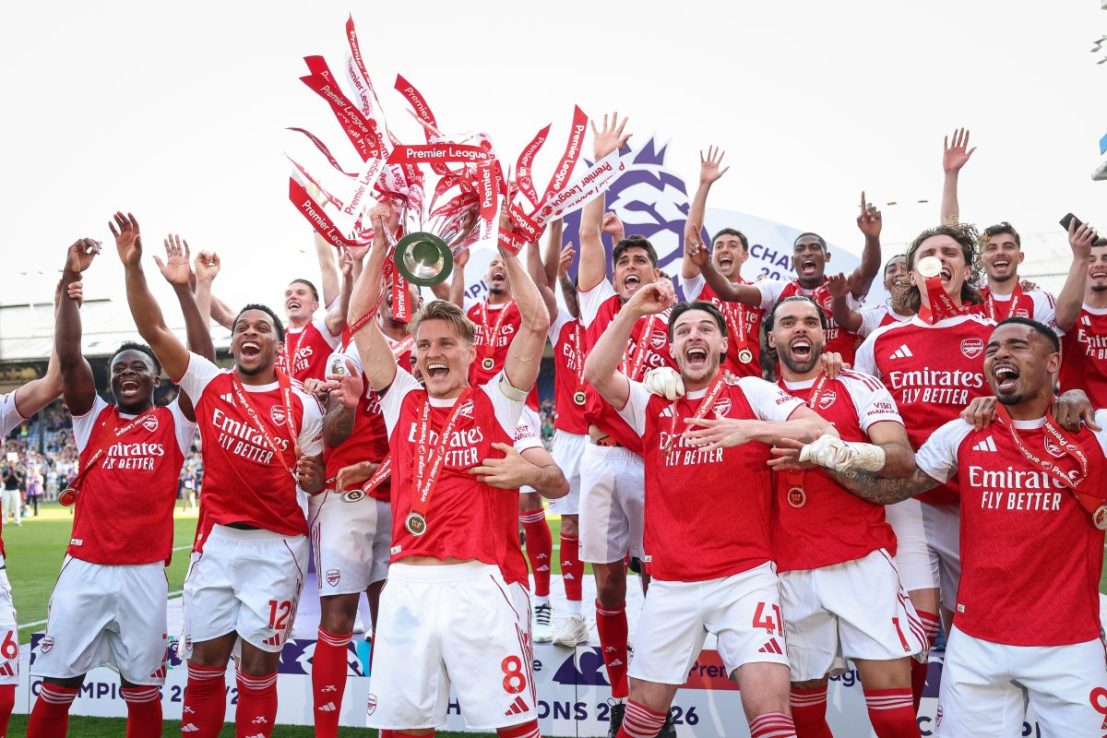
Arsenal have returned to the top five of the world’s most valuable football clubs according to the latest edition of an annual independent ranking.
The newly-crowned Premier League champions, who meet Paris Saint-Germain in the final of the Champions League this weekend, have enjoyed a 23 per cent increase in enterprise value to €4.93bn, according to leading consultancy Football Benchmark.
It puts Arsenal fifth in the ranking, behind Real Madrid, Barcelona, Manchester City and Manchester United respectively.
The Gunners’ relative growth in EV was the third biggest in the ranking, as their first domestic league title for 22 years was matched by significant commercial uplift.
Real Madrid’s enterprise value of €7.73bn is comfortably ahead of Barcelona’s €5.92bn, with Manchester City (€5.10bn) marginally ahead of Manchester United (€5.09bn).
Liverpool slipped one place in the ranking to seventh, behind Bayern Munich. Tottenham Hotspur and Chelsea also retained their places in the top 10.
“The leading clubs in European football are increasingly operating on a different economic scale to the wider market,” said Football Benchmark CEO Andrea Sartori.
“What this year’s report highlights is how difficult it is becoming to consistently compete at the top without the ability to grow global audiences, invest in infrastructure, and continuously reinvest in sporting performance over long periods.”
Stadium revamp keeps Real Madrid at top
Real Madrid have benefited from additional revenue unlocked by regeneration of their Santiago Bernabeu stadium, a trick rivals Barcelona hope to emulate when their Camp Nou work is finished.
Manchester City have expanded their Etihad Stadium, Manchester United hope to build a “Wembley of the North” to replace Old Trafford, while Arsenal are in talks with architects over improvements to Emirates Stadium.
“Economically, the gap between the game’s elite and the wider market is becoming increasingly structural,” Sartori added.
“Clubs can still rise quickly through strong sporting cycles and ambitious ownership, but sustaining a position amongst the elite is becoming more demanding with every cycle of growth.
“At the same time, financial discipline and long-term sustainability are becoming increasingly important and apparent across the industry.
“The clubs best positioned for long-term success are those capable of combining sporting competitiveness with strong operational control and strategic thinking over time.”