Critically acclaimed artist and educator Aroosa Rana’s The Golden Ratio — Math of Beauty, at Canvas Gallery, sheds whatever abstraction its premise might suggest and settles into an experience that is at once optical and ethical.
One enters expecting a meditation on proportion, perhaps even a quiet homage to the classical lineage of the golden ratio and its origins in Euclid’s “extreme and mean ratio”. Euclid is considered among the greatest mathematicians of antiquity, the ‘father of geometry’, and his golden ratio’s long afterlife in art and architecture is idolised across centuries of Western art.
Here, however, it arrives not as a guarantee of harmony but as an imposition. As Islamic civilisation spread from Spain to India, its architects absorbed and reimagined Roman, Byzantine and Persian traditions. With figurative art discouraged in sacred spaces, geometry flourished. Craftsmen became mathematicians, shaping infinite patterns and imbuing structure with meaning — domes evoked the heavens, arches bridged worlds and calligraphy made the Divine visible.
A hospital room confronts the viewer. The image, rendered across vertical panels, centres on an abandoned bed, surrounded by debris, ruptured ceilings and the residue of interrupted care. There is no visible spiral, no overt diagrammatic intervention. Yet, the image feels composed. The divisions of the panels echo a quiet logic of measurement and proportion.
In another work, a child sits amid ruin, clutching his teddy bear, the radiating lines converging with unsettling precision — as the artist observes, it feels “almost choreographed”, as though even devastation has been arranged for the eye. And in yet another image, geometry declares itself more forcefully. White linear overlays cut across a bombed domestic interior, where children continue to play. A boy lifts a ball toward another seated higher on a broken staircase.
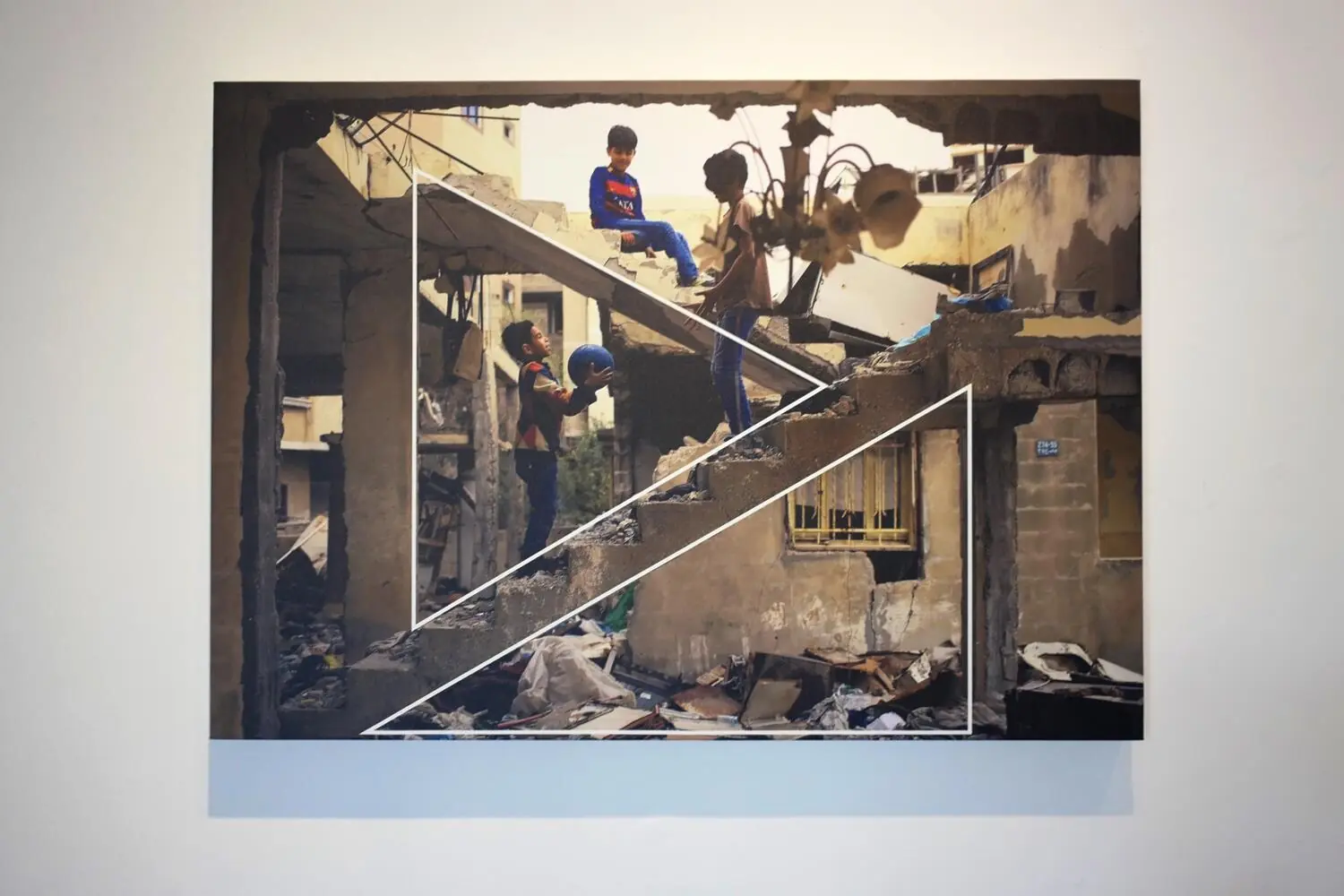
The triangular configuration imposed upon them feels rigid, almost didactic — an abstract system pressing on to a moment that is anything but abstract. The children, absorbed in their exchange, seem momentarily outside it. The viewer, however, cannot escape it. The geometry insists, reframing the scene as composition, as structure, as something legible.
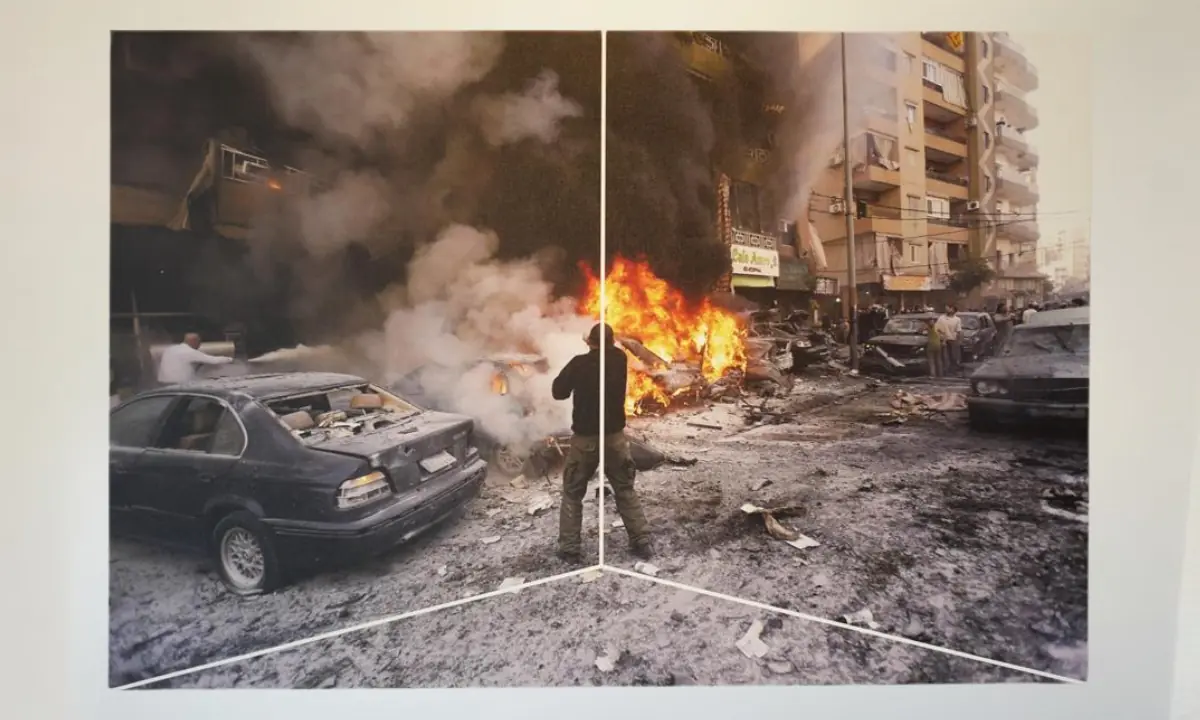
Then the spiral appears, unmistakable, almost lyrical in its sweep. It arcs across a field of rubble where men carry an injured figure, the curve tightening around the body as though to contain it. The eye follows instinctively, tracing its elegant movement inward, even as it registers the violence.
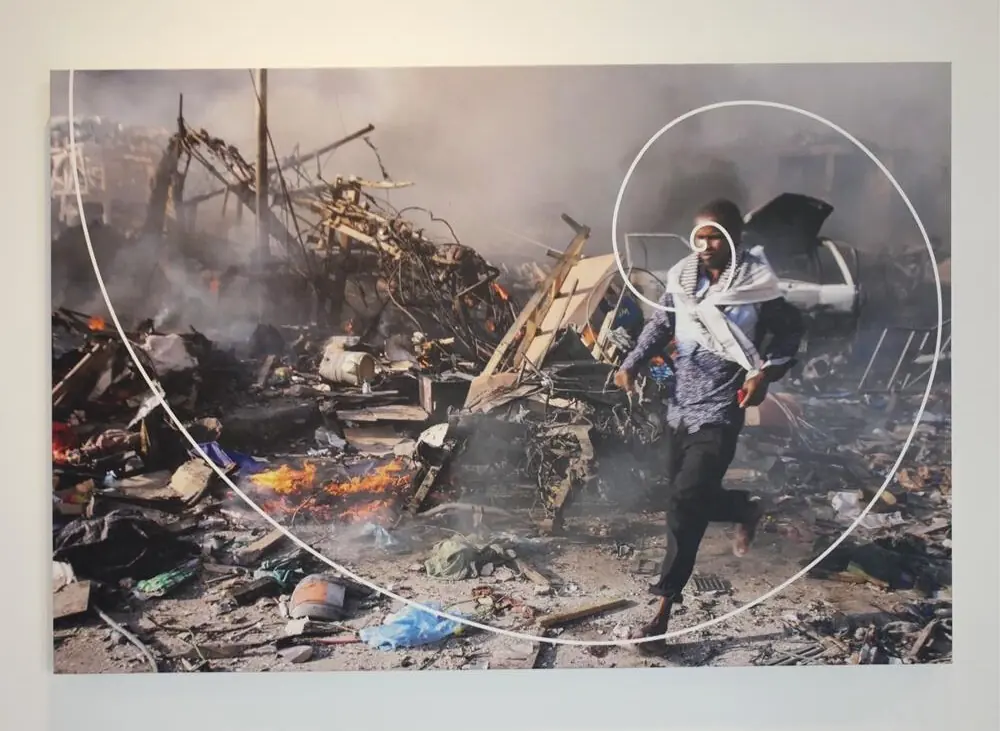
It is difficult in these moments not to recall Susan Sontag’s writing on the consumption of suffering — the way images of war are framed, circulated and absorbed into visual culture. Sontag delves into the idea of photography as an act of aggression. She argues that taking a photograph is inherently voyeuristic and objectifying, likening it to a form of predation. This idea was ground-breaking at the time and remains a subject of intense debate in modern discussions of ethical photography.
Rana’s intervention is subtle but pointed. By overlaying the golden ratio on to photographs sourced from various photographers, she does not claim authorship of the original moment. Instead, she intervenes in its afterlife. The images arrive already mediated, already part of a global archive of looking. What she alters is not the event but the way it is seen.
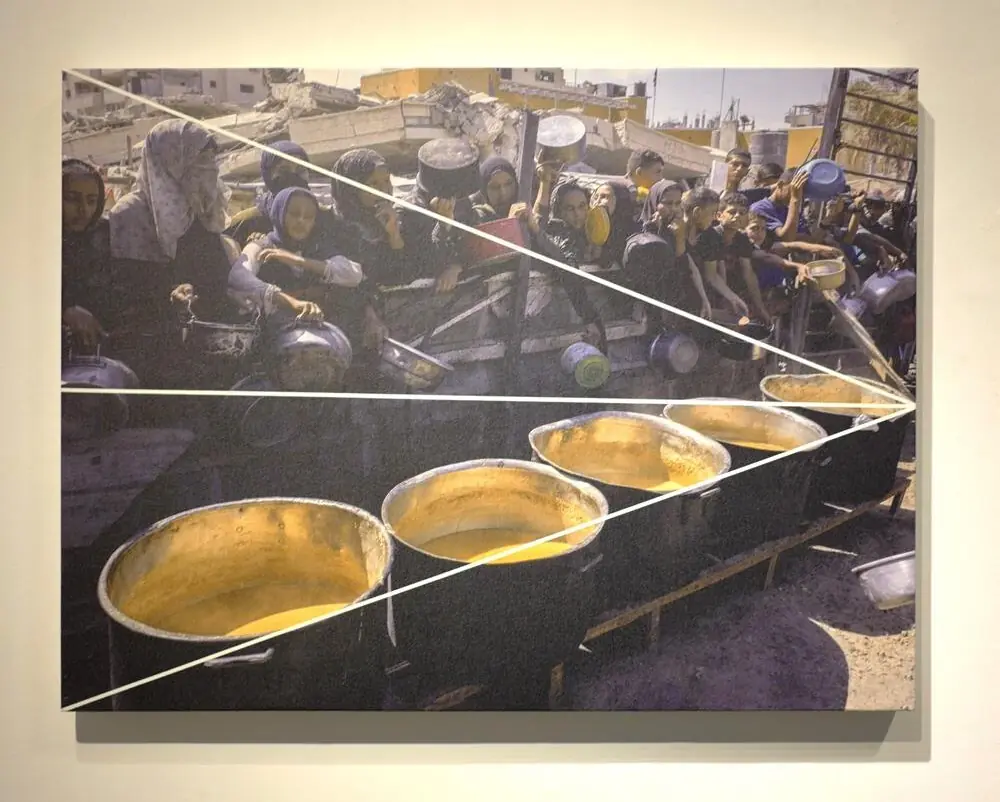
This gesture feels acutely contemporary. In an age of cropping and curated feeds, the ‘perfect frame’ has become second nature. We scroll past devastation rendered in striking composition, often without registering the dissonance. Rana slows that process down. She makes the frame visible and, in doing so, exposes its quiet authority.
A most eye-catching work is a serial grid of everyday commodities staged as a triptych, where the logic of the rule of thirds is both invoked and unsettled through excess, repetition and subtle shifts in arrangement. There is, in this, a continuation of concerns that have long marked her practice. Earlier works explored probability, permutation and the unstable threshold between order and chance — systems that promised coherence but delivered variation. Here, the system holds. The ratio is precise, unwavering. But what it contains is rupture.
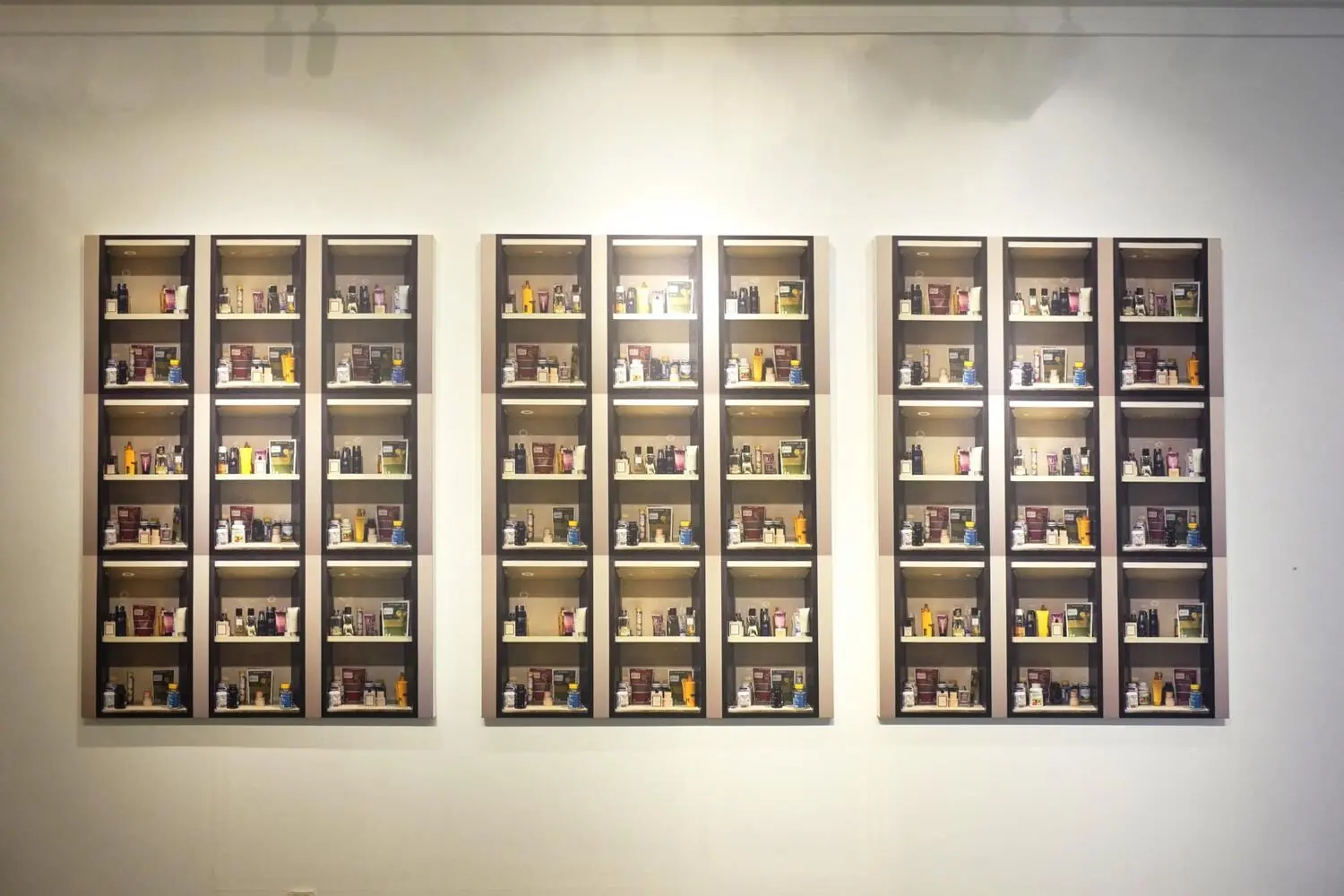
The exhibition does not resolve this tension. It allows it to linger in the spacing of the works, in the rhythm of their placement, and in the oscillation between subtlety and assertion. Some images seem to resist the imposed order, while others appear almost to submit to it. The viewer moves between these states, never fully settling.
Rana offers no moral closure. Instead, she leaves us with a question that feels increasingly difficult to ignore: if the eye has been trained, over centuries, to seek harmony, what happens when it begins to find it even in the aftermath of violence?
The Golden Ratio — Math of Beauty was on display at Canvas Gallery in Karachi from March 24-April 2, 2026.
Originally published in Dawn, EOS, April 5th, 2026
Cover photo: Canvas Art Gallery