Archaeologists uncover 1,700-year-old ancient Roman statues in 'once-in-a-lifetime discovery'
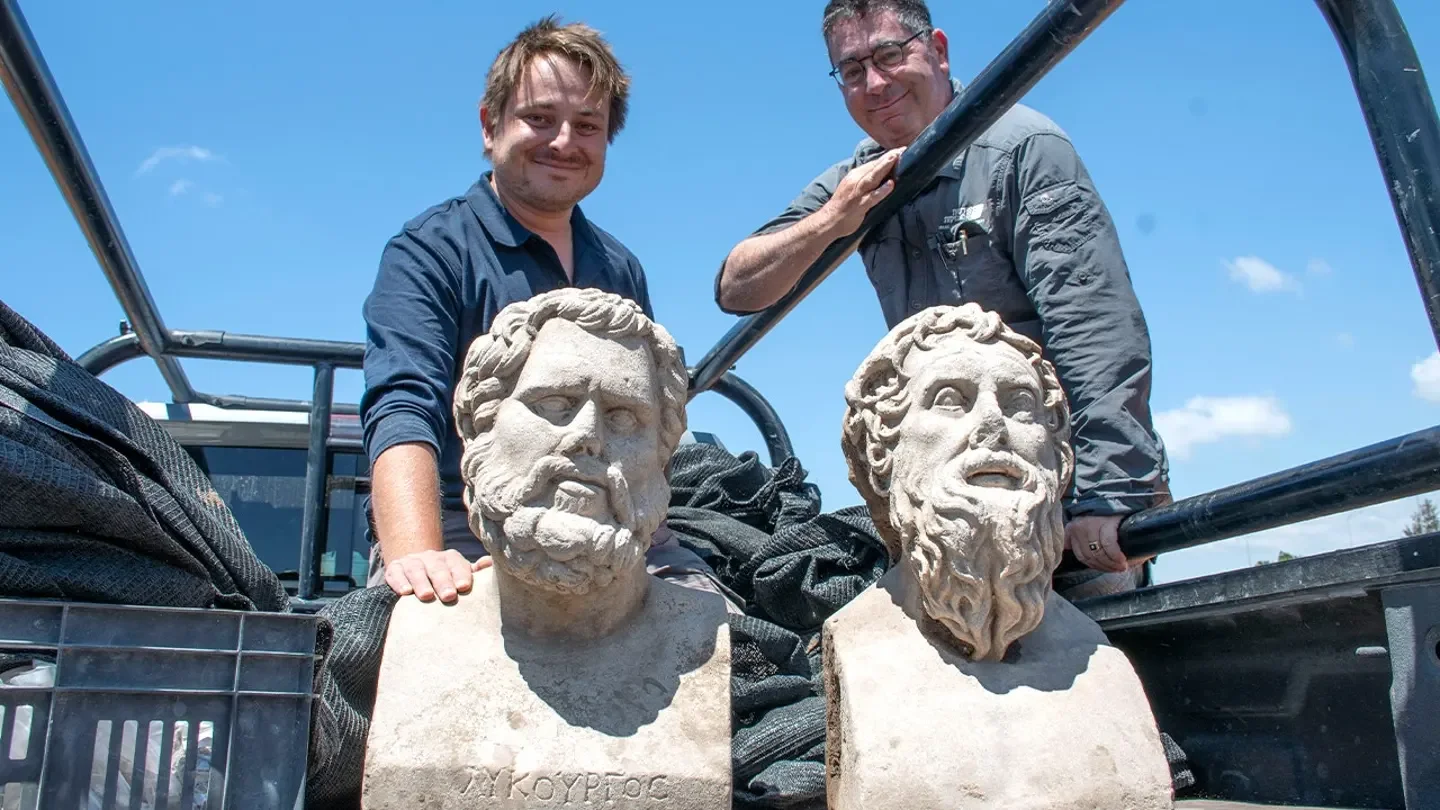
•Archaeologists in Israel have uncovered 1,700-year-old ancient Roman statues in a "once-in-a-lifetime discovery".
•The figures, located near Binyamina, were uncovered during preparatory excavations for a coastal high-speed railway, according to the Israel Antiquities Authority (IAA).Excavation directors Eliran Ore...
•TRENDING Stories Videos Your Say "At present, it is not known why the statues were hidden here perhaps to preserve them," Mr Oren and Ms Reiss said.Peter Gendelman, an IAA expert on the Caesarea...
هذا الخبر من GB News. خبر يقدم أدوات ذكاء اصطناعي للتلخيص والترجمة والاستماع.
المصدر: GB News | Source: GB NewsArchaeologists in Israel have uncovered 1,700-year-old ancient Roman statues in a "once-in-a-lifetime discovery".
The figures, located near Binyamina, were uncovered during preparatory excavations for a coastal high-speed railway, according to the Israel Antiquities Authority (IAA).
Excavation directors Eliran Oren and Avishag Reiss revealed the statues had been positioned "neatly laid, face down" within the wine collection pit of a Roman-Byzantine winepress.
The pair believe the figures were deliberately concealed when the winepress ceased operation, though the precise reason remains unclear.
TRENDINGStoriesVideosYour Say"At present, it is not known why the statues were hidden here perhaps to preserve them," Mr Oren and Ms Reiss said.
Peter Gendelman, an IAA expert on the Caesarea region, noted this represented the first such discovery in roughly thirty years.
One of the marble figures bears a Greek inscription featuring the name "Lycurgus", officials confirmed.
According to Mr Gendelman, this inscription could potentially identify the statue as depicting one of two historical figures sharing that name.
"Possibly this statue may prove to be one of these two historical figures, but our research is just beginning," he said.
The first possibility is Lycurgus of Sparta, while the second is Lycurgus of Athens, the expert said.
Both statues portray unidentified individuals from the ancient Greco-Roman world, with researchers now working to establish their precise identities.
Mr Gendelman suggested during the Roman period, such sculptures would typically have adorned public buildings or the residences of affluent citizens seeking to "connect themselves to the cultural and spiritual world of antiquity".
LATEST DEVELOPMENTS
- Resting place of Royal Navy ship that won decisive victory over France restored to former glory
- Message from ancient Rome emerges from ash after nearly 2,000 years
- Controversial Bible mystery finally solved after two new sermons discovered in lost manuscripts
Michael Sorotskin, an IAA archaeologist involved in the discovery, described the moment as "simply wondrous".
"While digging the winepress, something was sticking out of the ground, and the workers called me," Mr Sorotskin said.
"There was a feeling that we were about to discover something that really shouldn't be there."
The initial assumption was the protruding object was ordinary pottery, but this quickly changed.
"Suddenly, we saw that this was not the usual pottery it was marble," he added.
"Then, slowly, slowly, the two statues were revealed. I'm still struggling to find the right words."
Mr Oren and Ms Reiss said significant archaeological finds often emerge unexpectedly.
"It was very unexpected, but somehow, the really big discoveries always turn up on the excavation's very last day," they said.
Archaeological evidence suggests the statues may have originally graced a luxurious private residence in the area.
Mr Gendelman pointed to the discovery of bathhouse remains not far from the excavation site, raising the possibility the figures once decorated an opulent villa belonging to a wealthy inhabitant of nearby Caesarea.
The IAA team is currently undertaking careful cleaning and conservation work on both sculptures.
Once this preservation process is complete, researchers will conduct further analysis in an effort to definitively establish which figures from antiquity the statues represent.
Our Standards: The GB News Editorial Charter


ملاحظة تحريرية | Editorial Note: نُشر هذا المقال في الأصل بواسطة GB News. خبر (Khabr) هي منصة إعلامية أردنية مرخّصة تعمل بالذكاء الاصطناعي. نضيف قيمة تحريرية من خلال: تحليل ذكي للأخبار، ملخصات تلقائية، رواية صوتية بالذكاء الاصطناعي، ترجمة متعددة اللغات، وتدقيق الحقائق. هدفنا جعل الأخبار أكثر وضوحاً وسهولةً للقارئ العربي.
This article was originally published by GB News. Khabr is a licensed Jordanian AI-powered news platform (Registration #82086). We add editorial value through: AI-powered news analysis, automated summaries, AI audio narration, multi-language translation (Arabic, English, French, Turkish), and AI fact-checking. Our mission is to make news more accessible and understandable for Arabic-speaking audiences worldwide.