‘Absolutely nothing is sacred’: Meet the rural communities fighting the surge of giant solar farms
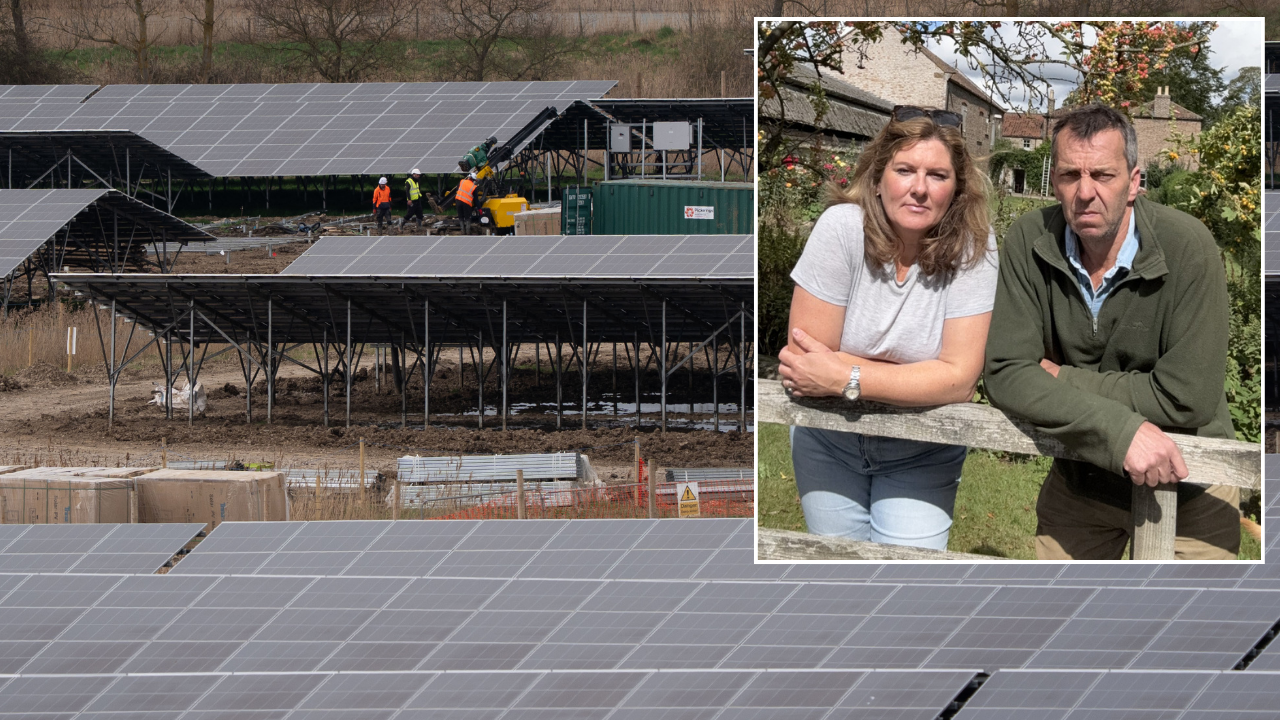
•With more than half a million panels, some almost ten feet tall, it is the UK’s largest operational solar farm.Cleve Hill Solar Park is capable of powering more than 100,000 homes.
•Sprawling across 900 acres of former grazing marsh, it is larger than the nearby town of Faversham, Kent.It is just the beginning.
•With solar seen as critical to Net Zero, experts have estimated it would take 80 farms the size of Cleve Hill to hit Government targets.Opponents say the mega-projects raise a string of flashpoints, f...
هذا الخبر من GB News. خبر يقدم أدوات ذكاء اصطناعي للتلخيص والترجمة والاستماع.
المصدر: GB News | Source: GB NewsWith more than half a million panels, some almost ten feet tall, it is the UK’s largest operational solar farm.
Cleve Hill Solar Park is capable of powering more than 100,000 homes. Sprawling across 900 acres of former grazing marsh, it is larger than the nearby town of Faversham, Kent.
It is just the beginning. With solar seen as critical to Net Zero, experts have estimated it would take 80 farms the size of Cleve Hill to hit Government targets.
Opponents say the mega-projects raise a string of flashpoints, from food security to property rights, and even the future of the countryside itself.
TRENDINGStoriesVideosYour SayAre the enormous schemes critical pieces of infrastructure that spare us from the “whims of dictators”?
Or are we jeopardising our ability to feed ourselves, amounting to “an attack on rural communities, an attack on farmers, on tenant farmers and on the English rural way of life”?
The question is set to vex ministers when they return from their summer break, with solar farms the subject of an autumn debate.
One issue up for discussion will be their impact on prime farmland.
The Campaign to Protect Rural England has warned that arable farming land is being given over to solar panels. It has estimated that solar farms will need to cover an area larger than Greater London to hit targets.
Last year, it reported that more than half of the country’s operational giant solar farms included areas of prime farmland. Some 827 hectares of “best and most versatile” (BMV) soil was already being used for energy, its research found.
Dr Caroline Johnson is the MP for Sleaford and North Hykeham who has called for the debate. Seven per cent of her Lincolnshire constituency could be lost to panels should every planned project go ahead.
Dr Johnson has said that five huge projects on her doorstep alone will cover 9,982 acres - “land that could produce 25.1 million loaves of bread and more than 730 million Weetabix”.
LATEST DEVELOPMENTS
- John Healey given warning over promise to re-industrialise Britain as Labour set lofty goals
- Labour told to tackle sky-high electricity costs 'head-on' as businesses miss out on support
- Net Zero subsidies and grid upgrades set to cost £40bn a year by 2030
She told GB News: “We are putting food security at risk.
“Energy security is important, but food security is also important too.
“If the government wants to use solar, it doesn’t make sense to put it on the best quality land as it takes the land out of production and has a potential impact on the quality of land in the long-term too so that foods cannot be grown as readily.”
Oxford university professor, Peter Dobson, agrees that “land is finite” and argues more joined-up thinking is needed.
The Emeritus Fellow of Queen's College is a supporter of solar energy as a power source but claims it should not play a major part in the UK mix.
It is intermittent – it only generates in the daytime and when the sun is shining – and the UK weather is not geared towards it, he says. The country also has a dense population, placing space at a premium.
He points to a World Bank report that showed the UK, and Ireland, at the bottom of the table for solar potential, and believes that “ground-mounted solar schemes operating in the UK climate cannot generate anywhere near enough power to justify the loss of good farmland”.
Prof Dobson said: “We’re just too far north, and our climate is such that we get clouds.
“It's just a ridiculous notion to put solar on large areas in the UK and Ireland.
“When you start looking at where they're putting them, they're putting them on good arable land, they're putting them on land where livestock are being used. It's crazy.
“We haven't got an infinite supply of land in the UK and we have got a fairly dense population.
“We should not just be approving things without a thorough analysis of the land use for food.
“We're a scientific country and we should be doing things much more rationally.”
The solar industry disagrees with his perspective. It points out that, even when complete, there will be less land given over to solar farms than to golf courses.
A study last year found that under Government plans – and assuming 55 per cent of solar is ground mounted – 0.45 per cent of farmland will be needed to host the schemes.
The Government’s own worst-case scenario is 0.6 per cent of arable land by 2030, when solar is expected to produce up to 47 GW of electricity. This is still considerably smaller than the CPRE estimate.
“Solar farms do not, and never will, pose a threat to food security,” said Gareth Simkin, spokesman for trade association, Solar Energy UK.
Solar Energy UK also points towards July energy figures, which showed solar farms and rooftop panels providing 14.4 per cent of the country’s electricity last month.
“Solar power provides the cheapest electricity available in the UK, and the bigger the installation, the more the economies of scale,” said Mr Simkins.
“By displacing expensive gas from the grid, solar farms are helping to keep bills lower than they otherwise would be.”
Despite these reassurances, critics remain vocal in their opposition. Countless campaign groups have sprung up across the country.
Not only do the projects pose a threat to UK farmland and the shape of the countryside, they say, but they are almost impossible to stop.
“Clean energy – that's the trump card for the government,” said Annette Exley, a former animal rescuer from North Yorkshire. She now helps affected residents study and run through planning applications for solar projects
“They'll just play that trump card and say, well, it doesn't matter that we're destroying this.
“Absolutely nothing is sacred.”
Farmer Nick Wright says he came up against this “trump card” when plans were unveiled for a project near his land.
The Sunnica Energy Farm is set to straddle the Suffolk / Cambdridgeshire border and will span 2500 acres, spread across four sites.
The £600m project will be able to power 172,000 homes. But Mr Wright turned down an offer to lease his land to the developers.
“I just didn't want to be involved with the scheme,” he said. “I thought it was too large -2500 acres is enormous.
“It's all irrigated land. We grow high quality Maris Piper potatoes for supermarkets. And we would be expecting to grow in excess of 60 tons a hectare.
“This is prime vegetable growing land. The country is only 50 per cent self sufficient in vegetables at the moment – we import nearly half.”
Planning inspectors recommended the scheme be turned down, stating “the Proposed Development would have significant adverse effects that would outweigh its benefits”.
Amongst their findings, the planners said that the development “will have an adverse impact on farming enterprises, particularly in respect of the loss of productive farmland”.
But Mr Miliband approved the project within days of taking office
He said solar power was "crucial to achieving Net Zero”. He complained that some cases had been "held up for months before I arrived in the department", adding: "I've made the decision in three days”.
"The reason we're moving at this pace is for one overriding reason, because of the urgency of the challenges we face,” he said.
“The challenge of the climate crisis”, he said, was “not a future threat but a present reality".
Sunnica said only four per cent of the land it sought to use was top-grade farmland and that the scheme would help tackle the “existential threat” of climate change.
But Mr Wright finds the Secretary of State’s decision “remarkable”.
“The examiners recommended it for refusal,” he said. “In any normal planning process, that would have been it. But not with Mr Miliband.
“And it's a remarkable decision to say, well, actually, we're going to ignore all of that process.
“Agriculture has been totally ignored.
“This sort of land is prime agricultural land. What on earth are we doing?
“I think for a developed nation to have a deteriorating food security situation is really a huge oversight. It seems out of kilter.
“I'm absolutely a renewables fan. We've got solar all over our potato sheds. But it has to be done in tandem. We're importing gas from Norway which runs through our own gas fields.
“We're having to turn wind turbines off because we've got too much electricity, and we're swallowing up our farmland.
“The pursuit of Net Zero, absolutely, but not at the cost of creating another issue somewhere else.”
As a landowner, Mr Wright had some agency in the matter. The Sturdy family were not so fortunate.
They are tenant farmers whose family has worked the North Yorkshire land since the 1950s. Much is high-quality soil and they grow a range of crops including wheat, barley and oil seed rape.
But their landlord struck a deal that will see almost half of the fields given over to solar energy. Of these 110 acres, the Sturdys say, 60 per cent is BMV, or prime land.
A last-minute plea to the High Court was turned down, meaning Robert and Emma Sturdy have harvested many of their crops for the final time this year.
Emma said: “It’s devastating, really. We have been battling for a long time. This is going to hit us really hard. This was our best farmland.
“My husband lives and breathes the land and the soil. He has spent years improving it. We are good farmers, and it’s devastating.”
Emma is not blind to the warming planet. “We are famers – we get it,” she said. “We are seeing it every day, and climate is an issue for us.”
While she understood why landowners might accept the “financial carrots” solar offered, she questioned why the panels should go on farmland. Rooftops or industrial estates would be a better location, she says – a suggestion backed by the CPRE.
“They say clean power is more important than anything else – that's what’s happening and it can’t be right,” she explained. An offer of compensation would not make up for their losses, she has said.
“Solar can offer massive incentives, but for tenant farmers the situation is very different.
“Tenant famers are our small family farms. They are almost the backbone of the community. They send their kids to the local schools, they shop in the local shops.
“If we lose our tenant farmers, we lose a lot of the feel of the countryside.
“Our family is dealing with the reality of a failed planning system. That’s what fundamentally has to change.”
Mr Simkins argued that the need for clean, cheap energy in the race to Net Zero meant it was understandable that so many schemes were approved.
He said: “Everyone acknowledges that we need to cut energy bills. We therefore need more cheap energy, which means renewables and less natural gas power.
“Solar farms are normally approved first thing by local authorities. Rejections are rare and are generally overturned by the Planning Inspectorate.
“It is right that there are few lawful grounds for rejection – solar farms are a strategic priority.”
He pointed out that the panels – fitted to metal frames – can be removed at the end of their lease, and farm animals can graze beneath them while operational.
He said that many developers would provide “a package of community benefits” and points out that solar farms “are designed to integrate into the landscape”.
But CPRE Norfolk trustee, David Hook, fears the race for green power risks turning fields into factories.
In the south of the county, the proposed East Pye solar farm is earmarked near Long Stratton. The 500MW scheme will be capable of powering 115,000 homes a year.
The developer say it will “boost Norfolk’s emerging renewable energy industry and will secure clean, affordable energy while providing investment and job opportunities in the county”.
It is currently with planning inspectors, with a decision expected next year.
Mr Hook, who also chairs Hempnall Parish Council, said the scheme had seen more than 2,000 people register as interested parties, largely in opposition.
“There’s this fear,” he said. “Local people are having sleepless nights because of this - it's huge. It's very disturbing. And people's well-being is being upset by it.”
He worried that decisions that could “industrialise the countryside” were being made in Whitehall, many miles from the homes affected.
He said:“The beauty of Norfolk is a very subtle beauty. It hasn't got the grandeur of the Lake District. It hasn't got the Cotswolds’ show.
“It's the fact that you feel you've got away from it all, that there's a tranquil rural tract of landscape and you can get lost in it and get away from things.
“If you take, you chunks of that and cover them with solar panel, security fences, inverter building, new roads andtracks, et cetera, etcetera, you are converting what is essentially a farming landscape into a factory.”
The Government maintains there is enough land to meet energy needs without disrupting rural life. In March, the Department for Environment, Food & Rural Affairs (Defra) set out a framework for land use in March.
It found there was sufficient space for homes, food production, nature restoration and renewable power projects. Done properly, the interests could work hand in hand, it said.
“It demonstrates clearly that we have enough land to build the homes needed to address the housing crisis, maintain domestic food production, restore nature at scale, and build clean, homegrown power to provide energy security,” said Emma Reynolds, Environment Secretary.
“These are not competing demands. With the right data, the right tools, and the strategic direction this Framework provides, they are complementary ones.”
A spokesman for the Department for Energy Security and Net Zero insisted that the damage caused by climate change posed the greatest risk to farmers.
“The biggest threat to agriculture and nature is the climate crisis,” he said.
“Solar is also one of the cheapest and quickest forms of energy to build, helping get bills down for good.
“All projects are subject to a rigorous planning process and the views of the local community must be considered.”
With regard to tenanted farms, he said the tenancy must be respected, with “fair compensation” paid for the loss of any land.
The Planning Inspectorate, meanwhile, says its team will make independent assessments on any project they are asked to examine.
“Inspectors are independent and impartial,” a spokesman said.
“When making a decision, Inspectors give careful consideration to the evidence submitted taking account of current planning legislation, guidance and policy.”
The Government is moving at speed. By mid 2025, after just a year in power, Mr Miliband told how the Labour administration had already consented “almost 3GW of nationally significant solar projects – nearly three times as much as the previous 14 years combined”.
As he unveiled the Solar Roadmap, which details the next stages of the energy plan, he insisted: “Every solar panel we install helps us take back control of our energy supply – protecting families, businesses and the public finances from the rollercoaster of fossil fuel markets controlled by petrostates and dictators.”
All eyes will now be on his successor as Energy Secretary, Miatta Fahnbulleh. Among the items in her in-tray are more applications for large-scale solar farms.
Later this month she will be asked to decide on Beacon Fen, a 400MW project in Sleaford, Lincolnshire. The developers say it will produce enough power for 130,000 homes, while avoiding 72,000 tonnes of CO2 pollution.
It would “make a significant contribution towards achieving net zero”, they say.
Opposition has come in a familiar form – size, loss of farmland and changes to a historic landscape.
The local MP – one Dr Caroline Johnson - will be watching the decision with interest.
Our Standards: The GB News Editorial Charter


ملاحظة تحريرية | Editorial Note: نُشر هذا المقال في الأصل بواسطة GB News. خبر (Khabr) هي منصة إعلامية أردنية مرخّصة تعمل بالذكاء الاصطناعي. نضيف قيمة تحريرية من خلال: تحليل ذكي للأخبار، ملخصات تلقائية، رواية صوتية بالذكاء الاصطناعي، ترجمة متعددة اللغات، وتدقيق الحقائق. هدفنا جعل الأخبار أكثر وضوحاً وسهولةً للقارئ العربي.
This article was originally published by GB News. Khabr is a licensed Jordanian AI-powered news platform (Registration #82086). We add editorial value through: AI-powered news analysis, automated summaries, AI audio narration, multi-language translation (Arabic, English, French, Turkish), and AI fact-checking. Our mission is to make news more accessible and understandable for Arabic-speaking audiences worldwide.