10% of Indian households can rise to a higher economic class just by quitting tobacco: Study
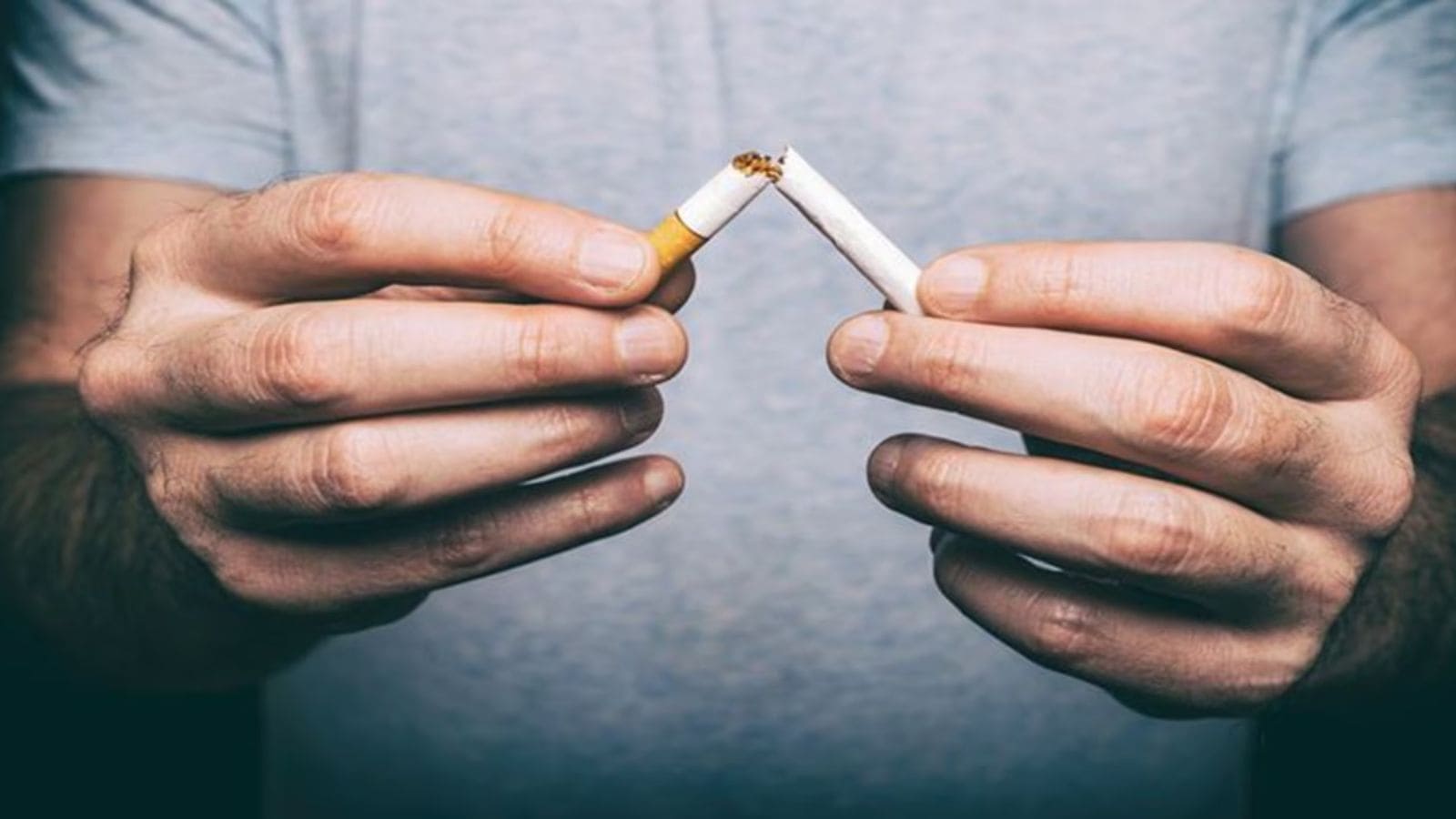
Weather ePaper Today’s Paper Journalism of Courage Home ePaper Politics Explained Opinion India Business Premium Cities UPSC Entertainment Sports World Lifestyle Tech Subscribe Sign In TrendingUPSC OfferIPL 2026US NewsPuzzles & GamesLegal NewsFresh TakeHealthResearch🎙️ Podcast Advertisement function checkAndLoadWindowSizeScript() { if (window.jQuery) { // jQuery is loaded, include your script jQuery(document).ready(function($) { // Your existing script for checking window width if (window.innerWidth) var page_w = window.innerWidth; else if (document.all) var page_w = document.body.clientWidth; if (page_w > 1024) { $(".add-left, .add-right").show(); } else { $(".add-left, .add-right").hide(); } }); } else { // jQuery is not loaded, check again after 0.2 seconds setTimeout(checkAndLoadWindowSizeScript, 200); } } // Initial call to the function checkAndLoadWindowSizeScript(); NewsHealth and Wellness10% of Indian households can rise to a higher economic class just by quitting tobacco: Study 10% of Indian households can rise to a higher economic class just by quitting tobacco: Study Authors suggest integrating tobacco control with flagship poverty programmes, other nutrition and livelihood schemes. Written by: Anuradha Mascarenhas4 min readPuneApr 21, 2026 07:24 AM IST The poorest households, the study finds, spend 6.4% of their entire monthly income on tobacco, the study found. (File photo) Make us preferred source on Google Whatsapp twitter Facebook Reddit PRINT Over 20.49 million households — 10.6% of all households in the country — could rise to a higher economic class just by stopping spending on tobacco and redirecting that money to other needs, as per a new study published in BMJ Global Health. The study led by researchers at ICMR National Institute of Cancer Prevention and Research (ICMR-NICPR), Noida, and Tata Institute of Social Sciences (TISS), Mumbai, is the first to quantify at national scale the households using tobacco in different forms. The poorest households, the study finds, spend 6.4% of their entire monthly income on tobacco, the study found. “Tobacco is not just a health burden — it is a poverty trap. We have now shown, with the most rigorous national data available, that 20 million households could move up an economic class simply by quitting. For a rural family already spending nearly 7% of all its income on tobacco, this is not an abstraction — this is the difference between poverty and dignity. Tobacco cessation must be treated as a poverty alleviation strategy, not merely a health message,” Dr Prashant Kumar Singh, Senior Scientist, ICMR-NICPR, Noida, and corresponding author told The Indian Express. India carries one of the world’s largest tobacco burdens. With over 267 million tobacco users, which is nearly a quarter of the adult population, tobacco is the single largest preventable cause of death and disease in the country, responsible for over a million deaths every year. Its established links to cancers of the mouth, throat, lung, and oesophagus as well as to heart disease and stroke, have long made it a central concern of public health policy. Drawing on 2,61,746 nationally representative households from the 2022-23 survey on Household Consumption Expenditure, the study found that the poorest families are paying the highest price. According to the study (The economics of quitting: estimating the uplift potential of Indian households through tobacco cessation), a family in the lowest income group spends 6.4% of its entire monthly income on tobacco. A family at the top spends just 2%. Among the poorest households, 5.62 million (12.4%) could escape their income class entirely through cessation, the study suggests. India is the second largest consumer and producer of tobacco globally. Tobacco products account for nearly 1.35 million deaths every year (3,700 deaths every single day). India also accounts for 70% of the global burden of smokeless tobacco, and 27% of all cancers in India are attributable to tobacco use. Nearly 9 out of 10 adults who use tobacco started before age 18 when the brain is still developing, making young people far more susceptible to nicotine dependence. Among adolescents specifically, tobacco prevalence among those aged 13-15 was 8.5% in 2019 according to the Global Youth Tobacco Survey. In India, 9.6% of boys and 7.4% of girls use tobacco, it said. According to the researchers, 17 million rural households could move up an economic class through tobacco cessation, compared to 3.5 million urban households. Rural families spend a larger share of income on tobacco (6.6% vs 5.6% in cities) and have far fewer financial safety nets. The rural uplift rate is 60% higher than in urban areas. Also 7.12 million lower-middle-income households (16.8%) could advance to a higher income bracket through cessation. “This study reframes the conversation on tobacco. It is no longer sufficient to speak of lives saved, we must speak of livelihoods transformed. When a family quits tobacco, they do not just reduce their cancer risk, they reclaim the income to feed their children, pay school fees, and seek timely medical care. Our findings demand that tobacco control be placed at the centre of poverty and development agenda,” said Dr Shalini Singh, Director, ICMR–National Institute of Cancer Prevention and Research (ICMR-NICPR), Noida. According to Dr Montu Bose, School of Health Systems Studies, TISS Mumbai, the household expenditure data tells a story that tobacco is actively blocking economic mobility for millions of Indian families. “This study contributes evidence that bridges public health and social equity in such a direct, policy-relevant way,” Dr Bose said. Study authors have pointed out that no new government schemes or additional cash transfer are required. “The resources are already there … What is vital is to integrate tobacco control into flagship poverty programmes and other nutrition and livelihood schemes. International development organisations should likewise incorporate cessation into their poverty reduction frameworks for low- and middle-income countries,” they said. Anuradha Mascarenhas is a Senior Editor at The Indian Express, based in Pune. With a career spanning three decades, she is one of the most respected voices in Indian journalism regarding healthcare, science and environment and research developments. She also takes a keen interest in covering women's issues . Professional Background Education: A gold medalist in Communication and Journalism from Savitribai Phule Pune University and a Master’s degree in Literature. Author: She authored the biography At The Wheel Of Research, which chronicles the life and work of Dr. Soumya Swaminathan, the former Chief Scientist at the WHO. Key Focus: She combines scientific accuracy with storytelling, translating complex medical research into compelling public and human-interest narratives. Awards and Recognition Anuradha has won several awards including the Press Council of India's national award for excellence in journalism under the gender based reporting category in 2019 and the Laadli Media award (gender sensitivity -2024). A recipient of the Lokmat journalism award (gender category-2022), she was also shortlisted for the RedInk awards for excellence in journalism-2021. Her debut book At The Wheel Of Research, an exclusive biography of Dr Soumya Swaminathan the inaugural chief scientist of World Health Organisation was also nominated in the Popular Choice Category of JK Paper AUTHER awards. She has also secured competitive fellowships including the Laadli Media Fellowship (2022), the Survivors Against TB – New Research in TB Media Fellowship (2023) and is part of the prestigious 2025 India Cohort of the WomenLift Health Leadership Journey.” Recent Notable Articles (Late 2025) 1. Cancer & Specialized Medical Care "Tata Memorial finds way to kill drug-resistant cancer cells" (Nov 26, 2025): Reporting on a breakthrough for triple-negative breast cancer, one of the most aggressive forms of the disease. Discipline, diet and purpose; How a 97-year-old professor defies ageing'' (Nov 15, 2025) Report about Prof Gururaj Mutalik, the first Head of Department at Pune's B J Government Medical College who at 97 credits his longevity to healthy habits and a strong sense of purpose. 2. Environmental Health (The "Breathless Pune" Series) Long-term exposure even to 'moderate' air leads to chronic heart, lung, kidney issues" (Nov 26, 2025): Part of an investigative series highlighting that even "safe" pollution levels are damaging to vital organs. "For every 10 µg/m3 increase in PM2.5 level, there was 6-8% jump in medicine sales" (Nov 23, 2025): Using commercial data to prove the direct link between air quality and respiratory illnesses in Pune. 3. Lifestyle & Wellness News "They didn't let cancer, diabetes and heart disease stop them from travelling" (Dec 22, 2025): A collaborative piece featuring survivors who share practical tips for traveling with chronic conditions. At 17, his BP shot up to 200/120 mmHG; Lancet study flags why child and teen hypertension doubled between 2000 and 2020'' (Nov 12,2025)--A report that focusses on 17-year-old-boy's hypertensive crisis and reflects the rising global trend of high blood pressure among children and adolescents. 4. Scientific Recognition & Infrastructure For promoting sci-comm, gender diversity: IUCAA woman prof highlighted in Nature" (Nov 25, 2025): Covering the global recognition of Indian women scientists in gender studies and physics. Pune researchers find a spiral galaxy like the Milky Way from early universe'' (December 3, 2025)- A report on how Indian researchers discovered a massive galaxy that existed when the universe was just 1.5 billion years old , one of the earliest to have been observed so far. Signature Beat: Health, Science & Women in Leadership Anuradha is known for her COVID-19 reportage, where she was one of the first journalists to provide detailed insights into the Covishield and Covaxin trials. She has a dedicated interest in gender diversity in health and science, often profiling women researchers who are breaking the "leaky pipeline" in STEM fields. Her writing style is scrupulous, often featuring interviews with top-tier scientists and health experts from various institutions. ... Read Moreالمصدر: Indian Express | Source: Indian Express
ملاحظة تحريرية | Editorial Note: نُشر هذا المقال في الأصل بواسطة Indian Express. خبر (Khabr) هي منصة إعلامية أردنية مرخّصة تعمل بالذكاء الاصطناعي. نضيف قيمة تحريرية من خلال: تحليل ذكي للأخبار، ملخصات تلقائية، رواية صوتية بالذكاء الاصطناعي، ترجمة متعددة اللغات، وتدقيق الحقائق. هدفنا جعل الأخبار أكثر وضوحاً وسهولةً للقارئ العربي.
This article was originally published by Indian Express. Khabr is a licensed Jordanian AI-powered news platform (Registration #82086). We add editorial value through: AI-powered news analysis, automated summaries, AI audio narration, multi-language translation (Arabic, English, French, Turkish), and AI fact-checking. Our mission is to make news more accessible and understandable for Arabic-speaking audiences worldwide.